
Why does CVD matter to you? If you are choosing a laboratory-grown diamond, knowing how it was grown helps you understand the stone. CVD is one of the methods used to make diamonds in a laboratory 1. It is a gas-based chemical process that is almost nothing like the way a natural diamond forms 3. Another method, HPHT (high pressure, high temperature), tries to copy the conditions where diamond forms in nature 5. You can compare the two in CVD vs HPHT lab-grown diamonds.
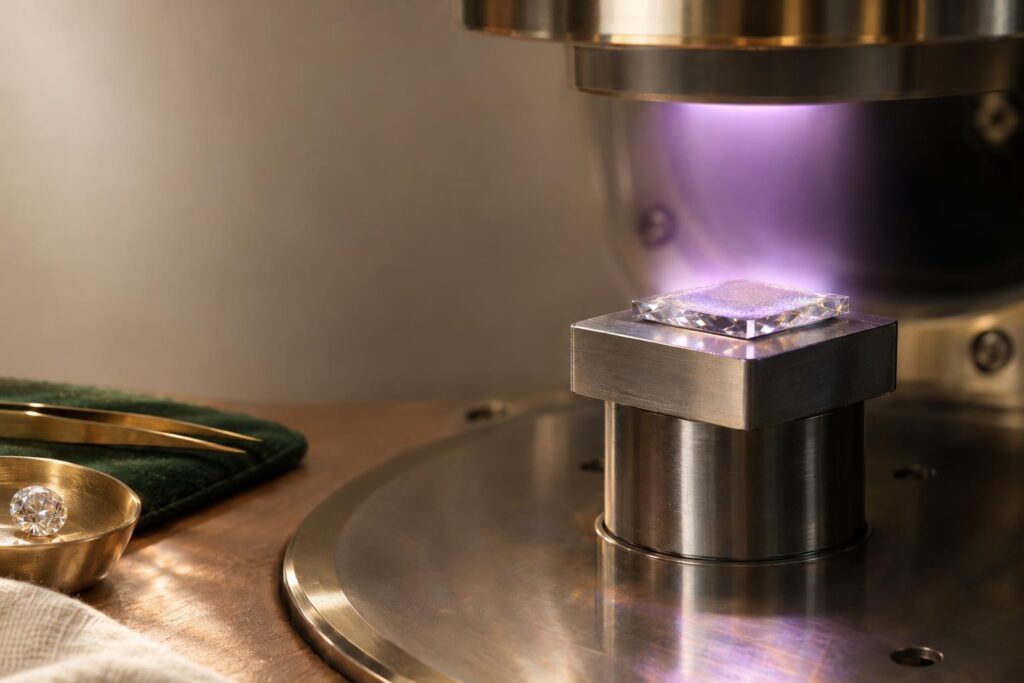
How is a CVD diamond grown? Hydrogen and a carbon-containing gas, usually methane, flow over one or more diamond seeds (thin, flat slices of diamond). Microwaves turn the gas into a plasma, an energised gas, which deposits diamond onto the seeds 3. The new diamond grows layer by layer on top of each seed 2. This happens inside a vacuum chamber, and the diamond gets thicker the longer growth runs 1.
What does this mean for the stone you buy? CVD crystals often come out brown, and most colourless CVD material was probably once brown and then heat-treated to remove that colour 1. Jewellery industry guidance says buyers should be told clearly that a lab-grown diamond was made by an industrial process, not formed in the earth 6. For the wider picture, see natural vs lab-grown diamonds.
Example: You are comparing two laboratory-grown diamonds that look the same. One is described as grown by CVD and the other by HPHT. That tells you the first was built up layer by layer from gas in a vacuum chamber, while the second was made under high pressure and heat. If the CVD stone’s paperwork also mentions treatment after growth, you can ask whether it was heated to remove a brown tint.