
Why do those tiny stamps matter? You can’t tell how much precious metal is in a piece just by looking at it or touching it 4. A hallmark is struck by an assay office (an independent metal-testing centre) and guarantees a certain fineness, meaning the share of pure metal 2.
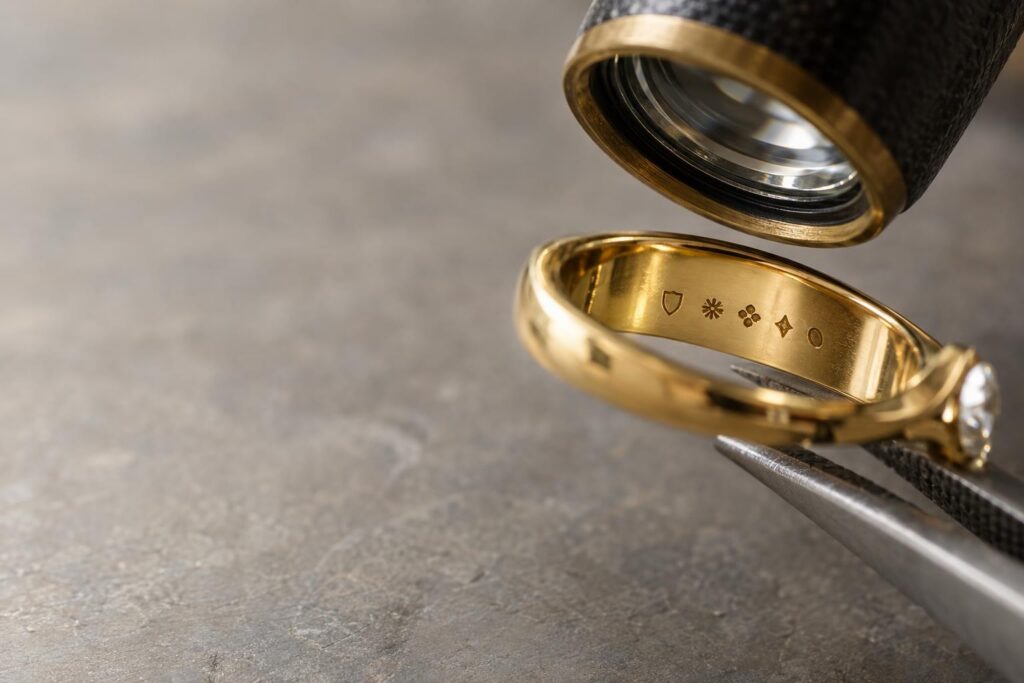
How do you read one? Under the international Hallmarking Convention, assay offices test the metal and then apply the Common Control Mark. It sits alongside an assay office mark and a responsibility mark, which some countries call the sponsor’s mark. On one type of this mark, the number shows the fineness in parts per thousand, and the shape of the shield shows the metal 1. Common gold marks are 375 (9ct), 585 (14ct), 750 (18ct, or 18K) and 999 (24ct), where ct means karat, a measure of gold purity. The mark 925 means sterling silver, which is 92.5% silver, and platinum fineness standards are 850, 900 and 950 2. Read more in What 375, 585 and 750 gold marks mean.
Why isn’t every stamp proof? Hallmarking systems differ between countries, and some let jewellery be sold with or without hallmarks. A fineness number with a maker’s mark is not an independent guarantee of the metal content 2. Fakes exist too. People have used counterfeit punches or moved a genuine hallmark onto another piece, so experts judge doubtful marks with expert knowledge and laboratory testing 5.
Example: Say you find "750" stamped inside a ring. The 750 means 750 parts of gold per thousand by weight, which is 18ct gold. If the ring shows only "750" and a maker’s mark, with no assay office mark, the number is the trader’s own statement rather than an independent third-party guarantee 2.