

Key takeaways
- Solid gold is gold all the way through, pure or alloyed; plating is a layer of precious metal applied to the surface.
- Plating thickness is matched to use, with far thicker layers needed where heavy wear is expected.
- A fineness mark such as 750 shows parts per thousand of gold by weight; 750 equals 18ct (18K).
- A fineness mark states gold content, while a hallmark from an independent assay office guarantees it.
- White gold is a gold alloy, and a rhodium coating on it should still be declared.
Why solid gold vs gold plated is a real difference
Why does this matter to you? When you pay for gold, you want to know where the gold is. In a solid piece, it runs right through the metal. In a plated piece, it is a layer on the surface. Knowing which one you hold tells you what you are buying.
Where is the gold? Three bands cut in half
Switch between three plain bands, each cut through, to see where the gold is in solid gold, gold plating and rhodium-plated white gold.
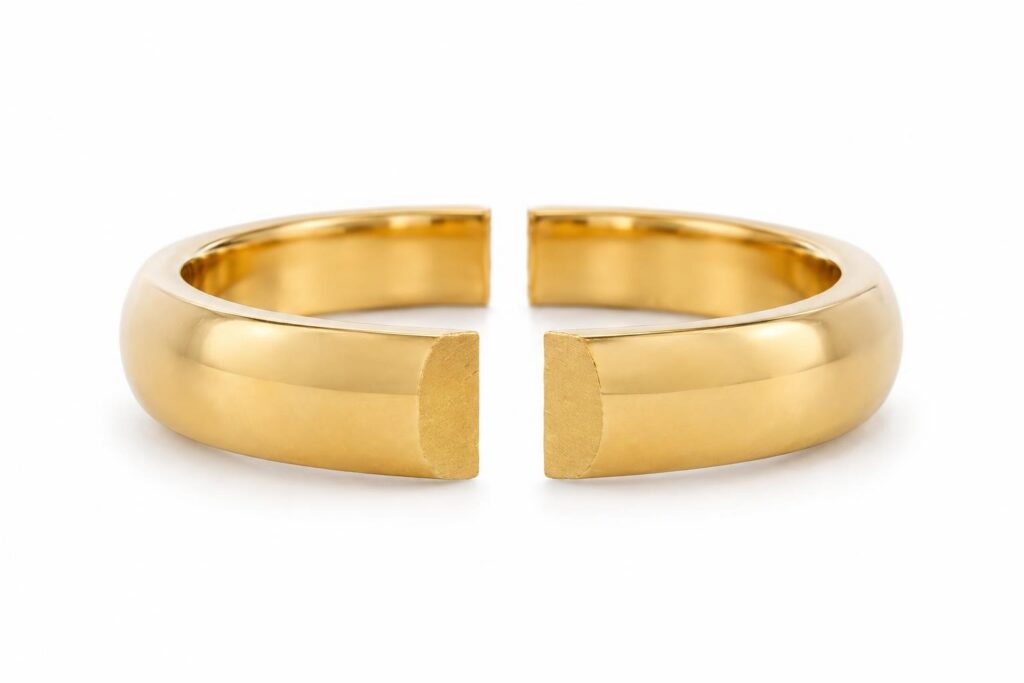
- Gold all the way through
- Solid gold means the piece is gold all the way through. That can be fine gold, at 999 parts per thousand, or a gold alloy. Cut it anywhere and the gold runs right through the metal.
- A gold layer on top
- A plating, also called a coating, is a layer of precious metal or precious metal alloy applied to all or part of an item. The gold you see is a layer on the surface, so the metal underneath can be something else, such as silver.
- A coating over a gold alloy
- White gold is itself a gold alloy, and a coating such as rhodium sits on top of it. In rhodium-plated white gold, the gold is in the alloy beneath, not in the plating. A coating should be declared even when it is the same colour as the alloy.
The coating layers are drawn thicker than they are in life so you can see them. Real plating is only a few microns thick, and a rhodium layer can be as thin as about 0.13 to 0.25 µm. Pictures: AI-generated illustrations, checked for accuracy. They are not photographs of a real piece.
Solid gold means the piece is gold all the way through. That can be fine gold, at 999 parts per thousand, or a gold alloy. A precious metal alloy is a solid solution (metals blended evenly together) that contains at least one precious metal 1.
A plating, also called a coating, is different. It is a layer of precious metal or precious metal alloy applied to all or part of an item. It can be applied by a chemical, electrochemical, mechanical or physical process 1.
Standards treat the two as separate things. Gold coatings have their own international standard, which sets the coating’s thickness and the fineness of its gold 4. Solid alloys are covered by a different standard on fineness 3.
| Solid gold | Gold plated | |
|---|---|---|
| What it is | Gold right through: fine gold or a gold alloy | A layer of precious metal or alloy applied to all or part of an item 1 |
| What is underneath | The same gold or gold alloy | Can be a different metal, such as silver under gold |
| Marking | A fineness mark in parts per thousand, such as 750 | A coating should be declared when it changes the metal’s colour 1 |
| What XRF reads | Only the first few microns below the surface | Only the first few microns, so the result would not represent the bulk of the item 2 |
Why plating thickness matters for wear
Why think about wear before you buy? With plating, the gold you see is a layer on top, so the thickness of that layer matters. The right thickness depends on use: from about 0.00001 in for tarnish protection to over 0.001 in where heavy mechanical wear is expected 6.
How thin can jewellery plating be? For rhodium, a white metal plated onto jewellery, deposits of only about 0.13 to 0.25 µm (0.000005 to 0.000010 in) were enough for jewellery use 6.
So when you look at a plated piece, it helps to ask how thick the layer is. It also helps to think about how often, and where, you will wear it.
Why fineness marks help you tell solid gold from plating
Why look for a stamped number? It states the gold content, and you can look for it before anyone tests the metal. That number is the fineness: the content of the named precious metal, in parts per thousand by weight of the alloy. A karat is one twenty-fourth part of pure gold, so 18ct (18K) gold is 750 parts per thousand. Here ct means karat, the gold purity, not the carat used to weigh diamonds 1.
Which numbers will you see? The World Jewellery Confederation (CIBJO) recognises gold finenesses of 999, 986, 916, 750, 585, 416, 375 and 333. Its guidance is that items made from alloys below 333 should not be described as gold, though some countries have national exceptions 1. Our guide to 375, 585 and 750 gold marks explains each number, and 9ct vs 14ct vs 18ct gold covers what changes between them.
What does a lower number mean? Because fineness is measured by weight, a 375 alloy is 375 parts per thousand gold. So most of its weight is other metals 1.
A scale from 0 to 1,000 parts per thousand, shading the span from 333 to 999 where CIBJO’s recognised gold finenesses sit as specific values, with marks at 375, 585, 750 (18ct), 916 and 999 1.
- 375375
- 585585
- 750750 (18ct)
- 916916
- 999999
Why a fineness stamp and a hallmark are not the same
Why does it matter who applied the mark? The same trade guidance sets minimum marks: a registered responsibility mark, which identifies who is responsible for the piece, plus a fineness mark in Arabic numerals (ordinary numbers such as 750) 1. This is trade guidance, not a law everywhere, and individual countries may have their own marking rules 3.
A hallmark is different. It is applied by an independent assay office, a body that tests the metal, and it guarantees the fineness 1. Why does that guarantee matter? Underkarating, meaning jewellery that contains less gold than its karat mark states, has been an industry concern for hundreds of years 2.
There is also an international system, though membership is not worldwide. Under the Hallmarking Convention, designated national assay offices apply the Common Control Mark after testing fineness by agreed methods. It shows the metal through the shape of its shield and the fineness in parts per thousand, and sits alongside the assay office mark and the responsibility mark 5.
What about plating? A coating should be declared when it changes the colour of the metal beneath, such as gold on silver 1.
Why surface tests can be fooled by plating
Why not just test the piece? Some tests read only the surface, and on a plated item the surface is the coating. X-ray fluorescence (XRF) is a machine test that reads only the first few microns below the surface. So its result would not represent the bulk of a plated item 2.
Electronic testers can have the same limit. With the electronic tester studied, plating could only be detected by testing a small area where the plating had been removed 2.
A touchstone test watches how the metal reacts to acid. Gold resists corrosion, so the more alloying metal there is compared with gold, the stronger the reaction. Traditional tests for plated material also include cutting, heating and ringing the metal 2. If a piece has been tested, it is worth asking which method was used and which part of the piece it read.
Why white gold’s rhodium plating is a different thing
Why does this confuse people? White gold can carry a plating, so it is easy to think of it as plated jewellery. But white gold is itself a gold alloy, and a coating such as rhodium sits on top of it. A coating should be declared even when it is the same colour as the alloy, for example rhodium on white gold 1.
Rhodium plating was originally used mainly on jewellery to give a white, non-tarnishing, highly reflective surface. Electrodeposited rhodium is very hard, which gives it excellent wear resistance 6.
So in rhodium-plated white gold, the gold is in the alloy beneath, not in the plating. It is fair to ask whether a white gold piece has a coating. If you are comparing white metals, see white gold vs platinum.
The downsides: when solid gold or plating may not suit you
Why look at the downsides? Neither option suits everyone, and each has limits worth knowing before you choose.
- Plating is a surface layer. It can be removed, and a surface test such as XRF would not represent the bulk of a plated item 2.
- Thin layers suit lighter use. Plating thickness is matched to use, with far thicker deposits where heavy mechanical wear is expected 6.
- Marks differ in what they prove. A hallmark is applied by an independent assay office and guarantees fineness 1.
Solid gold has its own trade-off. A lower-fineness alloy contains less gold: a 375 alloy is 375 parts per thousand gold by weight, so most of it is other metals 1.
Plating has real strengths too. Electrodeposited rhodium’s hardness gives it excellent wear resistance 6, and gold coatings have their own standard for thickness and the fineness of the coating’s gold 4. Which matters more depends on how often you will wear the piece, how long you want it to last, and whether gold all the way through is important to you.
What to check or ask before you buy
Why ask questions? A few plain answers can tell you most of what a photo or a quick glance cannot. These are worth asking about any gold piece:
- Is this solid gold, or gold plated over another metal?
- What fineness mark does it carry, and where is it stamped?
- Is there a responsibility mark, and is there a hallmark from an assay office?
- Does it have a coating, such as rhodium on white gold?
- How was the gold content checked, and did the test read only the surface?
If you would like to talk these questions through, we offer a free consultation, online from any country at bookings.ralphjacobs.org, on WhatsApp, or at our showroom.
Frequently asked questions
No. Solid gold is gold all the way through, either fine gold or a gold alloy. Plating is a layer of precious metal applied to all or part of an item, so the metal underneath can be something else, such as silver 1.
Not always. XRF reads only the first few microns below the surface, so its result would not represent the bulk of a plated item. One electronic tester could only detect plating where some had been removed 2.
No. White gold is a gold alloy. Rhodium is a coating on top, and it should be declared even though it is the same colour as the alloy 1.
It is the fineness: 750 parts per thousand of the alloy’s weight is gold. Because a karat is one twenty-fourth part gold, 750 equals 18ct (18K) 1.
Not on its own. A hallmark applied by an independent assay office guarantees fineness. Jewellery containing less gold than its karat mark states has been an industry concern for hundreds of years 2.