
Why should you know what the shank is? It is the part of the ring that touches your finger all day. It shapes both how the ring looks and how comfortable it feels 2. The shank is the circular part that slips around the finger, and many people simply call it the band 1. At the top, it rises through the shoulders (the areas either side of the stone) to the head, which is the part that holds the stone with prongs or a bezel (a metal rim).
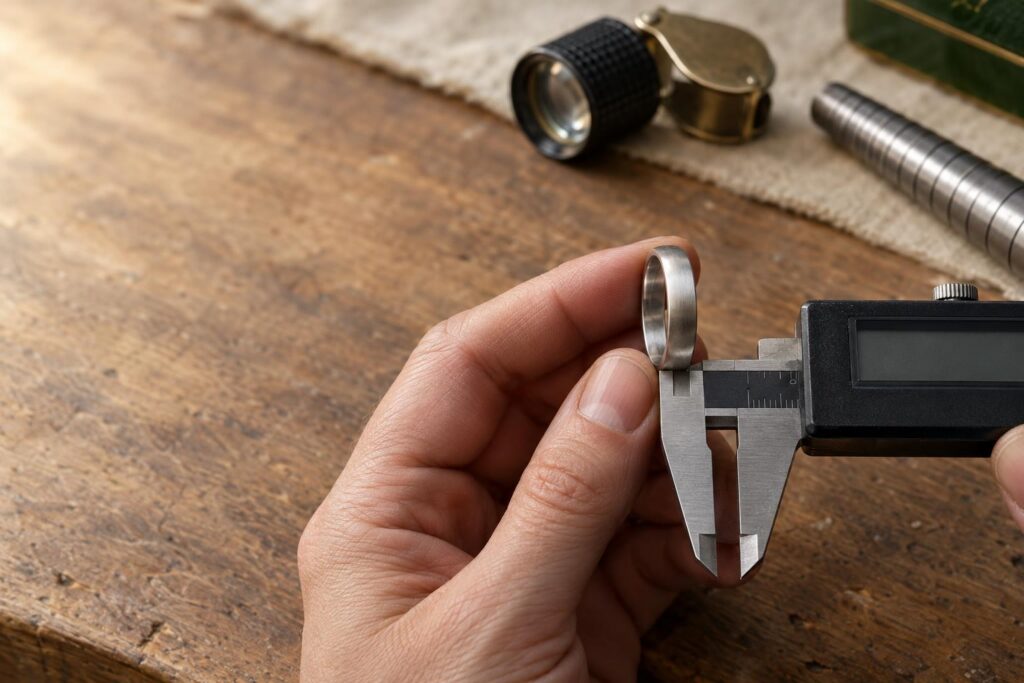
Why does the shank’s thickness matter? Thickness and width are two separate measurements. In one platinum example, the bottom of the shank was 1.5 mm thick and 3 mm wide 5. Some designs need more metal. For example, flush-set rings, where the stone sits sunk into the band, usually need wider and thicker shanks to hold the stone safely. Over years of wear, a shank slowly wears thin, especially at its lowest point. A jeweller can then remove the worn metal and replace it with a new partial shank, which is called reshanking 3.
The shank is also where a ring is resized. A jeweller adds or removes metal from the shank to change the ring’s size, then files it back to its proper shape and thickness 4. You can read more in Why can’t every ring be resized? and Ring Settings Explained.
Example: Turn your ring around so the stone faces your palm. The strip of metal now on top, where your finger meets your hand, is the bottom of the shank. On a ring worn every day for many years, this is the spot that usually wears thin first 3.