
Key takeaways
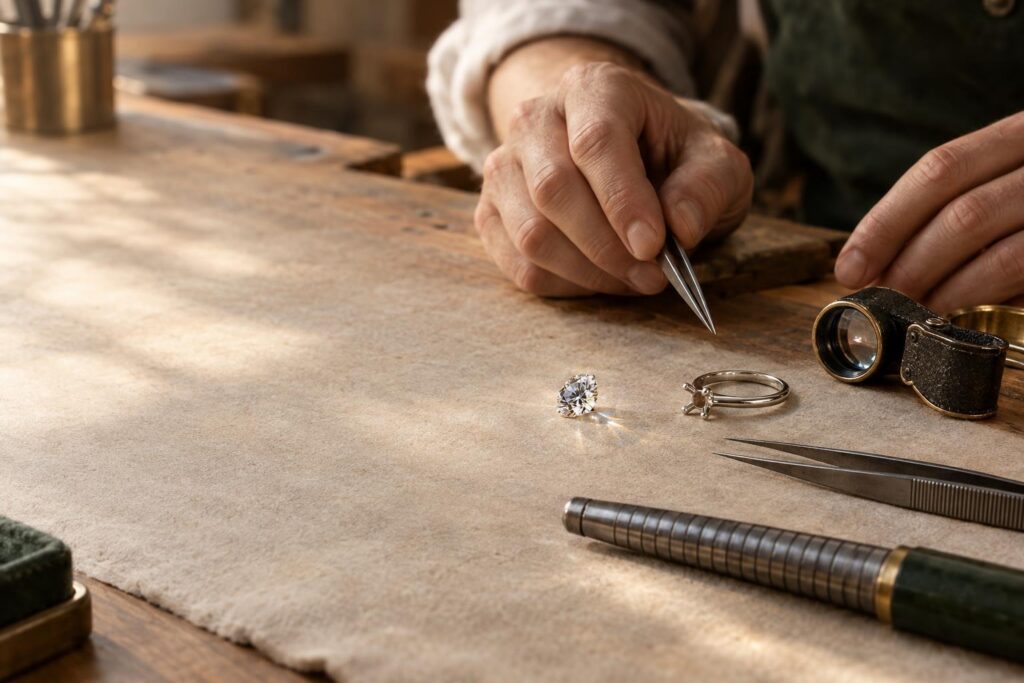
- A loose diamond is set at the bench, where the metal is cut and shaped to fit that one stone.
- Before setting, the mounting is checked against the stone’s measurements so the sizes match.
- In a claw setting, the seat is 30% to 50% of the prong thickness and the tips reach halfway up the crown.
- In a full bezel, the metal should cover 10% or more of the crown distance and touch the crown all the way round.
- If the stone moves when gently pushed, a prong is loose; have claws checked every six months to a year.
Why your band and loose diamond need a jeweller to join them
You chose a band and a loose diamond separately. So will they arrive as one ring, and how will the stone be held in place? Both questions come down to one step: setting the stone.
Setting is bench work. A jeweller cuts and shapes the metal around that one diamond, so it sits level and the metal fits tight against it 1. Each diamond has its own measurements, so the metal is fitted to the stone, not the other way round.
First, a few words. A ring setting is the whole metal mounting, including the parts that hold the stone and the band 5. The head is the top part that holds the stone, using prongs or a bezel. The shank is the circular part that goes round your finger. For a picture of the main styles, see ring settings explained.
One quality-assurance example from the trade begins where you may be now: a sales associate has sold a loose diamond and a platinum ring setting 4. Tightening prongs is a routine job for a bench jeweller 6. Whether your ring is sent with the stone already set is a question to ask your jeweller before you order. The sections below explain what happens at the bench, so you know what you’re asking about.
Why setting a loose diamond starts with its measurements
Why measure first? Because the seat in the metal is cut to suit one stone. Before any setting starts, the jeweller checks the mounting for stone size, then measures the stone to make sure the sizes match 1.
If your diamond comes with a grading report (a laboratory’s written description of the stone), its size is already on paper. On a GIA report, a round diamond is measured as minimum diameter – maximum diameter x depth. Fancy shapes, such as oval or pear, are measured as length x width x depth. Carat weight, the stone’s weight, is recorded to the nearest hundredth of a carat 3.
The report also has an inscription field. It lists any text or report number inscribed on the diamond’s girdle, the thin outer edge of the stone 3. That gives you and your jeweller a way to match the stone in hand to its paperwork before it goes into the metal. To read the rest of the report, see how to read a GIA diamond report.
How a jeweller fits a claw setting to your diamond
Why does a claw setting need such careful fitting? Prongs, also called claws, are narrow strips of metal that rise from the base and bend over the stone’s edges to hold it 5. Most round brilliant diamond rings use four or six of them. If a prong breaks, a six-prong setting is more likely to keep the diamond in place 6. The number is a design choice with trade-offs, covered in four claws vs six claws and the claw setting glossary entry.
The work starts with a decision: how high or low the stone will sit. The jeweller then measures the stone and picks a setting bur, a small rotary cutter, slightly smaller than the girdle. Dividers, a measuring tool, mark where the seat goes on each prong. The seat is a small notch cut 30% to 50% of the prong’s thickness, and the stone must sit level in every one 1.
Next comes tightening. The prong tips are tightened in a cross pattern until each one fits tight to the crown, the top part of the stone, with equal space between the prongs. The tips are then trimmed so each reaches halfway up the crown. A final inspection checks that the stone is still tight, straight and undamaged 1.
How a claw setting is fitted to a loose diamond
- Match the sizes The mounting is checked for stone size, and the stone is measured so the two match.
- Decide the height The jeweller decides how high or low the stone will sit.
- Mark and cut the seats Dividers mark the seats, and a setting bur slightly smaller than the girdle cuts each one 30% to 50% of the prong thickness.
- Check it sits level The stone must sit level in every seat before tightening.
- Tighten the tips Prong tips are tightened in a cross pattern until they fit tight to the crown, with equal spacing.
- Trim and inspect Tips are trimmed to reach halfway up the crown. The stone is checked to be tight, straight and undamaged.
Why a bezel setting is fitted differently
Why does the fitting change with a bezel? In a bezel setting, a smooth rim of metal surrounds the stone and protects its edges well 5. So instead of shaping separate claws, the jeweller works on that rim.
Four claws, six claws or a bezel: how the metal holds the diamond
The metal around your diamond is fitted to that one stone. Switch between the three common ways of holding a round diamond to see how each one grips it.
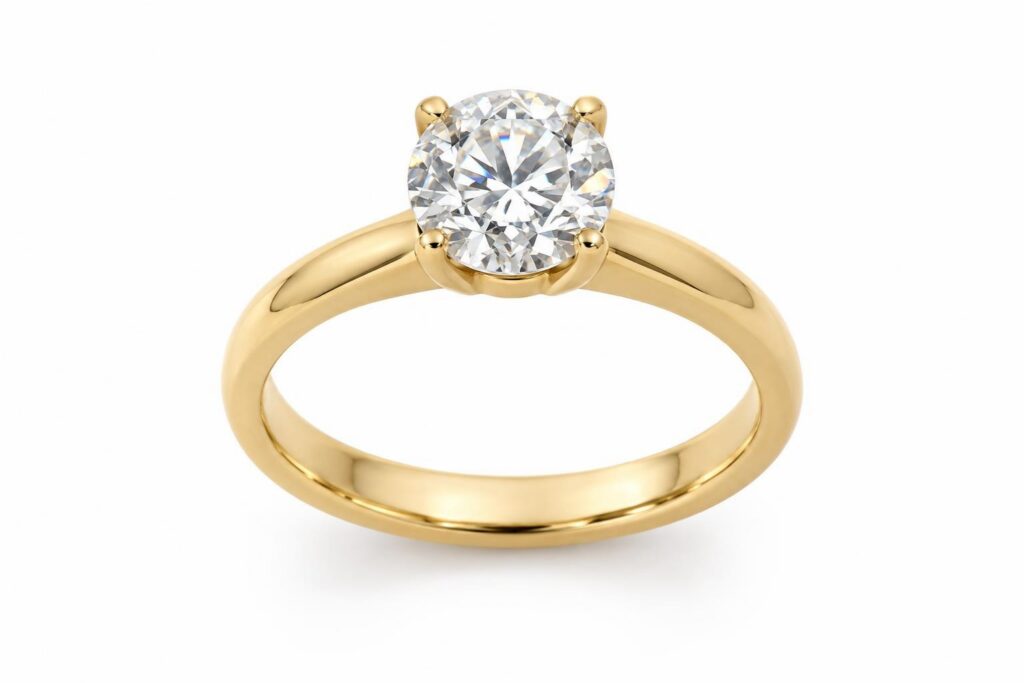
- Four claws
- Claws, also called prongs, are narrow strips of metal that rise from the base and bend over the stone's edges to hold it. Most round brilliant diamond rings use four or six of them. The number is a design choice with trade-offs.
- Six claws
- Six claws do the same job as four, with more strips of metal round the stone. If a prong breaks, a six-prong setting is more likely to keep the diamond in place. Whichever you choose, the jeweller cuts a seat in each prong to suit that stone.
- Full bezel
- In a bezel setting, a smooth rim of metal surrounds the stone and protects its edges well. There are no separate claws to shape, so the jeweller works on the rim. Once it is pushed over, the metal should touch the crown all the way round, through 360 degrees.
The pictures show plain round brilliant solitaires so the three holds are easy to compare. Real settings vary in height, metal and detail. Pictures: AI-generated illustrations, checked for accuracy. They are not photographs of a real piece.
For a round faceted stone in a full bezel, the jeweller measures the stone, chooses the right setting bur and cuts the bearing, the ledge the stone rests on. The stone is then checked to sit level and at the correct depth, and how deep the bearing goes depends on the stone’s cut and proportions. When the rim is pushed over, the metal should cover 10% or more of the crown distance. The jeweller then checks closely that the metal touches the crown all the way round, through 360 degrees 2.
| Claw setting | Full bezel setting | |
|---|---|---|
| What holds the stone | Narrow metal prongs that bend over the stone’s edges, four or six on most round brilliant diamond rings | A smooth metal rim that surrounds the stone |
| The seat | A notch 30% to 50% of the prong thickness | A bearing whose depth depends on the stone’s cut and proportions |
| Metal on the crown | Tips trimmed to reach halfway up the crown | Metal covering 10% or more of the crown distance |
| Final check | Stone tight, straight and undamaged, prongs evenly spaced | Metal touching the crown all the way round |
When buying a loose diamond and setting separately may not suit you
Why look at the downsides? So you know what to ask before the stone goes in. These points come from how setting is done at the bench.
- The sizes have to match. The mounting is checked against the stone’s measurements before any seat is cut 1. If the band you chose was made for a different stone size, that has to be sorted out first.
- Not every mounting is built the same. In one real case, a fragile custom mounting was compared with one built to the specifications for a secure setting 4. It is fair to ask how your setting is made.
- Heat matters for some stones. When a bezel already holding a stone that can’t take heat is joined to the rest of the piece, a laser welder should be used, not a torch 2. Ask how the jeweller handles heat for your stone.
- Paperwork depends on the stone. A GIA Diamond Grading Report is issued only for loose natural diamonds of 0.15 carats or more 3. See why a diamond might come without a certificate.
If the stone is one you already own, setting your own stone has its own checks. Weigh these points against what matters most to you.
What to check once your diamond is set
Why check at all? Because the point of setting is a stone that doesn’t loosen or fall out 4. Here’s what to look at.
On a claw setting, gently push the stone. If it moves, a prong is loose. Gaps between the diamond and the setting are another warning sign, and a 10× loupe (a small hand magnifier) helps you spot them 6.
Then look at how the metal meets the stone. On claws, the prongs should be evenly spaced, with each tip reaching about halfway up the crown 1. On a full bezel, the metal should touch the crown all the way round 2.
After that, have the prongs checked every six months, or at least once a year. Tightening them is a routine job for a bench jeweller 6.
Why it helps to ask questions before the stone is set
Why ask before, not after? Because the jeweller decides how high or low to set the stone as part of the setting work 1. These questions cover what this guide has explained:
- Will the stone be set before the ring is sent, or arrive separately?
- Which measurements will the setting be fitted to?
- How high or low will the stone sit?
- Claws or a bezel, and if claws, how many?
- Can the girdle inscription be checked against the report before setting?
If you’d like to talk it through, we offer a free consultation, online at bookings.ralphjacobs.org from any country, on WhatsApp or at our showroom. When Ralph Jacobs makes a ring to order, you approve the design, stone, size and engraving in writing before we start. Delivery terms differ by country, so check the delivery policy for your country on ralphjacobs.org. You can also read how the custom jewellery process works.
Frequently asked questions
Ask your jeweller before you order, as this guide can’t answer it for every jeweller. Here is how setting works: the jeweller checks the mounting against the stone’s size, measures the stone, cuts seats in the prongs and tightens the tips to the crown 1.
Have the prongs checked every six months, or at least once a year. Tightening prongs is a routine job for a bench jeweller 6.
They hold the stone differently. In a bezel, a smooth metal rim surrounds the stone and protects its edges well, while most round brilliant diamond rings use four or six prongs 5. If a prong breaks, a six-prong setting is more likely to keep the diamond in place 6. Which suits you depends on your priorities.