
Why should you care about the crown? It is the upper part of a cut diamond. It sits above the girdle, the narrow edge that separates it from the pavilion (the lower, pointed part) 2. The pavilion reflects light back up through the crown to your eye, so the crown shapes much of the sparkle you see 1.
The parts of a diamond
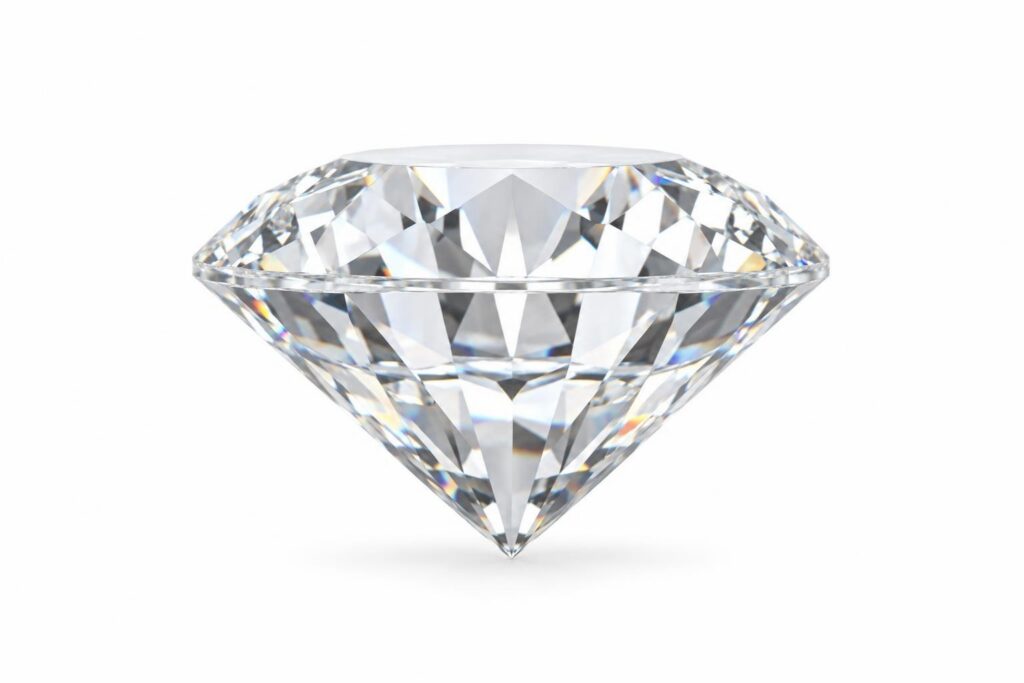
- Table
- The large flat facet on top. Most light enters the stone here.
- Crown
- The upper part, between the table and the girdle. Its angled facets help split light into flashes of colour (fire).
- Girdle
- The thin outer edge at the widest point. The setting usually grips the stone here.
- Pavilion
- The lower part, below the girdle. Its angle decides how much light reflects back up through the top.
- Culet
- The point, or tiny facet, at the very bottom of the pavilion.
- Total depth
- The height from the table to the culet, compared with the diameter. It is one of the measurements behind the cut grade.
Pictures: one AI-generated illustration of a diamond, adjusted for each grade. They show how the grades differ; they are not a grading of any stone.
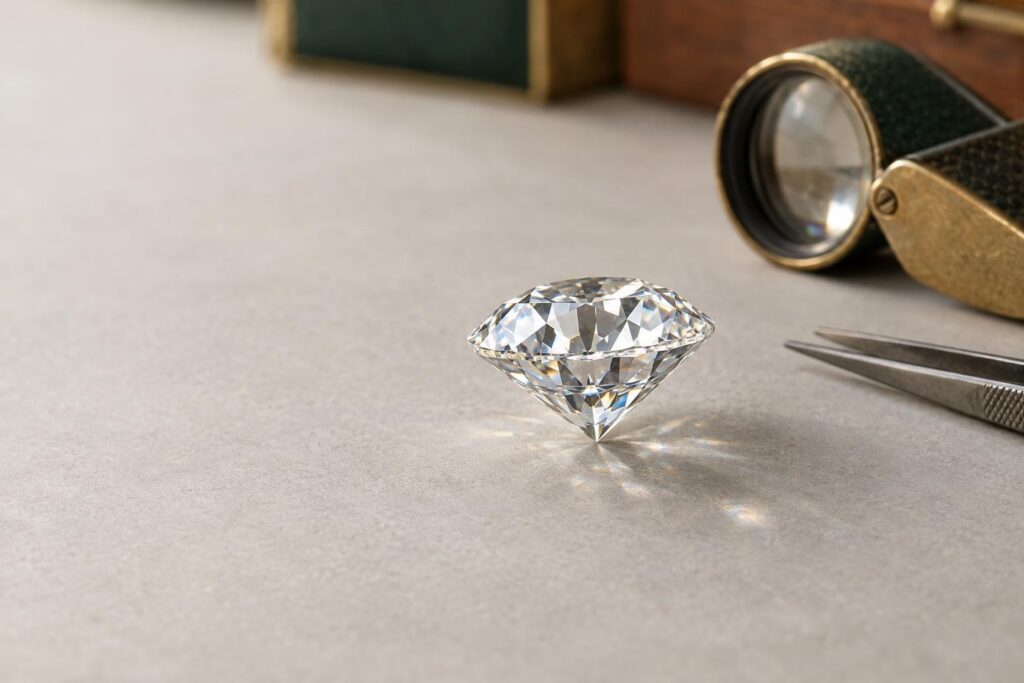
How does the crown create sparkle? Its facets (small, flat polished surfaces) gather and spread light. On a standard round brilliant, the crown has 8 bezel facets, 8 star facets and 16 upper half facets. Together they create brilliance (brightness), fire (flashes of colour) and a pattern of light and dark 1.
What do the crown measurements on a grading report mean? Crown angle is the slope of the bezel facets, and crown height is the crown’s height as a percentage of the girdle’s diameter 2. In a GIA study, top-graded round diamonds had crown angles of roughly 32 to 36 degrees. The same study found that no single measurement decides cut quality on its own 5. You can see how these figures appear in How to Read a GIA Diamond Grading Report.
Example: Picture a diamond in a ring. The claws grip the girdle, the pavilion points down into the setting, and the crown, topped by the table, forms the top of the stone. When you admire the sparkle, much of that light reaches you through the crown.