
Key takeaways
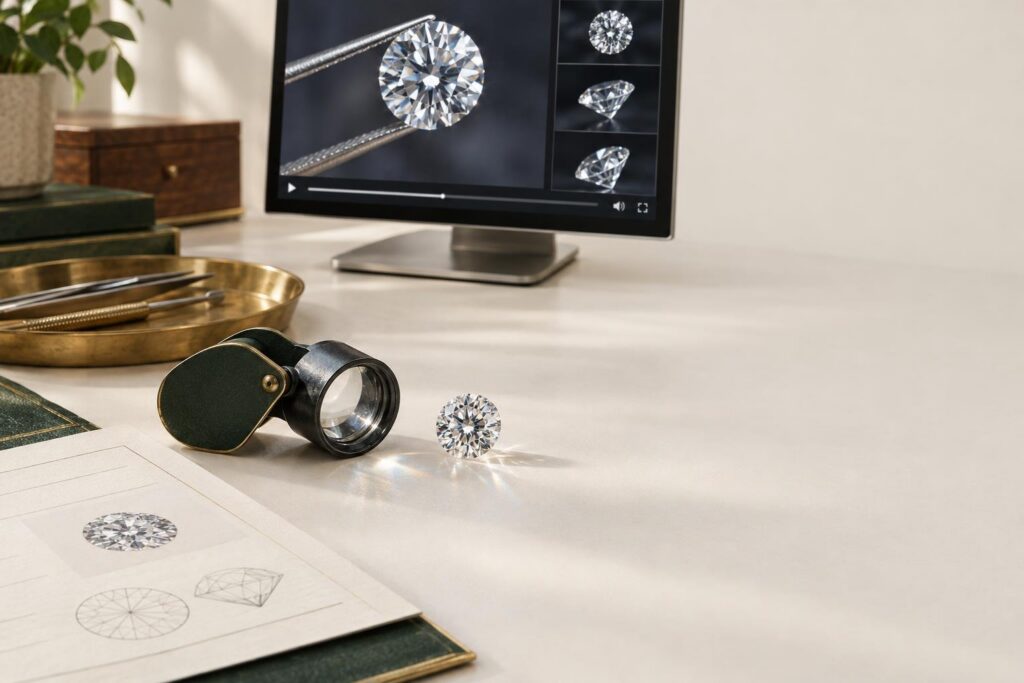
- A video lets you watch a diamond’s contrast and brightness change as it is rocked and tilted.
- In ovals, the bow-tie can vary even between stones in the same length-to-width ratio range.
- Most diamonds have inclusions visible only with magnification, so ask how much a video is enlarged.
- Light and background strongly affect how colour looks; the report’s colour grade comes from standard conditions.
- The plotting diagram and any report number inscribed on the girdle help you match a stone to its report.
Why a diamond video matters when you can’t see the stone
You are about to pay for a diamond you have never held. You want to see the actual stone first, and you may not be sure what a video can tell you. This guide covers what to look for, what a video can’t settle on its own, and how to check it against the grading report.
Why not rely on the report alone? For an oval diamond, it’s a good idea to view it in person or ask for videos. Its proportions, and how visible its dark centre is, can vary even between ovals in the same length-to-width ratio range (how long the stone is compared with how wide) 1.
Why see the exact stone, not a similar one? No two diamonds below Flawless or Internally Flawless (the highest clarity grades) have exactly the same combination or placement of clarity characteristics 4. For the wider choice, see the guide to choosing a diamond for an engagement ring.
Why movement shows sparkle better than a still photo
Why does movement matter? A diamond’s sparkle is not one fixed picture. As the stone is rocked and tilted, its contrast and brightness change, and that change is an important part of what your eye sees 2. A photo freezes one angle. A video shows the changes.
How does sparkle work? Brilliance, the bright white sparkle, needs a well-spread contrast of light and dark areas. A polished diamond returns less than half the light that enters it, not most of it. Brighter does not mean better-looking either: a mirror and a sheet of white paper both return a lot of light, but neither is brilliant 2.
What should you look for? Watch for light and dark flashes spread across the stone as it turns, rather than one big bright patch. In research on how people judge diamonds, large dark areas were widely disliked, but observers disagreed on what looked most pleasing 2. Your own taste counts. For more on fire (flashes of rainbow colour) and scintillation (the moving pattern of sparkle), see why a diamond sparkles.
Why a video can reveal the bow-tie effect
Why look for it? The bow-tie effect is a dark shadow across the centre of a diamond, shaped like a bow tie. It is common in elongated fancy cuts (shapes other than round), such as ovals. How visible it is can vary between ovals, which is one reason viewing in person or asking for videos is a good idea 1.
How does it form? Part of the light is blocked by the viewer’s own head and shoulders, which creates the dark shape. The closer your face is to the diamond, the stronger the bow-tie looks 1.
What can you look for? A well-cut oval reduces the bow-tie, but some degree of it is always present. When it is subtle and balanced, it can add character. Ovals longer than 1.50:1 may show a stronger bow-tie 1. A video of the actual stone gives you a chance to see how strong it looks in that diamond. Read more in why some diamonds show a dark bow-tie.
Why inclusions may or may not show up on video
Why does this matter? An inclusion is a tiny feature inside a diamond. Clarity is the grade for a stone’s inclusions and surface marks, called blemishes. Gemmologists set that grade under 10x magnification. Most diamonds have inclusions visible only with magnification, while cheaper diamonds often have inclusions you can see with the naked eye 4.
How does shape change what you see? Inclusions are usually easier to see in an emerald cut than in a round brilliant, because of its long, rectangular facets (the flat, polished faces). Many large clarity features, or ones mirrored by the facets, are easy to see whatever the shape. A diamond with many inclusions and blemishes can look off-colour, pitted and scratched 4.
What can you do with a video? If you notice an inclusion, note where it sits, so you can compare it with the report’s plotting diagram (see below). Keep in mind that clarity is graded under 10x magnification in standard viewing conditions, so a video is not a clarity grade 3.
Why ask how much a video is enlarged? Most diamonds have inclusions that can only be seen with magnification 4. So ask whoever filmed the stone how close the camera was and how much the picture is enlarged. Also ask whether the features you see on screen are visible without magnification. The answers help you judge whether something on screen is likely to show when the stone is worn.
Why a diamond video has limits: the downsides
Why can’t a video settle everything? Light source and background can strongly affect how a diamond’s colour looks. That is why colour is graded in a standardised viewing environment 3. A video is filmed under whatever light, background and camera setup the person filming chose, so it helps to know what those were.
- Colour: the colour grade on the report comes from standard viewing conditions 3. Ask what light and background the video used, and whether the camera settings stayed the same for every stone you compare.
- Brightness: a brighter-looking stone is not always a better-looking one. A mirror returns a lot of light, but it isn’t brilliant 2.
- Bow-tie: it comes from light blocked by whoever is looking, and it grows stronger the closer the viewer is, so distance changes what you see 1.
- Clarity: clarity is graded at 10x. Ask how much a video is enlarged, so you know whether a feature on screen is one you’d notice without magnification.
Which limit matters most depends on you. If colour is your main concern, the relevant fact is that the report’s grade comes from a standard environment, while a video’s light may differ. If you are choosing an oval, viewing it in person is the other option to asking for videos 1.
Why the grading report and the video belong together
Why use both? The grading report records what a laboratory found under standard viewing conditions 3. A video lets you watch the stone yourself. Two parts of the report give you features to compare with what you see: the plotting diagram and any laser inscription. The examples below use GIA reports; to see how labs compare, read GIA vs IGI diamond reports.
How the plotting diagram helps you match the stone
A plotting diagram is a map of a diamond’s clarity features. Graders draw them to scale, in their approximate shape and location, as seen at 10x. Because no two diamonds share the same diagram, it also works as a means of identification 5. If an inclusion shows in the video, you can see whether it sits where the plot places it.
The plot shows the stone from the crown (the top) and the pavilion (the lower, pointed part) 4. Red marks most inclusions, green marks naturals (small parts of the original rough surface) and black marks extra facets. Faint or widespread features may not be plotted but can appear under Comments. Reports without a plot list up to four significant clarity features 5.
How a laser inscription links stone and report
Diamonds graded by this lab often have their report number inscribed on the girdle, the stone’s thin outer edge. It is too small to see without magnification. A jeweller can read it at 10x with a loupe, a small hand magnifier. The number can be matched to the paper report or entered into the lab’s online Report Check database 6.
Why fancy shapes have no cut grade on the report
Why does this matter for a video? A cut grade from this lab is given only for standard round brilliant diamonds in the D-to-Z colour range. It considers brightness, fire, scintillation, weight ratio, durability, polish and symmetry 3. So an oval, pear or other fancy shape has no cut grade from this lab. For shapes, see choosing a diamond shape, and for every section of the report, how to read a GIA diamond report.
| Diamond video | Grading report | |
|---|---|---|
| Sparkle as the stone moves | Lets you watch contrast and brightness change as the stone is rocked and tilted 2 | Cut grade only for standard round brilliants in D-to-Z; it considers brightness, fire and scintillation |
| Inclusions | Most diamonds have inclusions visible only with magnification, so ask how much the video is enlarged 4 | Plotting diagram maps clarity features to scale, in approximate shape and location, as seen at 10x 5 |
| Colour | Light source and background can strongly affect how colour looks, so ask what light was used | Graded in a standardised viewing environment 3 |
| Linking to the stone | Any inclusion you spot can be compared with where the plot places it | An inscribed report number on the girdle can be read at 10x and matched 6 |
Frequently asked questions
Treat it as a rough guide. Light source and background can strongly affect how a diamond’s colour looks, which is why colour is graded in a standardised viewing environment 3. Ask what light the video used, and read the colour grade on the report.
Not necessarily. Most diamonds have inclusions visible only with magnification, though cheaper diamonds often have ones you can see with the naked eye 4. Ask how much the video is enlarged, and compare anything you spot with the report’s plotting diagram.
It may be the bow-tie effect, a dark shadow across the centre that is common in elongated cuts. It happens when the viewer’s head and shoulders block part of the light. A well-cut oval reduces it, but some is always present 1.
Not necessarily. Brilliance needs well-spread contrast of light and dark, and a stone with good contrast but lower light return can look better than a very bright one 2. Your own taste also counts.