
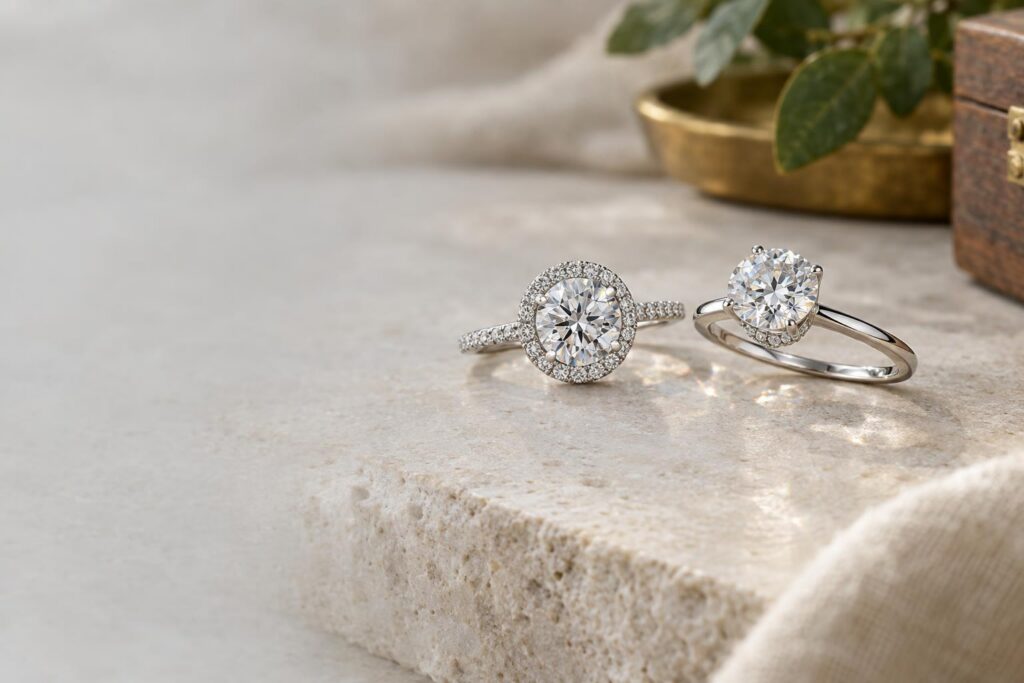
Why a hidden halo engagement ring is easy to confuse with a halo
Why is it so hard to tell a hidden halo from a normal halo? The names are almost the same, and both use small sparkling stones near the centre stone. This guide explains where each design puts those stones. It also covers what that means for the look, the care and resizing.
A halo ring has a centre stone held by prongs or a bezel, surrounded by a ring of smaller accent stones. Prongs, also called claws, are small metal tips that grip the stone. A bezel is a thin metal rim that wraps around it. The halo frames the centre stone and adds sparkle, which can make the centre stone look larger 1.
A hidden halo keeps that sparkle but moves it out of the main view. Designer Nikki Swift describes it as the pavé sparkle of a traditional halo, "but now it’s just hidden", which makes it a surprise element 5. Pavé means many small stones set close together in a honeycomb pattern 3.
Why are people looking at hidden halos at all? The trade publication JCK describes the halo as "almost considered classic", and reports that shoppers want different styles 5. Which design suits you depends on what you want to see when you look at your hand. For a wider view of setting styles, see Ring settings explained.
Why where the small stones sit changes the look
Why does position matter? Because a ring looks different from above than from the side, and the two designs put their sparkle in different places. Here is what to look for from each angle.
Hidden halo or traditional halo: what you see
The same kind of ring looks different depending on the halo and the angle you view it from. Switch between the three views to compare them.
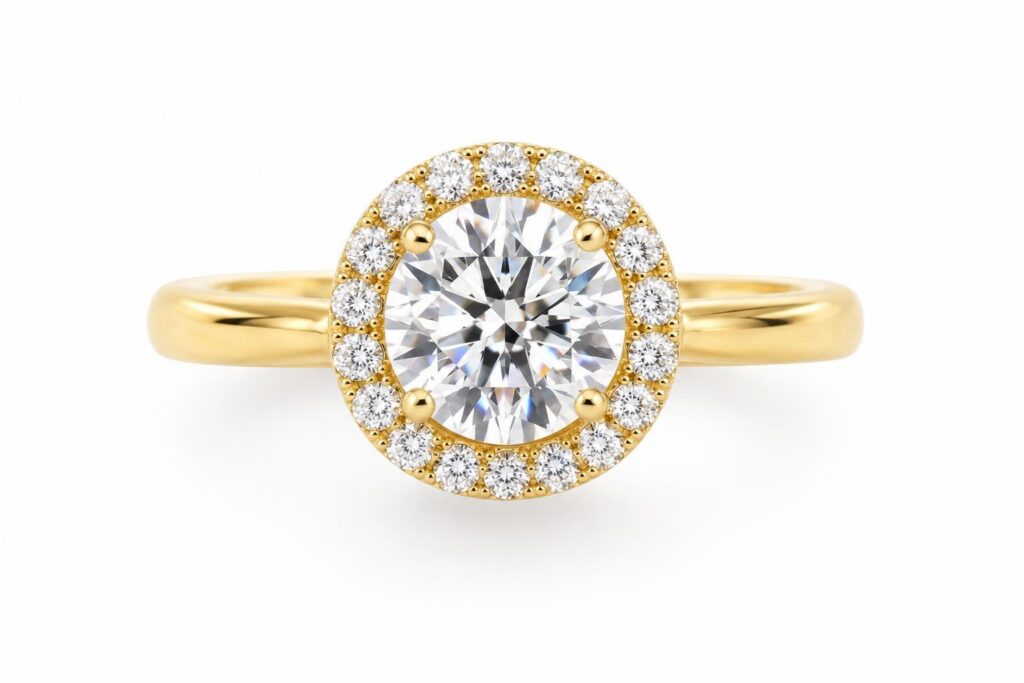
- Traditional halo
- The small stones circle the centre stone, so you can see them from every angle.
- Hidden halo from above
- Looking from directly above, the small stones are hidden, so only the centre stone shows.
- Hidden halo from the side
- From the side, or when you tilt the ring, the small stones show. They are a band of pavé on the gallery rail, which adds sparkle without distracting from the centre stone.
The pictures use a round centre stone and yellow gold for simplicity; hidden halos can be made in other shapes and metals. Pictures: AI-generated illustrations, checked for accuracy. They are not photographs of a real piece.
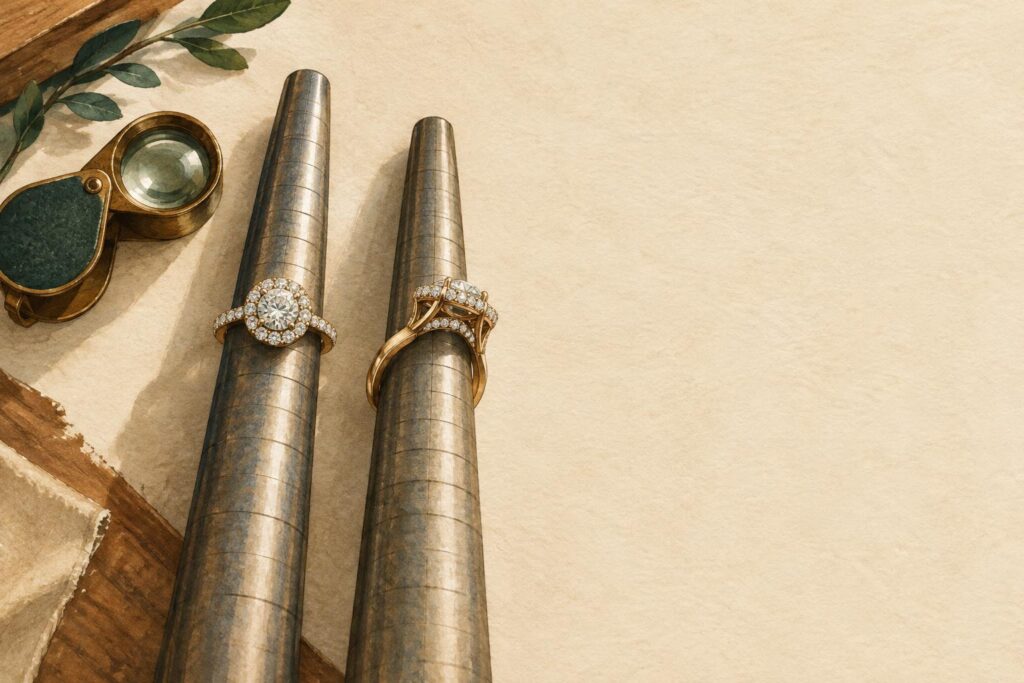
What you see from above
Why start with the top view? Because this is the view people call face-up: looking straight down at the top of the stone. With a visible halo, the centre stone can look as big as the whole halo 2. Some halos are a subtle, delicate frame. Others make the ring’s footprint, the area it covers on the finger, much bigger 1.
A hidden halo is designed to keep its small stones out of this view. Swift says clients like its extra sparkle because it doesn’t necessarily distract from the centre stone 5. If extra face-up size is your main reason for wanting a halo, note that the size effect comes from a ring of stones around the centre stone.
What you see from the side
Why look at the side of a ring before you choose? Because that is where a hidden halo’s surprise can show. The open space under a raised centre stone can hold hidden design elements that show from the side 1.
So ask to see the side view of any hidden halo you are considering, in person, in photos or in a render. Height also affects wear. A higher setting can make a diamond look bigger, but it is more likely to snag and be damaged 2.
Why the centre stone’s size matters with any halo
Why think about the centre stone before the halo? Because a halo frames the centre stone with much smaller diamonds, called melee. On GIA’s definition, melee are diamonds weighing less than 1/5 carat, the unit used to weigh gemstones. The exact range varies by country and part of the trade 3.
GIA’s guidance is that a centre diamond smaller than 0.50 ct would be too close in size to the melee around it 2. To see how weight relates to the size you notice on the hand, read Diamond carat weight vs visible size.
How are the small stones chosen? Melee are sorted by colour and clarity, and manufacturers match them to the centre stone. Don’t expect a grading report for each one, because grading costs too much relative to their value 3.
Why more small stones mean more care
Why does a halo ask for more attention? Because halo rings contain many small stones, and they may need more maintenance to keep the stones secure and clean 1. The prongs on halo diamonds also tend to wear out faster, so have the ring checked routinely 2.
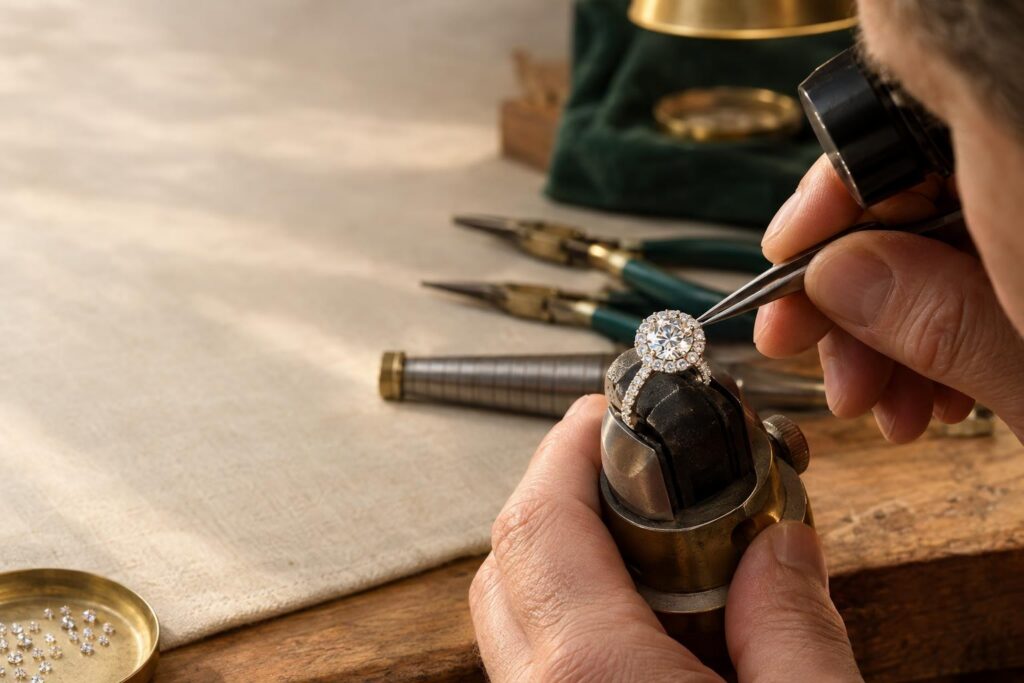
How are those small stones held? Pavé stones are usually held by tiny beads or prongs of metal, and pavé is often used in halos 1. Pavé diamonds are usually very secure. But if one falls out, it is harder for a bench jeweller, the jeweller who works on rings at the workshop bench, to replace 2.
Why can one loose stone cause more trouble? Diamond can scratch any precious metal used for settings, so a loose diamond can wear through a prong over time 4. These points come from guidance on halo and pavé designs. A hidden halo also uses pavé-style sparkle, so it is worth asking how its stones are held.
Halo and pavé designs also collect dirt more easily and may need cleaning more often 1. A simple routine helps:
- Clean at home with mild soap, warm water and a soft toothbrush, and have the ring professionally cleaned once or twice a year 2.
- Avoid ultrasonic cleaners (machines that clean with vibrations in liquid) and steam cleaners at home, because they can loosen stones in their settings 4.
Why resizing can be harder with small stones
Why think about resizing before you buy? Because some designs are harder to resize than others. Pavé-set bands can be harder to resize, because adjusting the ring may disturb the small stones 1. If the halo or hidden halo you like also has pavé along the band, ask how it would be resized.
The guide Why can’t every ring be resized? explains what happens in the workshop. To compare ring sizes between different sizing systems, use the Ring Size Converter.
The downsides: when a halo or hidden halo isn’t the right choice
Why look at the downsides? Because each design trades one thing for another, and a trade-off only matters if it clashes with what you want. Here are the situations where each may not suit you.
When a visible halo may not suit you
You want a slim, low-upkeep ring. Some halos make the ring’s overall footprint much bigger, and their many small stones may need more maintenance to stay secure and clean 1.
Your centre stone is small. GIA’s guidance is that a centre diamond under 0.50 ct would be too close in size to the melee, so the ring would probably look more like pavé than a framed centre stone 2.
When a hidden halo may not suit you
You want the centre stone to look bigger from above. The size effect comes from a ring of smaller diamonds around the centre stone, which can then look as big as the halo 2.
You want everyone to see the sparkle. A hidden halo’s pavé sparkle is "just hidden", designed as a surprise element rather than a frame in plain view 5.
Your hands are often busy. If the hidden stones sit under a raised centre stone, check its height. A higher setting is more likely to snag and be damaged 2.
Why the choice comes back to what you want to see
Why end with questions rather than an answer? Because only you know whether you want a bold frame from above, or a quiet top view with a surprise at the side. These questions can help you compare any two designs:
- Where exactly do the small stones sit, and can I see the ring from the side?
- How are the small stones held?
- How high does the centre stone sit above the band?
- Is there pavé on the band, and how would the ring be resized?
- How often should the ring be checked and cleaned?
For more on weighing setting styles, see How to choose an engagement ring setting. If you’d like to talk it through, we make halo and hidden halo settings in-house in South Africa and offer a free consultation online at bookings.ralphjacobs.org, from any country. For a made-to-order piece, you approve a CAD render (a computer drawing of the design) first. Renders are a visual guide, not an exact photo, so ask about the side view too.
Frequently asked questions
Usually not. Melee, the small diamonds in a halo, are sorted by colour and clarity and matched to the centre stone, but grading reports are not expected because grading costs too much relative to their value 3.
Pavé-set bands can be harder to resize, because adjusting the ring may disturb the small stones 1. Ask how a specific ring would be resized before you buy it.