
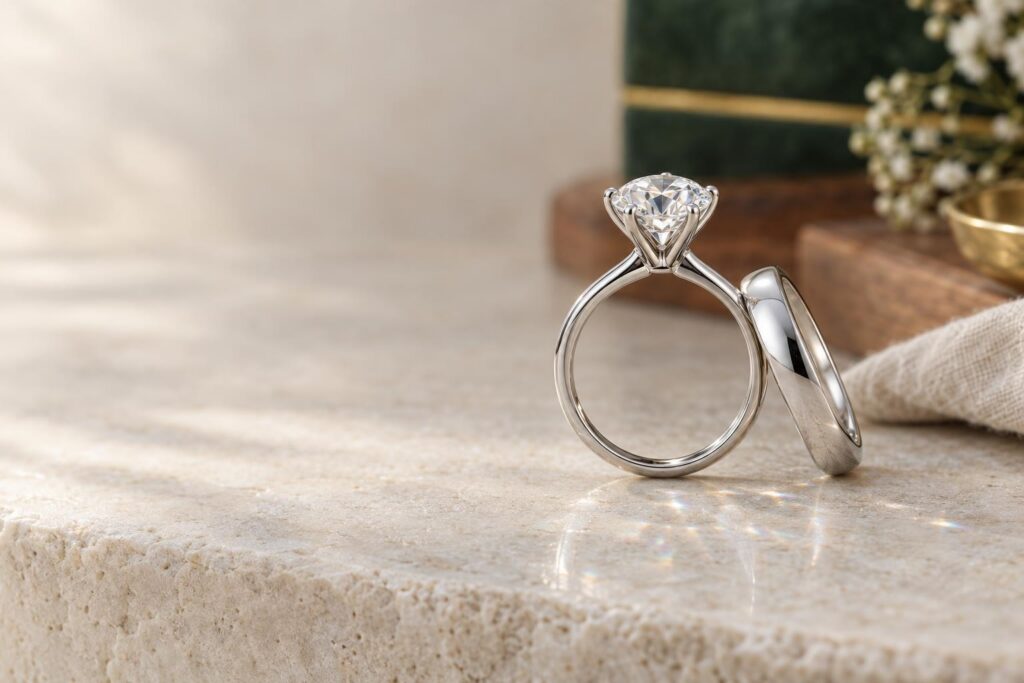
Why your band and engagement ring may not meet
You have an engagement ring you love, and you want a wedding band that sits neatly beside it. Then you hold a plain band next to it and see a gap. Why does that happen? The answer lies in the shape of both rings, especially the part that holds the stone.
Knowing where a gap comes from helps you choose a matching wedding band with confidence. It also tells you what to ask before you order. This guide explains which parts of a ring affect the fit, how straight and shaped bands differ, and what to check first.
- How high or low the stone’s setting sits, and the width and thickness of the band, both affect whether the rings meet.
- A solitaire ring pairs easily with a wide range of wedding bands 1.
- If the engagement ring has a twist or curve, a matching band is made so there are no gaps between the two rings 4.
- Gold can wear down faster when stacked with platinum, unless properly cared for, so care is worth thinking about as well as fit 3.
Why the setting decides how close a band can sit
Why look at the setting first? Because a band can only sit as close as the engagement ring allows. A setting is the metal mounting of a ring. It has three main parts: the head, which holds the stone; the shoulders, where the band rises towards the stone; and the shank, which is the band around your finger 1.
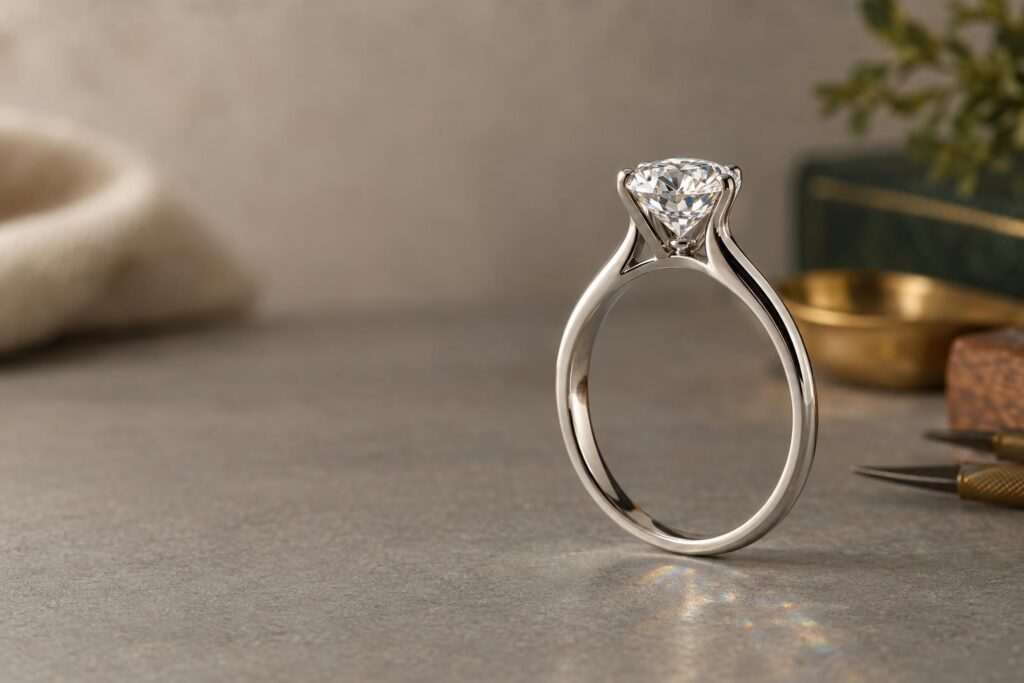
Fit depends on both rings, not only the engagement ring. The key question is where the head and its supports sit compared with the band you want to wear beside it. The band’s own width and thickness decide how much room it needs. For a picture of each part, see Ring Settings Explained: A Visual Guide.
Why setting height matters
Why does height change the fit? Because it decides whether there is room beneath the stone. Cathedral settings have metal arches rising from the shank that raise the stone above the band, and they often set the centre stone higher. A basket setting is a prong setting with horizontal supports joining the prongs beneath the stone, often used for larger or deeper stones 1.
A raised head can leave space underneath. If that space is deep enough for your band, a straight band may slide beneath the head and sit against the shank. If the head or its supports come down close to the shank, a straight band meets them first and a gap is left. In that case, a band shaped around the setting is one option.
Why halos change the picture
Why can a halo ring be harder to pair? A halo is a centre stone surrounded by a ring of smaller accent stones. Some halos are delicate, while larger ones greatly increase the ring’s overall footprint 1. What matters for fit is both how wide the halo is and how low it sits. A wide halo that sits high may clear a band, while one that comes down to the shank may not.
Why claws can get in the way
Why do claws matter for a band? Prongs, also called claws, are narrow strips of metal that rise from the base of the setting and bend over the stone’s edges. Claw prongs taper to fine points and stand out visually, and their raised edges can catch on fabric 1. Check how low the claws and their base reach, because that is where a band could touch them. You can compare claw styles in Four Claws vs Six Claws.
Why solitaires pair easily
Why do some rings pair with so many bands? A solitaire is a ring with a single centre stone. Solitaire rings pair easily with a wide range of wedding bands 1. A simple gold or platinum band complements a solitaire and keeps the focus on the centre stone 4.
Why a matching wedding band can close the gap
Why do some people order a band made for their ring? Because a band designed for one engagement ring can be shaped to fit it. Many engagement rings are sold with a matching band, so the diamond sizes match, along with how far the stones run down the band 4.
How straight and contoured bands differ
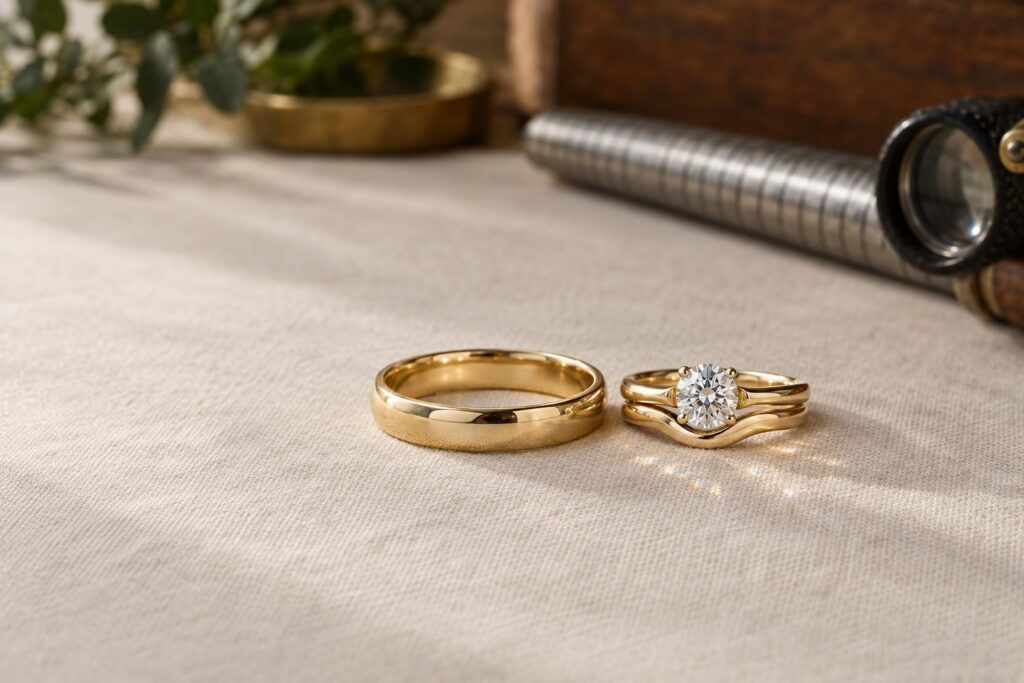
A straight band keeps the same shape all the way round. Whether it sits flush depends on the clearance under your engagement ring’s head, as explained above. A contoured band, sometimes called a curved or shaped band, has a dip or curve made to wrap around the head or halo.
If the engagement ring has a twist or curve, a matching band is made so there are no gaps between the two rings 4. The trade-off is in looks: the band’s shape is designed around that engagement ring.
Why the order and width of your rings matter
Why think about order? Because both tradition and personal taste play a part. Traditionally the wedding band goes on first and the engagement ring sits on top, so the band is closest to the heart. Some people wear the band above the engagement ring instead, as a personal twist on tradition 2.
Treat the engagement ring as the centrepiece of the stack, and choose a band that complements it without competing. With a large solitaire, a thin but detailed band such as micro-pavé (rows of very small diamonds set closely along the band) works well. If your rings are different widths, put the thickest ring at the bottom 3. For more on band width, see why wedding band width matters.
Why rings worn side by side need care
Why does care matter once the fit is right? Because rings that sit together can wear each other. Softer metals like gold can wear down faster if stacked with harder metals like platinum, unless they are properly cared for. A buffer ring, a thin ring worn between two others, can help prevent wear between them 3.
Some people have the two rings soldered, which means joined with melted metal. Soldering stops the rings spinning out of line, and the International Gem Society says most jewellers recommend it to stop the rings rubbing and wearing each other down 4. For how the two metals compare, see White Gold vs Platinum.
Prongs can loosen over time, so a professional cleaning and inspection once a year is worthwhile 2. Our video on checking claws and settings at home shows what to look for between visits.
The downsides: when a matching or contoured band isn’t the right choice
Why look at the other side? Because a perfect fit can come with limits you only notice later. Soldered rings cannot be worn apart. Some people choose not to solder so they can wear the band alone, for example at work, or swap bands 4.
- A contoured band is designed around one engagement ring. Before ordering, ask how it would look worn alone, or beside a different ring.
- An eternity band, which has stones all the way round, looks the same from every side, so it never appears "upside down" or out of line with the engagement ring. But eternity bands are very difficult, and sometimes impossible, to resize 4.
- Whether a small gap between your rings matters is a personal choice. Some people are happy with a little space.
- Finger size can change with temperature and other factors, so each ring still needs to fit you. Having rings professionally sized helps 2.
What to check before you order a matching wedding band
Why check before ordering? Because small details of both rings decide how they sit together. These points help you and your jeweller talk about the same thing.
- Look at your engagement ring side-on. Note how much space there is under the head, halo or claws, and how low they reach towards the shank.
- Name the setting style: solitaire, halo, cathedral or basket. How to Choose an Engagement Ring Setting explains each one.
- Think about the band’s width and thickness, and whether it needs to fit beneath the head.
- Decide whether you want the rings to touch along their full length, or whether a small gap is fine for you.
- Think about whether you will wear the band alone sometimes, as this affects soldering and band shape.
- Match the metals, or ask how two different metals will wear together.
- Make sure both rings sit snugly with minimal rotation and allow normal blood flow 3. If you compare sizes from different countries, use the Ring Size Converter.
- Show the jeweller the engagement ring itself, or clear photos from the side and top.
If you would like help working out which band shapes suit your engagement ring, we offer a free consultation. You can book online from anywhere at bookings.ralphjacobs.org, message us on WhatsApp, or visit our showroom in Secunda.
Frequently asked questions
It depends on the halo. Larger halos greatly increase a ring’s footprint 1. If the halo sits high, a straight band may fit beneath it. If it comes down to the shank, a band shaped around it is one option. Looking at the ring side-on shows how low it sits.
Traditionally the wedding band goes on first, with the engagement ring on top, so the band sits closest to the heart. Some people wear the band above the engagement ring instead, as a personal twist on tradition 2.
It depends on how you wear them. Soldering stops the rings spinning out of line, and most jewellers recommend it to stop them rubbing. Some people don’t solder so they can wear the band alone or swap bands 4.
Eternity bands have stones all the way round, so they never look out of line with the engagement ring. But they are very difficult, and sometimes impossible, to resize 4. That is worth knowing before you order one.
It can. Softer metals like gold can wear down faster when stacked with harder metals like platinum, unless properly cared for. A buffer ring worn between them can help prevent wear 3.