
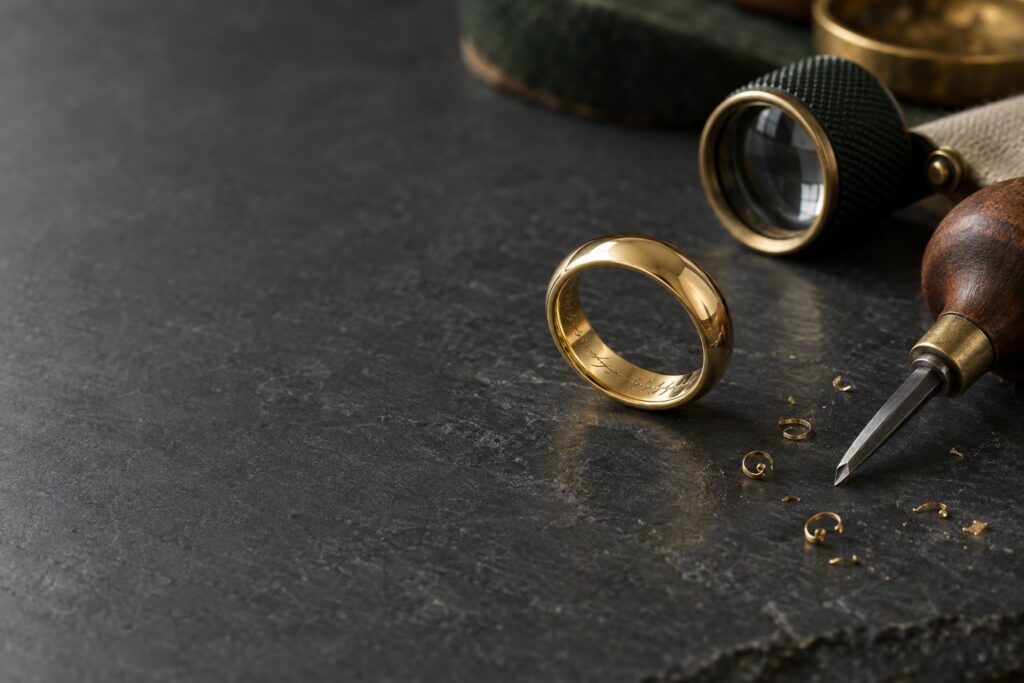
Why ring engraving is worth planning
A few words inside a ring can mean a lot. A name, a date or a short phrase may be something only the wearer ever sees. But engraving is not like writing with a pen. Mechanical engraving removes material or scratches the surface, and laser engraving vaporises or heat-marks it 2.
So it helps to know a few things before you ask. This guide walks through each one, so you can choose your wording with confidence:
- What fits, and why there is a character limit at all.
- How hand, mechanical and laser engraving differ.
- When to decide, and whether an engraving can be changed later.
- The downsides worth weighing before you commit.
Why the inside of a ring limits the characters
Why does ring engraving have a character limit at all? Because letters need room, and engraving inside a ring works within a limited area. One machine built for the inside of rings and bangles has a marking area about 15 mm tall, which limits how tall the engraving can be 3.
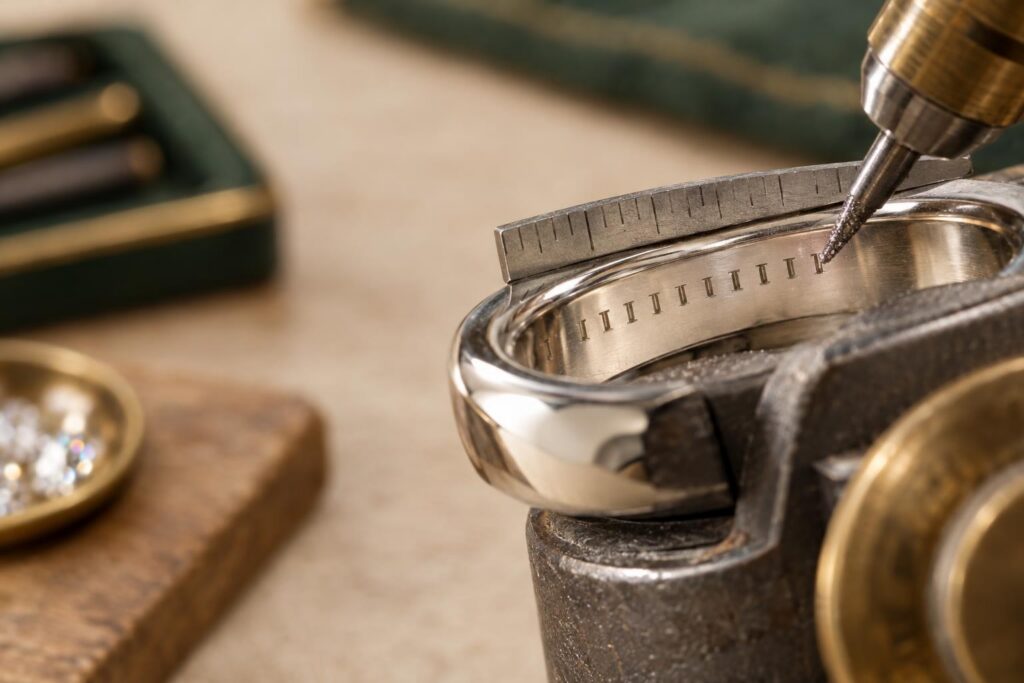
Letter height is only part of the story. Another inside-ring engraver is a fixed-ratio machine, meaning the size of the letters on its dial sets the engraving height. It cuts letters at either 1 mm or 2 mm high. The height can’t be adjusted, so letters can’t be shrunk to squeeze more in, but the spacing between them can 6.
The font matters too. Some fonts made for rotary engraving use two or three strokes per line to make each character wider 2. So the font you choose can change how much of your wording fits.
Band width and ring size also play a part, because the letters sit across the band and run around the inside. Ask how tall the letters will be for your band width, and how many characters fit at your size. To compare ring sizes between systems, use the Ring Size Converter.
Why the engraving method matters
Why should you care how the engraving is done? Because each method works in a different way, and the method shapes the look you get. Here are three ways a ring can be engraved.
Three ways to engrave a ring
The method used changes how the marks look on the metal. Switch between the three to compare them.
- Hand engraving
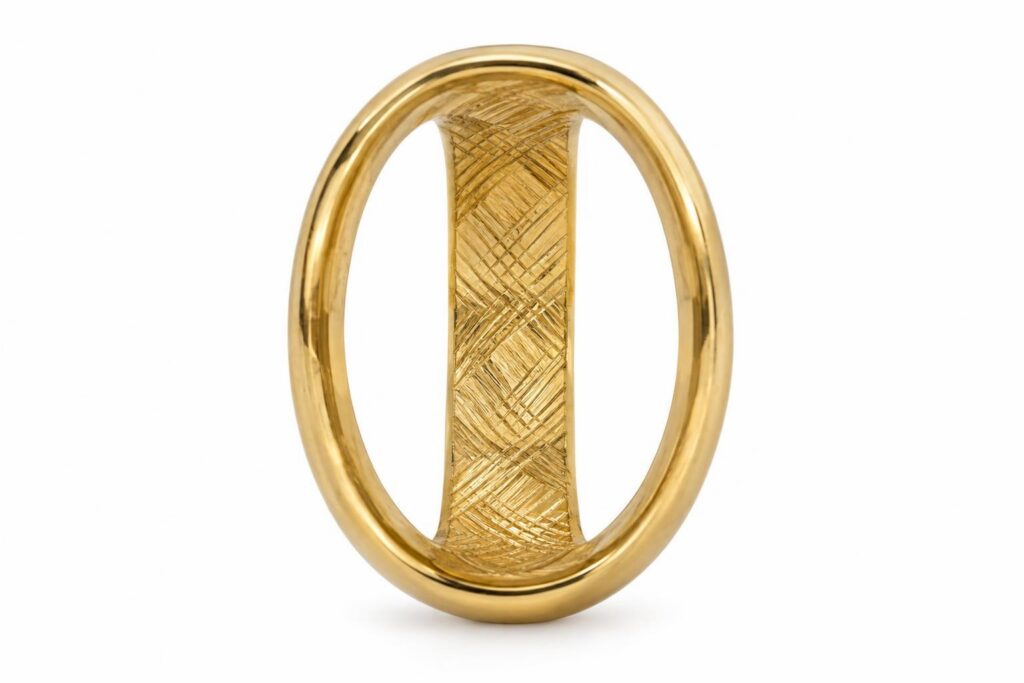
- An engraver cuts the metal with gravers, which are chisels made of hardened steel. Gravers come in various shapes and sizes, and each one creates a different effect. A finish graver cuts delicate parallel lines, and when sets of these lines cross, they make a textured pattern called a Florentine finish.
- Mechanical engraving
- A machine removes metal or scratches the surface. The result is a subtle tone-on-tone look.
- Laser engraving
- A laser vaporises or heat-marks the metal. It changes the colour of the material, and the brown areas left behind are metal oxides. A laser can give a high-contrast finish.
The pictures simplify things. Real results vary with the machine, the metal, the font and the laser type. Pictures: AI-generated illustrations, checked for accuracy. They are not photographs of a real piece.
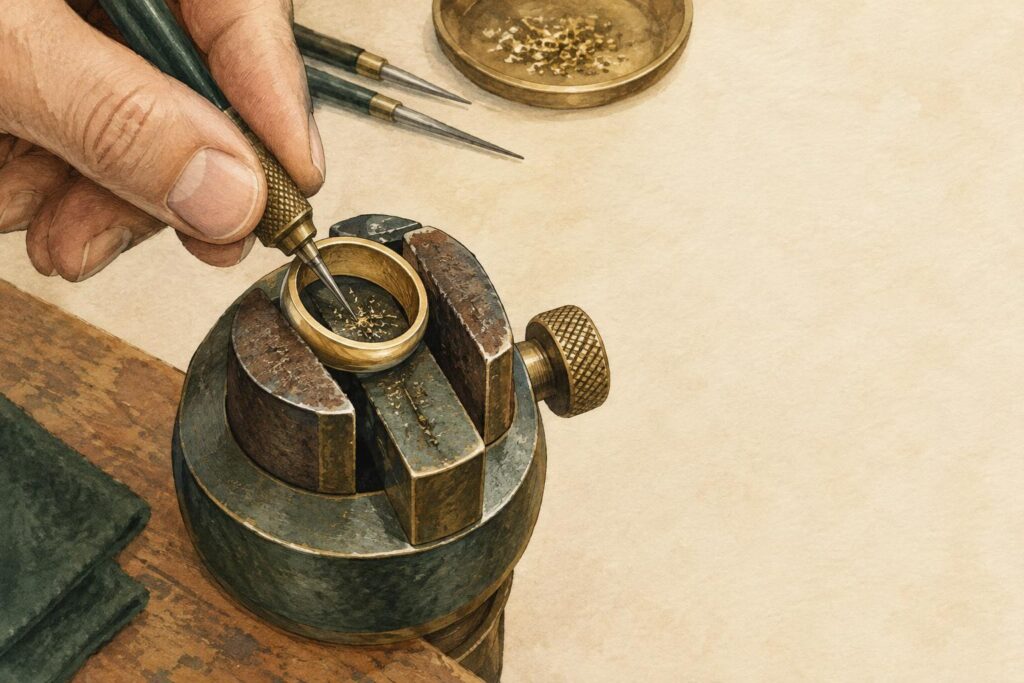
Hand engraving
Hand engraving is one of several traditional metalwork techniques. An engraver cuts the metal with gravers, which are chisels made of hardened steel. Gravers come in various shapes and sizes, and each one creates a different effect. A finish graver cuts delicate parallel lines, and when sets of these lines cross, they make a textured pattern called a Florentine finish 1.
Mechanical engraving
Mechanical engraving uses a machine to remove metal, or scratch the surface, with a rotating cutter, a diamond tip or a milling tool. A diamond tip gives the thinnest grooves, while a cutter allows deeper engraving. On precious metals, it gives a subtle tone-on-tone look, meaning the letters are the same colour as the metal around them 2. One inside-ring machine uses a diamond scribing tip that doesn’t spin, which is quiet and doesn’t cause chipping 3.
Laser engraving
Laser engraving uses a focused beam to vaporise or heat-mark the surface without touching it. It can give a high-contrast black, white or grey finish 2. A laser can mark the outside of a ring, the inside and even the narrow edge, which makes small text and fine lines possible. It can also produce graphics and images 5. By contrast, the dial included with one mechanical inside-ring machine has single-line block capital letters 6.
Why metal and laser type change the result
Why can the same words look different on two rings? Part of the answer is the type of laser used. All precious metals can be laser engraved, but the result varies with the type of laser. A fibre laser is recommended for deep engraving, while hybrid and green lasers give a thin engraving 2.
Fine detail depends partly on the equipment. One inside-ring engraver lists a maximum engraving precision of 0.05 mm 3. Laser spots can be very small too: one laser maker gives about 45 μm (micrometres) for the lens it names 4.
Lasers also change the metal they touch. Laser engraving changes the colour of the material, and the brown areas left behind are metal oxides, which is metal that has reacted with oxygen 4. If you are still choosing a metal, see 9ct vs 14ct vs 18ct gold or white gold vs platinum.
Why timing matters for ring engraving
Why think about engraving early? Because engraving works by taking material away or marking the surface. Laser engraving removes material from a solid surface and reduces its volume 4. So it is worth asking your jeweller when the wording needs to be final.
Depth adds time. Deep engraving is almost the same process as standard laser engraving, just with more passes. In one maker’s example, quality-focused settings took about three times as long as fast settings to reach the same depth 4.
Can an engraving be changed later? The sources used for this guide explain how engraving removes metal, but not how an existing engraving is altered or removed. So this is a question to ask the jeweller who made the ring, about that specific piece.
To see where engraving fits among the other steps, read how the custom jewellery process works or watch how a ring is made at the bench. Before you ask, it helps to settle these points:
- The exact wording and spelling, including any dates.
- How many characters your wording uses.
- Capital letters or mixed case, and which fonts the jeweller’s method offers.
- Where it goes: inside, outside or on the narrow edge, all of which a laser can mark 5.
- The look you prefer: subtle tone-on-tone or a high-contrast mark.
The downsides: when ring engraving may not suit you
Why look at the other side? Because engraving changes the metal itself, and that may not suit every ring or every person. These points are worth weighing before you commit.
- It takes material away. Laser engraving reduces the volume of the metal and can leave brown metal oxides 4.
- Letter size may be fixed. On a fixed-ratio machine, letter height can’t be adjusted, only the spacing 6.
- The look depends on the method. Mechanical engraving gives a subtle tone-on-tone look, while a laser can give a high-contrast finish 2. Whether you like that contrast is personal.
- Space is limited. A long message may not fit, so you may need to shorten your wording.
- Changes are uncertain. The sources here don’t cover changing an engraving, so treat the wording as something to get right the first time.
If you are not yet sure of the wording, it may help to wait until you are. Engraving something you might want to change later is a risk only you can weigh.
Why it helps to talk your wording through
Why ask before you finalise? Because, as this guide shows, methods, fonts and letter heights differ between machines. At Ralph Jacobs, engraving of up to 10 characters (letters and numbers, with no emojis or symbols) is free. On a made-to-order ring, you approve the engraving in writing, along with the design, stone and size, before we start. If you’d like to try a few options, book a free consultation online at bookings.ralphjacobs.org, from any country.
Frequently asked questions
Ask your jeweller as soon as you can, and ask how far making has got. Engraving works by removing or marking metal 2, so ask when your wording needs to be final.
Engraving removes material from the surface 4, so the letters are in the metal itself. The sources used here don’t describe how an engraving is changed, so ask the jeweller who made the ring what is possible for that piece.
Some can. One machine is designed to engrave the inside of rings and bangles, taking items from 12.5 mm to 80 mm in diameter 3. Ask your jeweller about a specific bracelet.
Mechanical engraving removes or scratches the metal with a tool and gives a subtle tone-on-tone look. Laser engraving uses a focused beam that doesn’t touch the surface and can give a high-contrast black, white or grey mark 2.