
Why your thin-band size may not carry over
Why would a ring in your usual size feel tight? You may know your size well from a thin band, and now you are choosing a wider ring. The fit matters. A ring that is too small can be uncomfortable and restrictive, while one that is too large may slip off or be lost 3.
Here is the short answer. Rings with wide shanks usually need to be a bit larger, because they fit more snugly 1. The shank is the band part of a ring, the metal that goes around your finger.
This article looks at what a ring size actually measures and how the inside shape of a band affects measuring. It also explains why your finger size moves during the day. It ends with what to tell your jeweller and the downsides of simply going bigger.
Why does a wide band feel tighter than a thin one?
Why should width change anything if the size is the same? It helps to know what a ring size measures. The international ring size standard, ISO 8653, defines ring size as the circumference of the largest cylinder that could be inserted in the ring. Put simply, it is a measurement around the inside of the ring 2.
Your finger also plays a part. For most people the knuckle is larger than the rest of the finger, so the ring has to slide over it 1.
Why, then, does width make a difference? A wider band covers more of your finger, so more of the ring sits against your skin, and the whole width has to pass over the knuckle when you put it on or take it off. That is why rings with wide shanks usually need to be a bit larger, because they fit more snugly, and why an unusually wide band should be measured from its centre 1. Where any band is measured also depends on the shape of its inside 2.
So how much bigger should a wide band be? The guidance from the Gemological Institute of America (GIA) that we draw on gives no exact amount. It says only that wide shanks usually need to be "a bit larger" because they fit more snugly 1. That word "usually" matters, and we come back to it in the downsides below.
Why does this matter more when rings are worn together? A bridal set is an engagement ring and a wedding band made to be worn side by side. Bridal sets wider than 4 or 5 mm, when the band and engagement ring are worn together, need special consideration. Ask your jeweller how to handle this 1.
Why the inside shape of the band matters
Why look inside a ring before you size it? Bands are not all shaped the same on the inside, and that shape affects how a ring is measured. The inside profile is the shape of the band on the side that touches your skin. ISO 8653 sets out two inside profiles, rounded and flat 2.
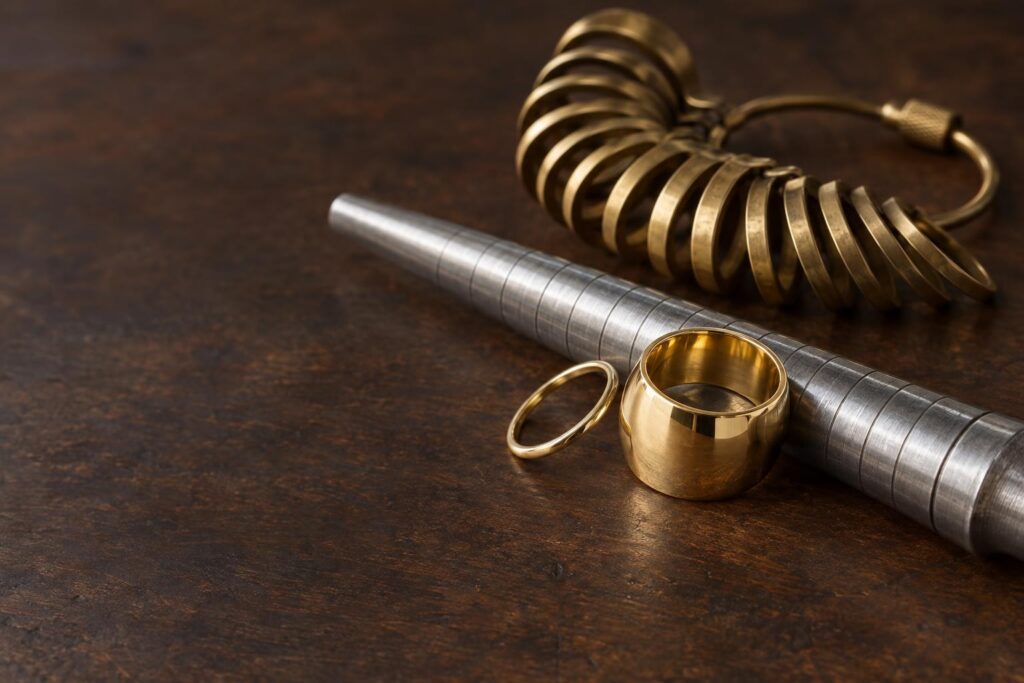
How is a ring measured? Rings are measured on a ring stick, also called a mandrel. It is a tapered rod marked with sizes. The ring is slid down the stick without force, and where it is measured depends on its inside profile 2.
Rounded inside (often called comfort fit)
A rounded inside curves gently towards your finger. Many jewellers describe this shape as a comfort fit band. On a rounded inside profile, the contact and measurement point sits in the middle of the ring’s thickness 2.
Flat inside
A flat inside is straight across, like the inside of a short tube. On a flat inside profile, the contact and measurement point sits at the bottom of the ring’s thickness 2.
Why does this matter to you? It means two rings with different inside profiles are not measured at the same point. The sources we use don’t say how much each profile changes the feel on your finger. That is a good question to put to your jeweller.
Why your finger size changes during the day
Why can the same ring feel loose in the morning and tight later on? Fingers shrink in the cold and swell in the heat. Humidity, altitude and time of day can also change your finger size 1.
The European standards body CEN-CENELEC also notes that finger size can vary slightly with temperature or time of day, which is why accuracy matters 3.
How do jewellers deal with this? Jewellers use finger gauges, also called ring sizers, and know how to allow for temperature, humidity, altitude and time of day 1.
How to get your wide band ring size right
Why not just reuse the size from your thin band? Rings with wide shanks usually need to be a bit larger, so a size found on a thin band may not carry over exactly 1.
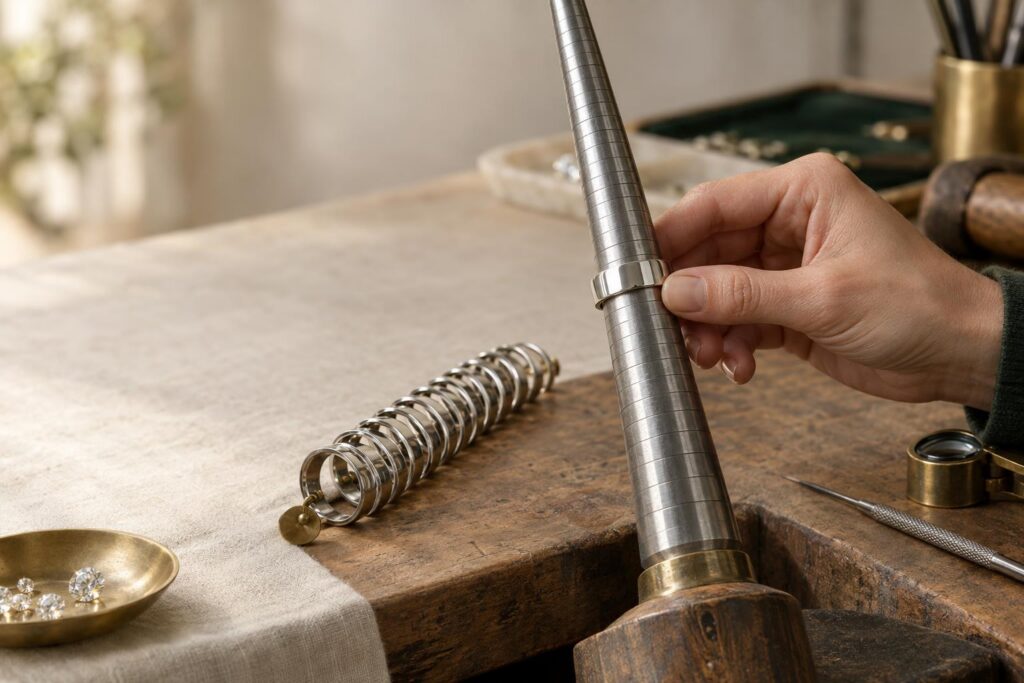
How are fingers measured? Under ISO 8653, finger size is measured with a finger gauge set, a set of sizing rings with one ring per size. These rings have the same diameters and tolerances as the ring stick 2. A tolerance is the small amount of variation a measurement is allowed.
Why does that matter? Customer sizing rings are made to the same diameters and tolerances as the workshop tools, so measurements taken in a shop and in the workshop match 3.
What if you already own a wide ring that fits well? When an existing ring is measured on a mandrel, the reading should be taken from the centre if the band is unusually wide 1.
What fit are you aiming for? Aim for a ring that is snug but not uncomfortable. It should pass over your knuckle but not fall off during work, play or hand washing 1.
If you are comparing sizes from different countries, the Ring Size Converter lets you line up the systems. For more detail, see Ring size systems: South Africa, UK, US and Europe.
What to tell your jeweller before ordering a wide band
Why give your jeweller more than a size? Under ISO 8653, where a ring is measured depends on its inside profile 2. Band width, and whether rings are worn together, affect the fit as well 1.
So these are the details worth sharing. Each one comes from the guidance in this article:
- Your known size, and the width of the ring it was measured with.
- The width of the new band, in millimetres.
- Whether its inside is rounded (comfort fit) or flat.
- Whether you will wear it next to another ring, such as an engagement ring and a wedding band.
- Whether your fingers change size between cold and warm days.
- Whether your knuckle is larger than the rest of your finger, which is true for most people 1.
If your ring is being made to order, How the custom jewellery process works explains the steps involved.
The downsides of sizing up for a wide band
Why not just go bigger to be safe? Going larger has its own risk. A ring that is too large may slip off or be lost 3.
Wide shanks usually need to be a bit larger, and usually is not the same as always. Fingers also shrink in the cold, and a ring should not fall off during work, play or hand washing 1.
How you balance a snug fit against a secure one is your decision. Your jeweller can measure you and explain the options, and the choice of size stays with you.
Why plan for a fix if the fit isn’t right?
Why think about adjustments before you buy? Because finger size can vary slightly with temperature or time of day 3.
How easy is a fix? It’s easier to remove metal from a ring that’s too big than to add metal to one that’s too small, and small gold beads can be added inside a loose ring to make it fit tighter 1.
To learn how ring resizing works, see Why can’t every ring be resized?.
If you’d like help working out the size for a wider band, we offer a free consultation. You can book it online from anywhere at bookings.ralphjacobs.org, or reach us on WhatsApp or at our Secunda showroom.
Frequently asked questions
The guidance we use doesn’t give a figure. It says rings with wide shanks usually need to be "a bit larger" because they fit more snugly 1. Your jeweller is the person to ask about the band you have in mind.
The ring size standard ISO 8653 measures them at different points. On a rounded inside, the measuring point sits in the middle of the ring’s thickness. On a flat inside, it sits at the bottom 2. Ask your jeweller which profile your ring has and how it was measured.
It’s a starting point. Rings with wide shanks usually need to be a bit larger. If you’ll wear both rings together and the set is wider than 4 or 5 mm, ask your jeweller how to handle it 1.
Use the Ring Size Converter to line up different systems. The international standard ISO 8653 defines ring size as the circumference of the largest cylinder that could be inserted in the ring 2.
It can. Fingers shrink in the cold and swell in the heat. Humidity, altitude and time of day can also change finger size, and jewellers know how to allow for these when sizing 1.