
Why does colour change everything here? Within the normal colour range, colourless diamonds are the rarest, so less colour means more value 1. Fancy colour diamonds have colour outside the D-to-Z scale used by the grading laboratory GIA, and they flip that rule. Colour is the main value factor, and the other three 4 Cs matter less: cut, carat weight and clarity (how free a stone is of tiny marks) 1. Graders judge hue, tone and saturation: the colour itself, how light or dark it is, and how strong it is. Grades include Fancy Light, Fancy Vivid and Fancy Deep 2. So a fancy colour does not have to be intense.
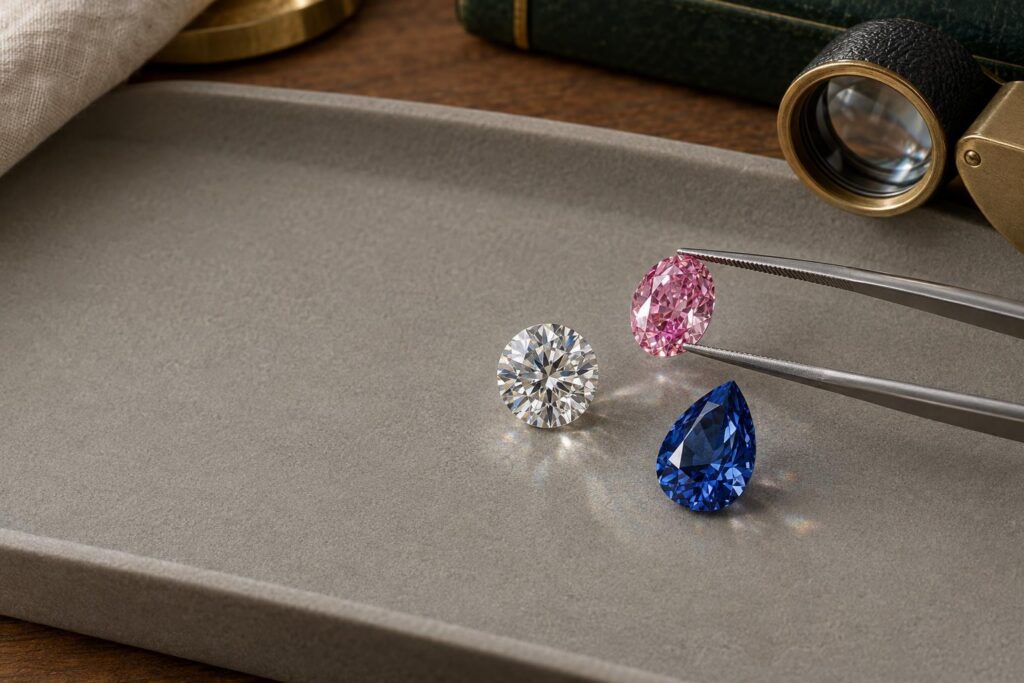
Why do some diamonds have colour at all? In nature, yellow and orange come from tiny defects linked to nitrogen, the most common impurity in diamond 3. Most pinks, reds and browns are linked to permanent distortion of the crystal 4. Blue comes from boron, and green forms when radiation pushes carbon atoms out of place. Brown and yellow are the most common fancy colours, while saturated pinks, blues and greens are among the rarest 1.
Why does the source of the colour matter? Natural fancy colour diamonds are among the most highly valued gemstones because they are attractive and very rare 4. Laboratory-grown diamonds can also be made in fancy colours such as yellow, blue and pink 5. Treatments can change colour too, for example irradiation, usually with high-energy electrons. Some treated colours are stable, but coatings scratch and wear off over time. Every GIA report states whether the colour is natural or treated 6. See reading a GIA report and natural vs lab-grown diamonds.
Example: Picture two yellow diamonds of the same size. One report says Fancy Light yellow; the other says Fancy Vivid yellow, a stronger colour. Both are fancy colour diamonds, and the colour grade is the main clue to how each is valued. Each report also shows whether the yellow is natural or treated.