
Why moissanite durability matters for a ring you wear every day
Why ask about durability before anything else? If you plan to wear a moissanite ring every day, you want it to look right for years, not weeks. Your questions are probably simple. Will it scratch? Will it chip? Will it go cloudy?
Gem research speaks to the first two directly. GIA’s study of moissanite reports high scratch hardness and excellent toughness, but says hard wear could still chip its outer edge 1. The third question is harder to answer, and this guide is open about what the sources do and do not show.
This guide explains each part of durability in turn. It then compares moissanite with diamond and sapphire, and ends with care and settings.
- Scratches: moissanite is 9¼ on the Mohs scale, above corundum, the mineral sapphire is made of, at 9 1.
- Chips: hardness alone does not stop chips. Even diamond, the hardest gem, can be cleaved or fractured by a hard blow 5.
- Settings: in GIA’s advice for diamond, bent or broken prongs (the small metal claws that hold a stone) are a very common cause of chipping 4.
- Clouding: none of the sources used here is a long-term study of worn rings, so this guide explains what they do and do not cover.
Why gem durability is more than one number
Why can’t one number tell you how well a stone will last? Because durability is made of three separate strengths. They are hardness (resisting scratches), toughness (resisting breaking and chipping) and stability (resisting chemicals and temperature changes) 2.
Diamond shows why this matters. It is the hardest gemstone, yet a hard blow can still cleave it, meaning split it along a flat plane, or fracture it. No gem scores a perfect 10 on all three strengths 5.
Hardness is given on the Mohs scale. It ranks relative scratch hardness, meaning which material can scratch which. Its steps are not even, so the gap between two numbers can be small or very large 5. For more, see why the Mohs scale is not the whole durability story.
Why moissanite resists scratches so well
Why does hardness matter in a ring? Hardness is a stone’s resistance to scratches and abrasion, which is rubbing wear 2.
Where moissanite sits on the hardness scale
Scratch hardness is only one part of durability, but it is the one most people ask about first. Step through four stones in order of Mohs hardness to see where moissanite falls.
- Topaz: 8 on Mohs
- Topaz is 8 on the Mohs scale. It sits below corundum, and the gap between the two is smaller than the gap between corundum and moissanite on the measured Knoop scale.
- Sapphire (corundum): 9 on Mohs
- Corundum, the mineral that sapphire is made of, is 9 on the Mohs scale. It has excellent toughness and no cleavage.
- Moissanite: 9¼ on Mohs
- Moissanite is 9¼ on the Mohs scale. GIA's study warns the figure may be misleading, because the scale is squeezed together above 8. The gap between corundum and moissanite is bigger than the gap between corundum and topaz.
- Diamond: 10 on Mohs
- Diamond is the highest on the Mohs scale, at 10. It is only one number above sapphire but many times harder. A hard blow can still cleave or fracture it.
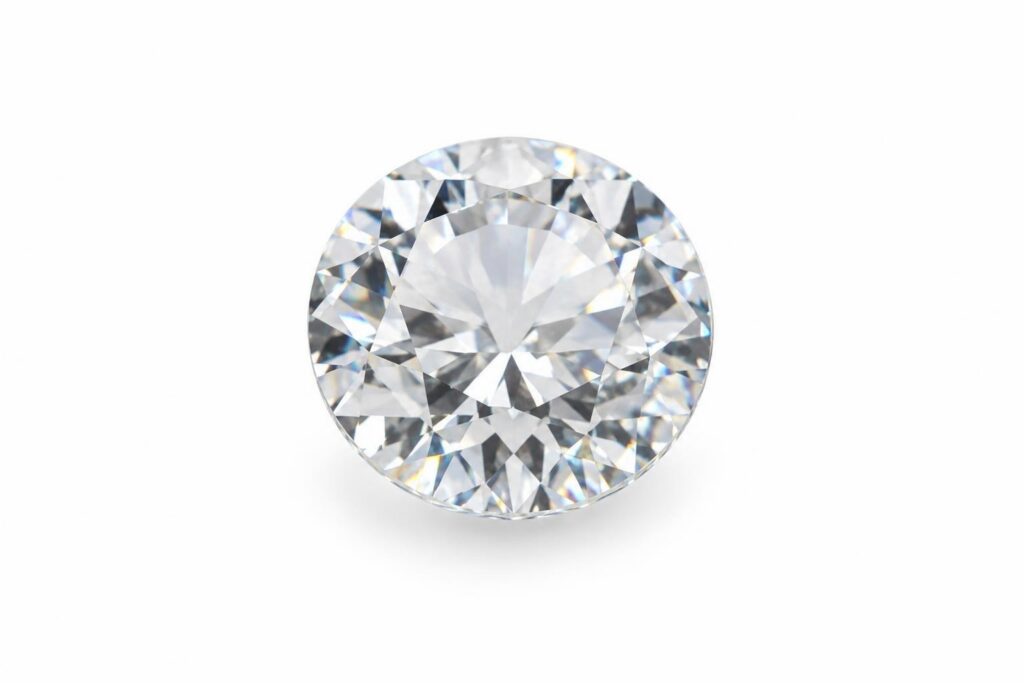
The stones are drawn to look alike, because that is how they appear to the eye. The pictures cannot show the uneven gaps between Mohs numbers, so read the text alongside them. Pictures: AI-generated illustrations, checked for accuracy. They are not photographs of a real piece.
The moissanite used in jewellery is made in a laboratory, and GIA calls it synthetic moissanite. GIA’s study gives it a hardness of 9¼ on the Mohs scale. The study warns this figure ‘may be misleading’, because the Mohs scale is squeezed together above 8. On a measured scale called Knoop, the gap between corundum (9) and moissanite (9¼) is bigger than the gap between corundum and topaz (8) 1.
Corundum is the mineral that sapphire is made of. Diamond is only one Mohs number above sapphire, but it is many times harder 3. Diamond is the highest on the scale, at 10 2.
What does this mean for your ring? Because the Mohs scale ranks which material can scratch which, moissanite, at 9¼, ranks above sapphire and below diamond 1 5. So a diamond, for example in a ring worn beside it, is harder still.
Why moissanite can still chip
Why can a very hard stone still chip? Because chipping is about toughness, not hardness. Toughness is a stone’s resistance to breaking and chipping 2.
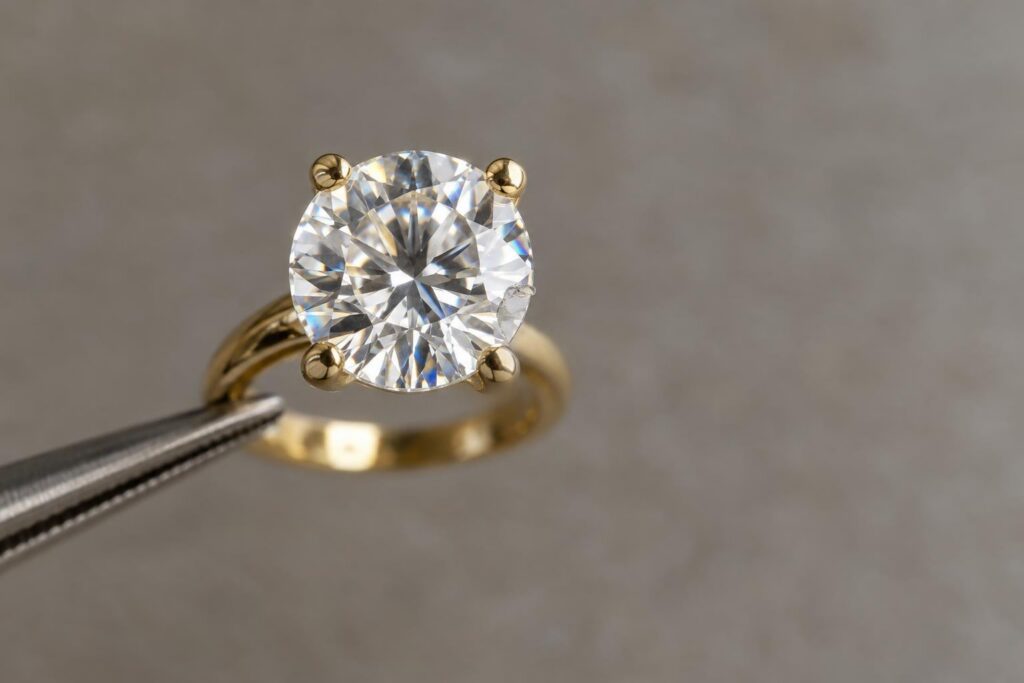
In GIA’s comparison table, toughness is rated ‘Excellent’ for moissanite, ‘Excellent’ for synthetic corundum and ‘Good to excellent’ for diamond 1. Diamond itself is very stable and extremely hard, but only somewhat tough 4.
GIA also tested moissanite directly. It struck a moissanite cube with a hammer until it shattered. The stone broke with curved, shell-like breaks called conchoidal fractures. It showed no cleavage, which means it has no natural flat planes of weakness where it would split more easily 1.
The same study says these fractures could be expected at the girdle under hard wear. The girdle is the thin outer edge of the stone, so it is the part to protect from hard knocks 1.
Research on silicon carbide, the material moissanite is made of, adds useful background. A NIST study of a silicon-carbide ceramic found it very hard, and called low fracture toughness its biggest drawback 6. That ceramic is made by fusing grains together, not grown as a single gem crystal. Its figures are not moissanite’s own, but they show why hardness alone does not prevent chips.
Why moissanite stays stable under heat and chemicals
Why does stability matter in a ring? Stability is a stone’s resistance to chemicals and temperature changes, the third part of durability 2.
Moissanite is reportedly stable in air up to 1700°C (3092°F), and it resists most chemicals to well over 1000°C. Its chemical make-up is fixed, so its properties vary little from one stone to the next 1.
For comparison, diamond burns at about 850°C (1562°F), a heat that house fires and jewellers’ torches can reach. Sudden, extreme temperature changes can also cause thermal shock in diamond, which can create or spread cracks 2. Sapphire resists heat, light and common chemicals under normal wear 3.
What does this mean in practice? Because moissanite is so stable in air, a jeweller could solder (join with heat) broken prongs with the stone still set, as is done with diamond. Small moissanites have even been cast in place in gold, meaning the gold was formed with the stone already in it 1.
Why the cloudiness question needs a careful answer
Why is clouding the hardest of your three questions? It is about how a stone looks after years of wear. The sources used in this guide describe the material’s properties and how to care for gems, and none of them is a long-term study of worn rings.
Here is what they do show. Moissanite’s make-up is fixed, it is reportedly stable in air up to 1700°C, and it resists most chemicals to well over 1000°C 1. None of the sources describe moissanite turning cloudy inside.
What can everyday wear do? Wearing jewellery while cooking risks heat and spattering oil, and that chlorine can damage gold mountings 5. The sources also describe scratches from harder materials and chips at the girdle, both covered above.
The sources do not explain how to tell build-up on the surface from a change inside a moissanite. If your stone looks less bright than it did, you can ask a jeweller to look at it under magnification and explain what they see.
How moissanite compares with diamond and sapphire
Why compare moissanite with these two stones? Seeing their ratings side by side shows where they overlap and where they differ.
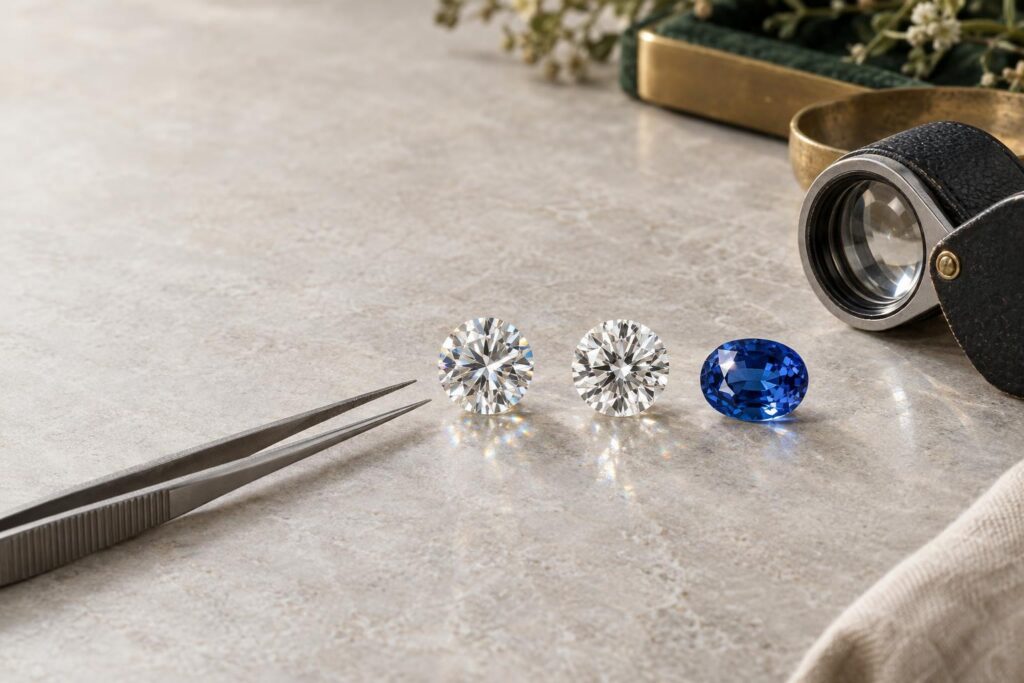
- Moissanite: 9¼ on the Mohs scale, toughness rated excellent, no cleavage, and stable in air up to 1700°C 1.
- Diamond: 10 on the Mohs scale, but a hard blow can cleave it, and it burns at about 850°C 2.
- Sapphire (corundum): 9 on the Mohs scale, excellent toughness, no cleavage, and resistant to heat and common chemicals under normal wear 3.
The toughness ratings overlap: ‘Excellent’ for moissanite and ‘Good to excellent’ for diamond do not show either stone as clearly tougher 1. Which facts matter most depends on how you live and work. For other stones, see which gemstones suit everyday rings, and for sapphire in depth, how to buy a sapphire.
The downsides: when moissanite can still be damaged
Why look at the downsides? Because high ratings do not make any stone immune. Even diamond, the hardest gem, can be cleaved or fractured by a hard blow 5.
- It is not the hardest gem. Diamond is the highest on the Mohs scale, at 10 2, so it ranks above moissanite, at 9¼, in scratch hardness 1.
- Its edge can chip. GIA expects curved fractures at the girdle under hard wear 1.
- The metal matters. With diamond, a stone loose in its mounting can cut through the metal prongs and fall out 5.
- Shape and setting add risk. In diamond, pointed shapes, very thin girdles and damaged prongs all raise the chance of chipping 4.
- Durability is only one factor. Looks, value and other differences are covered in natural diamond, laboratory-grown diamond or moissanite.
Why the setting and shape are worth asking about
Why think about the setting when your question is about the stone? GIA’s advice on preventing chips in diamond focuses on shape, girdle thickness and the setting 4.
That advice was not written for moissanite. But GIA’s moissanite study also expects fractures at the girdle under hard wear 1. So these points from the diamond guidance are questions you can raise with a jeweller, not proven moissanite facts:
- Shapes with points or sharp corners are more likely to chip there. Rounds, ovals and rounded cushions avoid this.
- Very thin girdles are at much higher risk of damage.
- Bezels (a metal rim around the stone), partial bezels or V-shaped prongs protect vulnerable points better.
- Bent or broken prongs are a very common cause of chipping, and a loose stone is at higher risk 4.
For more on setting styles, see ring settings explained and four claws vs six claws. Shapes are compared in choosing a diamond shape.
How to care for a moissanite ring
Why does care matter for such a stable stone? The sources describe damage from abrasion, chemicals, sudden temperature changes and hard knocks 2, and from the metal that holds the stone. Because GIA links bent or broken prongs to chipping in diamond, you may want a jeweller to check the prongs on any ring you wear every day 4.
GIA’s moissanite study does not set out a cleaning routine. GIA’s care guides for diamond and sapphire are written for those stones, so read them as their guidance, not as proven moissanite advice:
- For diamond, lint-free cloths, commercial jewellery cleaner and household detergent are safe, but ultrasonic and steam cleaners can loosen stones in their settings 2.
- For sapphire, warm soapy water is always safe 3.
- For any jewellery, cooking risks heat and spattering oil, and chlorine can damage gold mountings 5.
- For diamond, don’t keep wearing a stone that has already chipped 4.
Ask your jeweller which cleaning method suits your moissanite and its setting. If you would like to talk through moissanite and diamond before you decide, we offer a free consultation at Ralph Jacobs. You can book online from any country at bookings.ralphjacobs.org, or visit our showroom in Secunda.
Frequently asked questions
Moissanite is 9¼ on the Mohs scale, above corundum (sapphire) at 9 1. Diamond, at 10, is harder, so a diamond, for example in a ring worn next to it, ranks above moissanite in scratch hardness.
Yes. GIA rates its toughness as excellent and found no cleavage, but expects curved fractures at the girdle, the stone’s outer edge, under hard wear 1. GIA’s diamond advice on shape, girdle thickness and prongs gives useful questions to ask a jeweller.
None of the sources used here describe moissanite turning cloudy, and none is a long-term wear study. They describe a fixed make-up, stable in air up to 1700°C and resistant to most chemicals 1. If your stone looks dull, ask a jeweller to look at it under magnification.
Because moissanite is so stable in air, a jeweller could solder broken prongs with the stone still set, as is done with diamond 1. Ask your jeweller what is suitable for your ring.
GIA’s table rates moissanite’s toughness ‘Excellent’ and diamond’s ‘Good to excellent’ 1. These ratings overlap, so they do not show either stone as clearly tougher. Diamond is harder, at 10 on the Mohs scale.