
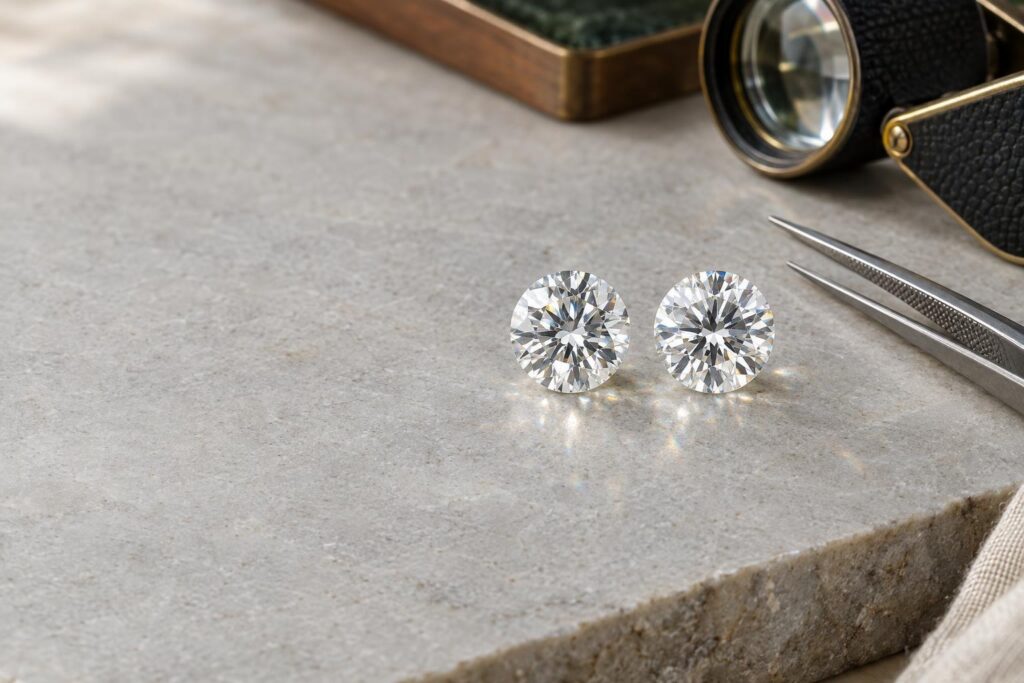
Why diamond magic sizes affect the price you see
Why would two diamonds that look almost the same have very different prices? You may have seen a 0.90 ct stone priced well below a 1.00 ct one. It’s natural to wonder if it looks smaller, or if there’s a catch you’re missing.
Carat: weight and size
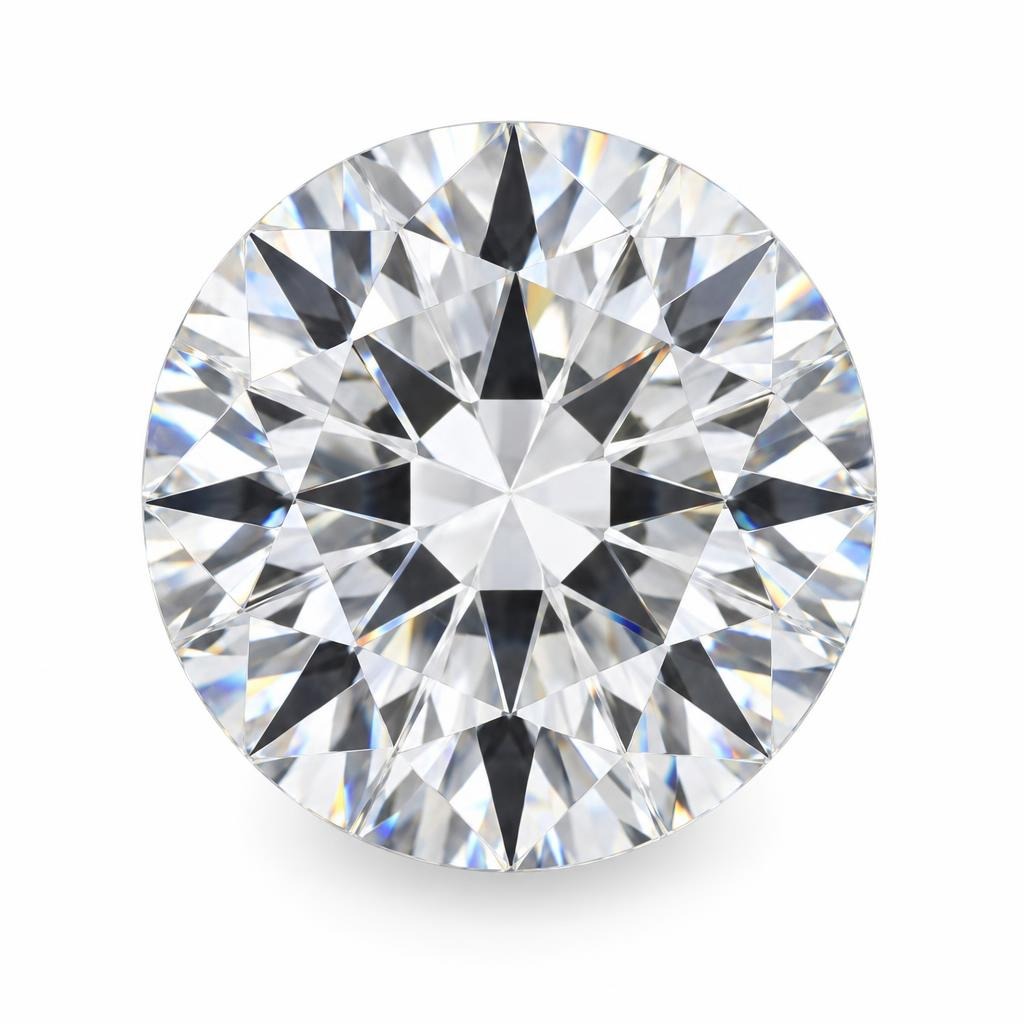
Pictures: one AI-generated illustration of a diamond, adjusted for each grade. They show how the grades differ; they are not a grading of any stone.
The short answer is a pricing effect that the diamond trade calls magic sizes. These are popular round weights, such as 0.50, 0.75 and 1.00 ct 2. At these weights, extra demand pushes the price per carat up sharply 1.
- Price per carat (the total price divided by the weight) rises sharply at magic sizes, especially at one carat 1.
- It’s hard to tell a 0.98 ct diamond from a 1.01 ct one by size 2.
- Carat measures weight, not size 4. Diamonds of the same weight can look different sizes from above 6.
- A 1 ct diamond can look smaller face-up when much of its weight is hidden in its depth 3.
- Whether the round number matters is a personal choice, and this article leaves that choice with you.
Why carat is a weight, not a size
Why start with what a carat is? Because every price step in this article is tied to it. A carat is a unit of weight: one carat is 200 milligrams (0.20 gram), split into 100 points 1. So a 0.90 ct diamond is a 90-point stone, 10 points below one carat.
How does weight relate to how big a diamond looks? Carat measures weight, not size 4. Two diamonds of the same weight can look different sizes from above, even when they are the same shape 6. There’s more on this in Diamond Carat Weight vs Visible Size.
Why prices jump at magic sizes
Why does the price leap at a round number instead of rising smoothly? Because many people want those exact weights. At boundaries that match popular weights, extra demand pushes the price per carat up sharply, and this is especially true at one carat 1.
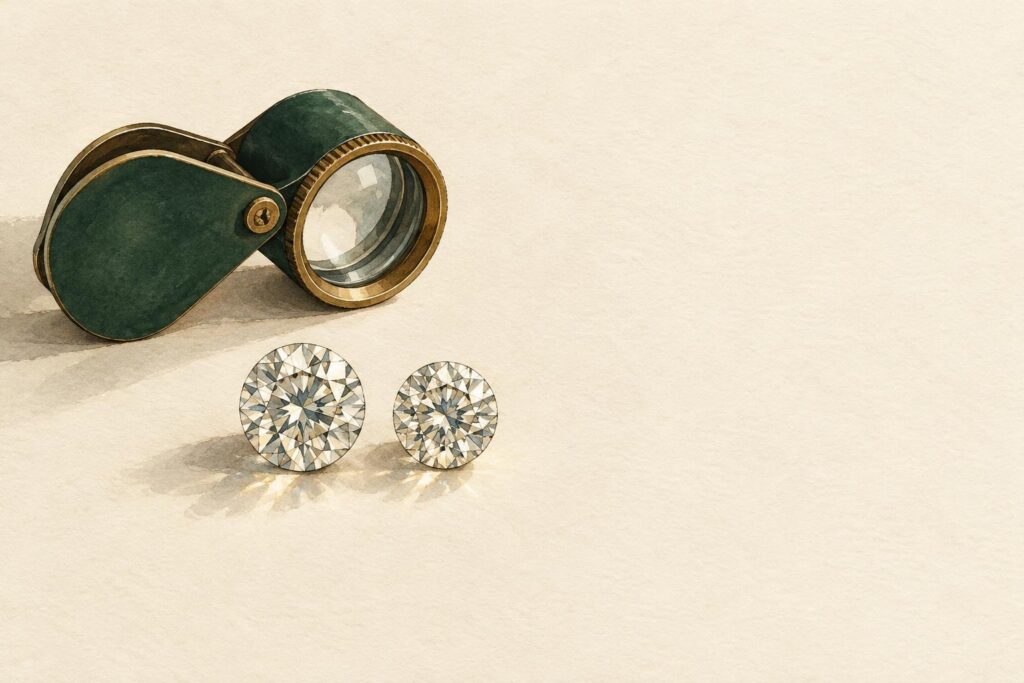
How the price step works
Which weights count as magic sizes? Examples include 0.25, 0.50, 0.75 and 1.00 ct 1, as well as 1.50 and 2.00 ct 4. Diamonds at or just above one of these weights usually cost more per carat than slightly lighter ones 2.
Why look at price per carat rather than the total? Because the magic-size effect shows up as a sharp rise in price per carat 1. To compare fairly, look at stones that also match on colour, clarity and cut, because value depends on all 4Cs 4.
Why larger diamonds cost more per carat anyway
Why are bigger stones dearer per carat, even without magic sizes? Nature produces far more diamonds under a carat than over, and larger diamonds cost more per carat 2. Carat weight also has an outsized effect on value as weight rises 6. On top of that general rise, the price per carat jumps sharply at the magic sizes themselves 1.
Why you may not see the difference on the hand
Why does this matter to you? Because the price step can be large while the change in look is small. Take a 0.96 ct and a 1.02 ct diamond: the 6-point size difference is almost impossible to see, yet the price difference is significant 1.
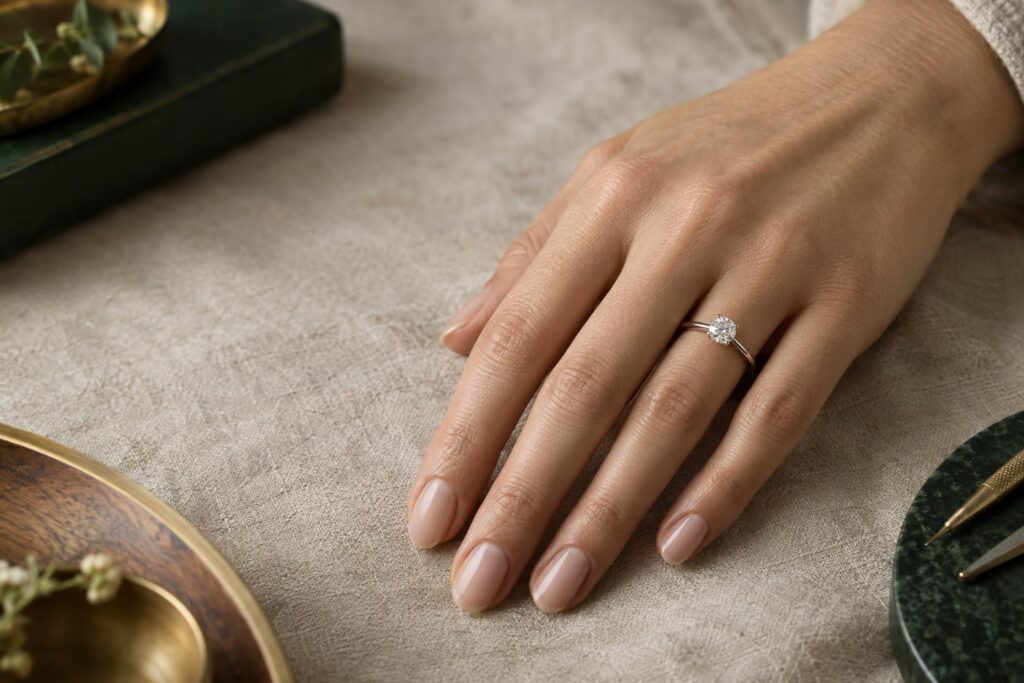
The same goes for other pairs. It’s hard to tell a 0.98 ct diamond from a 1.01 ct one by size 2. A 0.99 ct diamond is also hard to tell apart from a 1.00 ct by eye 4.
What about a 0.90 ct stone? That is a bigger gap of 10 points, and there is no general rule for how it compares. In one GIA photo of diamonds from 0.75 to 1.01 ct, the caption notes that most of the stones shown are hard to rank by size 2. That describes those stones, not every diamond, so the measurements of the two stones you are comparing are what to check.
What face-up size in millimetres tells you
Why look at millimetres? Because face-up size is how large the stone looks from above, which IGI calls its physical spread 6. Take a round brilliant, the classic round diamond with many small facets. A 1 ct stone about 6.5 to 6.6 mm across has the look of a fairly typical 1 ct diamond 3.
A 1 ct diamond only 5.7 mm across looks smaller face-up. Much of its weight is hidden in its depth, and the trade calls such stones "thick" or "heavy" 3.
Where do you find these numbers? A GIA grading report (the laboratory’s written description of a stone) gives measurements in millimetres to two decimal places. For round diamonds they read as minimum diameter – maximum diameter × depth 5. To estimate typical diameters for other weights, try the Carat to Millimetre Estimator.
Why cut decides how big a diamond looks
Why is cut the real catch in this story? Because you pay for weight whether or not you can see it. A poorly cut diamond can be too deep and hide weight below the girdle, the stone’s thin outer edge, which you can’t see once it’s set 1.
Weight can also sit in a deep pavilion, the lower half of the stone, or in a thick girdle. That can make a poorly cut 1.20 ct diamond look the same size as a well-cut 1.00 ct one. In that case, you pay for weight that gives no benefit 2.
The same happens at smaller sizes. One example is a 0.61 ct and a 0.71 ct diamond with similar diameters and face-up looks, where the extra weight sits in a thicker girdle 3. Two diamonds with the same diameter look the same size when set, even if one weighs more 2.
How do graders account for this? GIA uses a weight ratio, which compares a round diamond’s weight and diameter with a reference 1 ct stone 6.55 mm across. It is one of seven parts of the GIA cut grade, the lab’s overall rating of how well a diamond is cut 3. The cut grade also considers girdle thickness 5. For more, see Diamond Cut Explained.
Why the second decimal place on a report matters
Why check the second decimal place? Because near a magic size, a single point can move the price. GIA weighs diamonds to five decimal places. It rounds up to the next hundredth only if the thousandths digit is a 9, so 1.769 ct becomes 1.77 ct, but 1.768 ct becomes 1.76 ct 1.
So on a GIA report, a stone isn’t loosely rounded up to reach a round number. A 0.97 ct diamond is not a 1.00 ct diamond, and its price should reflect the difference. Weights should be stated to two decimal places 2. Our guide on how to read a GIA diamond grading report shows where to find the weight.
When a stone under a magic size isn’t the right choice
Why might the lighter stone not suit you? Because the saving only helps if what you give up doesn’t matter to you. If magic sizes don’t matter to you, a diamond slightly under one can save money 1. That "if" is worth thinking through.
- The number itself may matter. Some people prefer a symbolic round number, even when the size difference is hard to see 2.
- The weight is on the paperwork. GIA reports weight to the hundredth of a carat, so a 0.90 ct stone is reported as 0.90 ct 1.
- Weight is only one of the 4Cs. Two diamonds of the same weight aren’t necessarily equal, because value depends on carat, colour, clarity and cut together 4. See The 4 Cs of Diamonds.
- A lighter stone isn’t automatically a lookalike. Diamonds of the same shape and weight can look like different sizes, so check each stone’s own measurements 6.
Some buyers see carat weight as symbolic and will pay more to reach a magic size 1. Which side of that line you sit on is a personal choice. Only you know which matters more to you and the person wearing the ring.
Why a side-by-side checklist makes the comparison fair
Why use a checklist? Because a price tag shows one number, and magic sizes make that number easy to misread. Here is what to compare for stones either side of a round weight.
- The weight to two decimal places, such as 0.96 ct against 1.02 ct 2.
- For round diamonds, the measurements on each report (minimum diameter – maximum diameter × depth) and the cut grade, which takes weight relative to diameter into account 5.
- The depth and girdle, because extra weight in a thick girdle can leave two stones with similar diameters and face-up looks 3.
- The price per carat, compared between stones of similar colour, clarity and cut, since value depends on all 4Cs 4.
To see how a lighter or heavier stone fits your overall spend, the Engagement Ring Budget Planner can help. So can How to Set an Engagement Ring Budget Without Salary Rules.
If you’d like to compare stones either side of a magic size with a jeweller, Ralph Jacobs offers a free consultation. You can book online from any country at bookings.ralphjacobs.org, or visit our showroom in Secunda.
Frequently asked questions
They are popular round weights, such as 0.50, 0.75 and 1.00 ct, where the price per carat rises sharply. The step comes from extra demand for those weights, and it is especially true at one carat 1.
Not because of its weight alone. Weight is one of the 4Cs, and value depends on carat, colour, clarity and cut together 4. Check the colour, clarity and cut grades of each stone rather than judging by weight.
GIA weighs diamonds to five decimal places and rounds up to the next hundredth only when the thousandths digit is a 9 1. A stated weight of 0.99 ct means the stone is under one carat.