
Why diamond treatments matter before you buy
Why should you care whether a diamond has been treated? A treatment can change how a diamond looks and how it should be valued. It can also change how you need to look after it. Knowing which treatment a diamond has had is important for understanding both its value and its care 1.
If you have read that diamonds can be treated and now worry about buying one without knowing, that concern is fair. Laboratories such as GIA test diamonds for treatments 6. Trade standards also say a treatment must be disclosed 3. This guide explains each part, so you know what to look for and what to ask.
First, what counts as a treatment? The CIBJO Diamond Book, an international trade standard, defines a treated diamond as one altered "by ways other than normal lapidary practices" to change its appearance or durability 3. Lapidary practices are the normal cutting and polishing of a stone. So shaping and polishing a diamond is not a treatment, but filling a crack or changing its colour is.
- Treatments can change a diamond’s colour or improve its clarity. Laser drilling and HPHT are stable, but fracture filling is not permanent 1.
- GIA tests or examines diamonds for laser drilling, glass filling, surface coating, HPHT processing and irradiation 6.
- Trade standards say a seller must disclose a treatment, verbally and in writing, whether or not you ask 3.
- Ask for the laboratory report, and ask about treatments in writing.
Why are some diamonds treated at all?
Why would anyone alter a diamond? Treatments aim at two qualities: colour and clarity. Clarity describes a diamond’s inclusions, the features within the stone (some reach its surface), and its blemishes, the marks on its surface. Diamonds can be treated to enhance or remove their colour and to improve their clarity 1. To see how colour and clarity are graded, read the 4 Cs of diamonds.
How is clarity improved? There are two main ways to improve how clear a diamond looks: laser drilling and fracture filling 2. Colour is changed by other methods. HPHT, for example, uses high pressure and temperature 1.
What treatments exist? The CIBJO Diamond Book lists these:
- Coating and foiling, which add a layer to the stone’s surface or behind it.
- Fracture filling.
- Heating, also called annealing.
- HPHT, short for high pressure, high temperature.
- Laser drilling and internal laser drilling.
- Irradiation (exposing the stone to radiation), on its own or followed by annealing 3.
This guide looks closely at three of them: fracture filling, laser drilling and HPHT.
Why each treatment behaves differently
Why does it matter how each treatment works? Because fracture filling is not permanent, while laser drilling and HPHT are stable, and the treatment affects how a diamond should be cared for 1. Here is how each one works, and what it means for you.
Fracture filling: why hidden cracks can show again
Why fill a crack? A fracture or feather (a crack-like break inside the stone) can look white. Fracture filling fills feathers or white fractures with a molten substance similar to lead glass 1. The filler, typically a lead-containing glass, has a refractive index close to diamond’s, which makes fractures less visible 4. Refractive index measures how much a material bends light.
What should you know? The filling is not permanent. Steam, acid, ultrasonic cleaning and repairs can damage it, and a filler that turns dark can’t be made colourless again 1. The filler may also break down or discolour over time, especially with UV light, heat or certain chemicals 4.
Laser drilling: why a tiny tunnel can lighten a dark spot
Why drill a diamond? The aim is to lighten a dark inclusion. Laser drilling burns a channel from the surface to the inclusion, generally to turn a black inclusion white with chemical treatment 3.
How does that work? A laser bores tiny holes so a bleaching agent can reach and remove small dark inclusions. The holes are permanent. On a GIA report, they are always marked on the inclusion plot, the diagram that shows where a stone’s inclusions sit 1.
HPHT: why pressure and heat can change colour
Why change a diamond’s colour? Some diamonds have a brownish tint. HPHT is an annealing method, meaning a controlled heating process. It changes colour using high pressure and temperature in a press. It is often used to turn brownish diamonds yellow or green, and the result is stable 1.
HPHT can also make certain diamonds colourless, pink, blue, green, yellowish green or yellow. Outside a well-equipped grading laboratory, HPHT treatment is virtually undetectable 2. This is one reason a laboratory report matters when you choose a diamond for its colour.
Why a laboratory can find what your eye can’t
Why can’t you spot a treatment yourself? As diamond science advances, treatments get more sophisticated. They can be harder to detect without the advanced testing a reputable laboratory does 1. GIA tests every diamond it grades for colour treatments, even though many are not common in the market 2.
It also tests or examines diamonds for laser drilling, glass filling, surface coating, HPHT processing and irradiation 6.
How fracture filling is found
Why does finding a filling take skill? Good fracture filling is very subtle, so a skilled diamond grader needs to examine the stone 2. In GIA’s visual guide to filled diamonds, the main tool is a microscope used with various types of lighting. Every filled diamond examined for that guide had shown flash effects in a range of colours 5.
What does the grader look for? The main sign is the "flash effect": bright, rainbow-like reflections seen under magnification 4. Other signs include:
- flow lines in the filler
- trapped bubbles
- incomplete filling at the surface
- a crackled texture
- coloured filler
- cloudy filled areas 5
Signs can mislead, though. Unfilled fractures can also look iridescent (showing rainbow colours), so the viewing angle matters. A setting can also block the view of clarity features, so mounted stones need thorough testing 4.
What a laboratory report tells you
Why read the report closely? Every GIA diamond grading report lists any known treatments, and every GIA report states whether the colour is natural or treated. GIA only issues reports for stable treatments: irradiation, annealing, laser drilling and HPHT. When it finds a diamond is colour-treated, it laser-inscribes the girdle, the thin outer edge of the diamond 1.
A laser inscription on its own is not a treatment. CIBJO treats laser-inscribing as accepted practice 3. So read what the inscription says, and match it to the report. For a step-by-step guide, see how to read a GIA diamond grading report, and for how laboratories differ, see GIA vs IGI diamond reports.
Why disclosure rules protect you
Why should a seller tell you about a treatment you didn’t ask about? Under the CIBJO Diamond Book, a seller must fully disclose all material information, meaning the facts that matter to your decision. This applies whether or not you ask. It must be done verbally before the sale and in writing on commercial documents 3.
The same standard also says:
- A treated stone must be called a "treated diamond", with "treated" just as prominent as "diamond".
- Terms that hide a treatment, such as "improved", must not be used.
- Terms suggesting the treatment is part of normal cutting and polishing must not be used either.
- Any special care needs created by a treatment must be disclosed 3.
Full disclosure of treatments is crucial for consumer confidence 4. Coloured gemstones have their own disclosure questions, covered in how gemstone treatments should be disclosed.
The downsides of treated diamonds, and when one may not suit you
Why look at the downsides? A treatment is a trade-off, and only you can weigh it. Fracture filling is controversial because routine cleaning and repair may damage or remove the filling 2. Here is when each issue may matter to you:
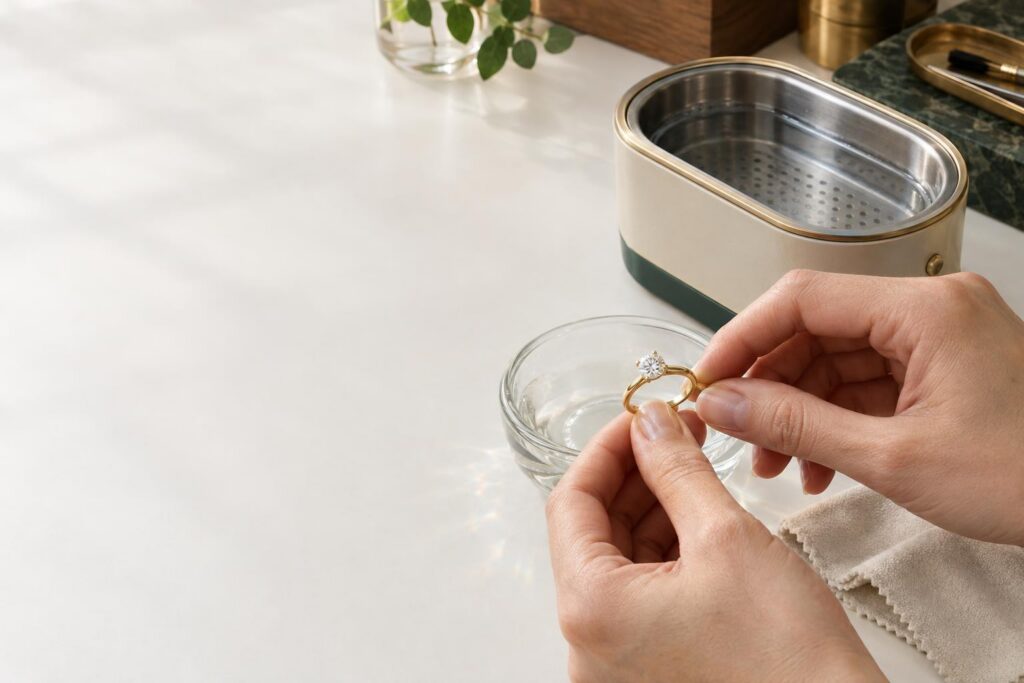
- If you want a ring that can handle ultrasonic cleaning and heat without risk to the treatment, the relevant fact is that fracture filler may break down or discolour with ultrasonic cleaning, heat, UV light or certain chemicals 4.
- If you want a GIA grading report, bear in mind that GIA only issues reports for stable treatments, and fracture filling is not on that list 1.
- If colour is what you are choosing for, HPHT is virtually undetectable outside a well-equipped grading laboratory, so laboratory testing matters 2.
What about the other side? Treatments exist to improve a diamond’s colour or clarity. Laser drilling holes are permanent, and HPHT is stable 1. When a stable treatment is clearly disclosed, the question becomes whether the look, the report and the care needs suit what you want.
Why the right questions help: what to ask a seller
Why ask, if the seller should tell you anyway? Disclosure should be made verbally before the sale and in writing on commercial documents 3. These questions help you check that it has happened:
- Has this diamond been treated in any way? If so, which treatment?
- Does it come with a laboratory report? Does the report list treatments and say whether the colour is natural or treated?
- Is the treatment stable, or is it not permanent?
- Does the treatment create any special care needs, for cleaning or repairs?
- Will the treatment be named on the invoice or other written documents?
- If the stone is set, was it tested while mounted, and could the setting hide anything?
Not every stone we sell comes with an independent laboratory report, so these questions are worth asking us too. If you would like to go through a diamond’s report together, we offer a free consultation. You can book it online at bookings.ralphjacobs.org from any country, or reach us on WhatsApp or at our showroom.
A report only helps if it belongs to the stone in front of you, so ask how the report is matched to the diamond. Keep the report and the written answers together. For the wider choice, see choosing a diamond for an engagement ring.
Frequently asked questions
Yes. The CIBJO Diamond Book calls it a "treated diamond": a diamond altered beyond normal cutting and polishing to change its appearance or durability. The word "treated" must be shown just as prominently as "diamond" 3.
It depends on the treatment. Steam, acid, ultrasonic cleaning and repairs can damage fracture filling, and a filler that turns dark can’t be made colourless again. Laser drilling holes are permanent and HPHT is stable 1. Tell your jeweller about any treatment before cleaning or repair.
GIA only issues reports for stable treatments: irradiation, annealing, laser drilling and HPHT 1. Fracture filling is not permanent and is not on that list, so ask the seller directly about it.