
Why laboratory-grown diamond resale value matters before you buy
You may be drawn to a laboratory-grown diamond, then hear that it is worth little if you ever sell it. That can feel worrying before a big purchase. Why does this happen, and should it change your decision? Knowing the reasons helps you decide on facts, not on a rumour.
Why would a stone made of diamond sell for less second-hand? The short answer lies in how it is made and who will buy it back. Natural, lab-grown and treated diamonds ‘differ greatly in commercial value’. 1 The secondary market for lab-grown diamonds, where used stones are resold, is a small one. 5
- Lab-grown diamonds have essentially the same chemical, physical and optical properties as natural ones, yet most sizes grow in less than a month. 2
- Many companies that buy diamonds from the public have taken only natural stones, and some trade-in schemes leave lab-grown stones out. 5
- Rapaport Magazine reported that no auction houses had offered lab-grown diamonds in their sales. 6
- The choice between natural and lab-grown is a personal one for each buyer. 3
Why a lab-grown diamond is still diamond
Why start with what a lab-grown diamond is? Because a low resale price can sound like a sign of a fake. Lab-grown diamonds have ‘essentially the same chemical, physical and optical properties’ as natural ones. 2
They are not imitations either. A simulant is a different material that only looks like diamond, such as cubic zirconia or moissanite. A lab-grown diamond is diamond, made in a factory rather than formed in the earth. 1
Shared properties don’t make every stone equal, though. Growers have been working to produce lab-grown diamonds with better colour and clarity, so these qualities vary from stone to stone. 1 The 4 Cs of diamonds explains how each grade changes a diamond.
The two are so alike that standard gem tests and older diamond testers can’t reliably tell them apart. A gem laboratory or advanced instruments can. 2 Correct identification matters for valuation and for telling buyers what they’re getting. 1 You can learn more in How to read a GIA diamond grading report.
Why the way a diamond is made affects resale
Why does it matter how a diamond comes into being? Because it shapes how many stones exist and how quickly more can be made. Here is how the two kinds compare.
How natural diamonds formed
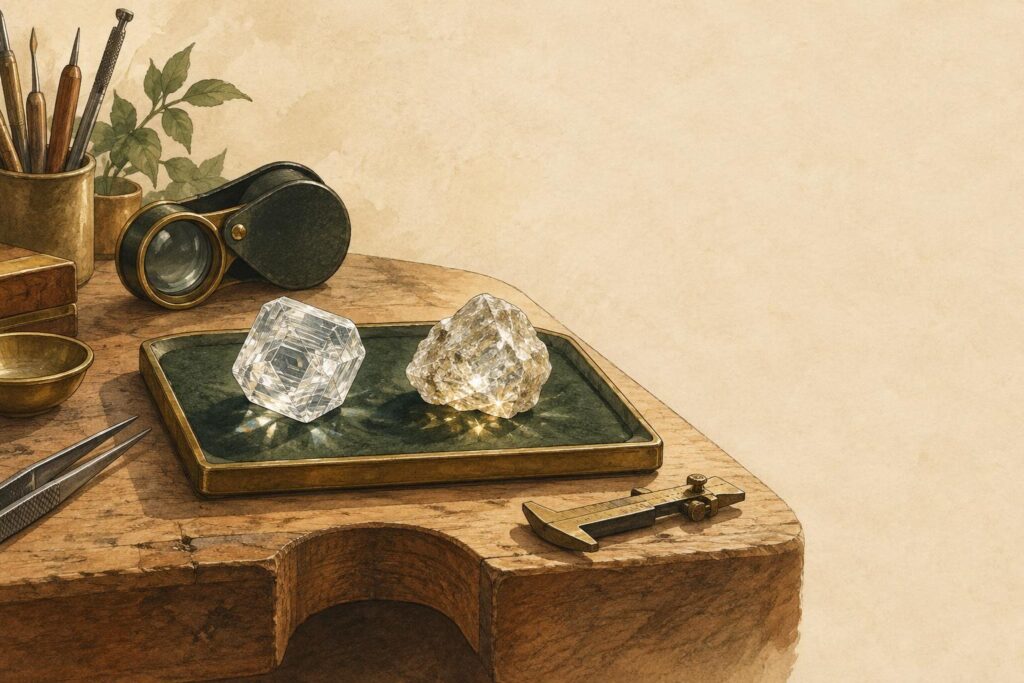
Natural diamonds formed deep in the earth, some as long as three billion years ago. They are mined from rock deposits called kimberlite pipes. Only about five percent of these pipes hold enough diamond to be worth mining. 2
How lab-grown diamonds are made
Lab-grown diamonds come from one of two methods. HPHT (high pressure, high temperature) copies the heat and pressure deep in the earth. CVD (chemical vapour deposition) grows diamond from carbon-rich gas onto a small diamond ‘seed’ inside a vacuum chamber, and several crystals can grow at once. 1
Either way, growing a diamond ‘typically requires less than a month for most sizes.’ 2 For how the methods differ, see CVD vs HPHT lab-grown diamonds.
Why production scale and pricing weigh on resale
Why does the scale of production matter? Let’s look at the evidence. A summer 2024 GIA update found that the quantity, size and quality of lab-grown diamonds had risen significantly, so they could be sold on a larger scale. The seed material that once limited production had also become far easier to get. 4
Most in the trade expected lab-grown prices to fall. The reasons given were that technology tends to get cheaper over time, and that lab-grown production ‘isn’t limited by nature’. 5 New methods may also bring production costs down. 3
The same 2024 GIA update found relatively few changes in lab-grown diamonds over the five years before the study. It described the technology as largely stable at the time of the study. 4 That finding describes the stones themselves, not their price, and none of these sources gives a firm forecast.
Pricing adds another layer. Russell Shor said lab-grown stones are ‘often priced relative to natural diamonds, rather than priced in a way that reflects a true market for synthetics.’ 3 In other words, shop prices for lab-grown stones have often been set with natural diamond prices in mind.
Why there are fewer buyers for second-hand lab-grown diamonds
Why does the number of buyers matter? Because you can only sell a diamond to someone willing to buy it. A secondary market for lab-grown diamonds exists, but it is small. 5 A secondary market is simply the market for reselling used pieces.
Trade reporting has found these patterns:
- Many major companies that buy diamonds from the public only bought natural stones.
- Some bought lab-grown stones only at steep discounts, or only above a minimum size.
- Some sellers left lab-grown stones out of trade-in and upgrade schemes, where the value of an old piece goes towards a different one.
- Dealers ‘only buy what we are willing to sell’, and less attractive stones are harder to sell. 5
Auction houses tell a similar story. Rapaport Magazine reported that no auction houses, not even smaller ones, had offered lab-grown diamonds in their sales. 6
Why not? Sotheby’s head of jewellery said auctions look for the rarest things and the strongest provenance, meaning a documented history of a piece. In his view, lab-grown diamonds lack the ‘value’, ‘rarity’ and ‘uniqueness’ that auctions look for. Heritage Auctions added that lab-grown stones are so easy to buy at retail that it’s hard to see how an auction house could profit from them. Experts said a lab-grown piece at auction would sell on the designer’s name, ‘not because of the component value of the diamond.’ 6
Why natural diamonds don’t hold full value either
Why compare with natural diamonds? Because many people say natural diamonds ‘hold their value’, and you may be weighing the two side by side. This view sits alongside how natural diamonds are often described: a GIA instructor called a natural diamond ‘really a rarity and a treasure from Earth.’ 3
The resale facts are more mixed. Most people don’t get full retail value back for natural diamonds either. One seller called diamonds a luxury purchase, not ‘a good place to park your money.’ 5
So both kinds of diamond usually resell for less than their shop price, and lab-grown stones face a smaller pool of buyers. For a wider side-by-side view, see Natural vs lab-grown diamonds: a clear comparison.
The downsides: when lab-grown resale value may matter to you
Why look at the downsides? Because a fair decision needs both sides, and resale is one of the trade-offs with lab-grown diamonds. These facts are the relevant ones if any of the situations below apply to you:
- If you expect you may sell the diamond one day: some buyers have taken lab-grown stones only at steep discounts or above a minimum size.
- If you hope to trade it in or upgrade it later: some sellers have excluded lab-grown stones from these schemes.
- If you think of jewellery as a way to hold money: one seller described diamonds in general as a luxury purchase, not a place to park money. 5
If part of the appeal for you is a stone formed in nature, natural diamonds formed deep in the earth, some as long as three billion years ago. 2
There is also uncertainty. No one knows whether lab-grown diamonds will stay popular in the long term. 3
When resale value may matter less
Why might resale matter less to some buyers? Because a resale price only comes into play if you sell. If you plan to keep and wear the ring, you may give more weight to other things, such as how the stone looks and what you spend at the start.
Younger shoppers may think the saving at purchase is worth a possible loss later. 5 In one GIA instructor’s view, lab-grown diamonds have a place in the market as long as buyers know exactly what they are buying. In the end, the choice is a personal one for each buyer. 3
If budget is part of your thinking, the Engagement ring budget planner can help you plan the whole ring, not only the stone.
What to check and ask before you buy
Why prepare a few questions? Because the facts you gather at the start help you understand your options later. These are worth checking with any seller:
- Ask for an independent laboratory report that identifies the stone as natural or lab-grown, since only a gem lab or advanced instruments can reliably tell them apart. 2
- Ask whether the seller includes lab-grown stones in any trade-in or upgrade scheme.
- Ask how the seller prices lab-grown stones compared with natural ones.
- Think honestly about how likely you are to sell, and weigh resale value to match.
To understand what a laboratory report shows, see GIA vs IGI diamond reports.
At Ralph Jacobs, we design and make rings with natural or laboratory-grown diamonds. If you would like to talk through the two, we offer a free consultation, online from any country at bookings.ralphjacobs.org, or in our showroom.
Frequently asked questions
Yes, but there are fewer buyers. A secondary market exists, but it is small. Many companies that buy from the public have only taken natural stones, and some take lab-grown stones only at steep discounts or above a minimum size. 5
Looks and material properties are only part of the story. The secondary market for lab-grown diamonds is small, and dealers say they ‘only buy what we are willing to sell’. 5
Usually not. Most people don’t get full retail value back for natural diamonds either. One seller described diamonds as a luxury purchase, not ‘a good place to park your money.’ 5
Auctions look for rarity and strong provenance. Sotheby’s head of jewellery said lab-grown stones don’t fit, and Heritage Auctions said they are so easy to buy at retail that it’s hard to see how an auction could profit. 6