
Why you may not get back what you paid
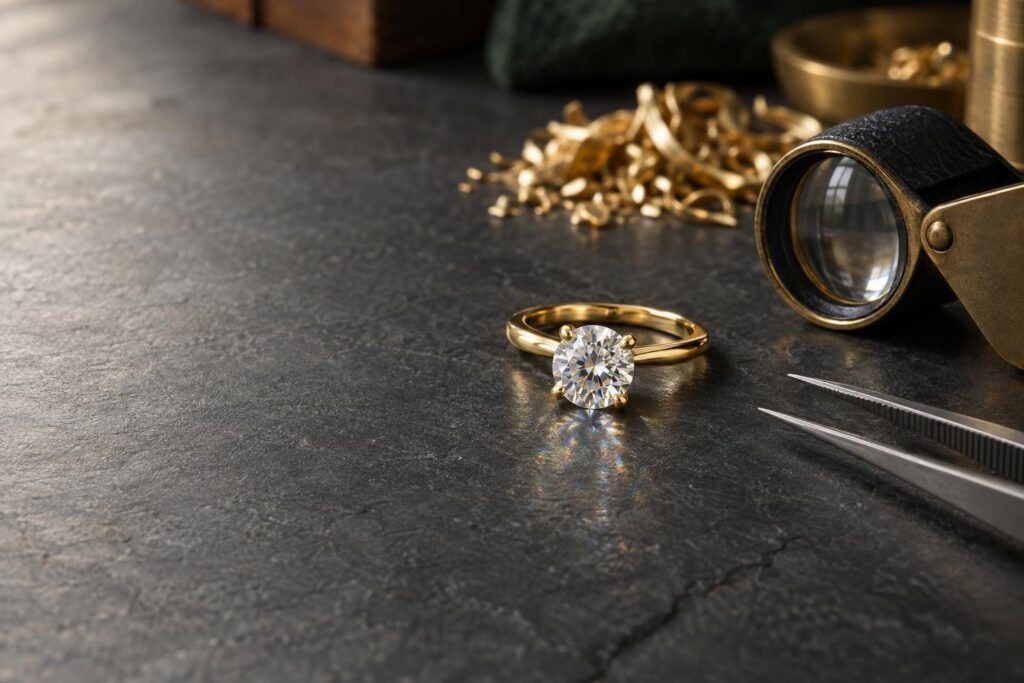
If you bought your ring in a shop, it can feel fair to expect something close to that price back. Then the first offer arrives, and it may be lower. A lower offer, on its own, does not mean anything was wrong with your ring. Most buyers don’t get full retail value for trade-ins, and that is true of natural diamonds too 6.
Knowing why offers work this way helps you judge one calmly. This article explains how jewellers buy stock, how the metal in a ring is valued, and why a grading report matters.
It also covers why natural diamonds and laboratory-grown diamonds behave differently when you sell. It ends with questions you can ask any buyer.
Why a jeweller pays less than the shop price
Why would a jeweller offer less than your ring cost new? The answer lies in how jewellers usually buy their stock. The retail price is what you pay in a shop. The wholesale price is what a jeweller pays a supplier for the same kind of item.
When jewellers buy from a wholesaler, they buy only when they need an item and can often pay in several instalments. Buying from a private seller is different. They pay up front for a piece that may sit in their stock for some time. Most jewellers will offer less than wholesale value 1.
Why the value when you sell an engagement ring starts with an appraisal
Why get an expert opinion before you accept an offer? Get a fair market value appraisal before selling. This is the appraiser’s opinion of what a willing buyer would pay a willing seller 1.
How does an appraiser reach that figure? They look at the quality of the stone or piece, how easy it is to find on the market, and how much local demand there is for it. For a stone set in jewellery, fashion can also affect the price.
What does that mean for you? Because demand and fashion feed into an appraisal, a ring in a less popular style may be valued lower, even if its stone is of good quality. A fair market value is about what a willing buyer will pay, which is a different question from what you paid 1.
Why the metal’s weight and purity matter
Why do buyers ask what your ring is made of and how much it weighs? It is worth asking whether the precious metal from an old mounting can be traded towards a new mounting 1. The mounting is the metal part of a ring that holds the stone.
How is gold content described? Gold’s weight is measured in troy ounces, while its purity is measured in carats. Here, 24 carat means pure gold, and lower caratages contain less gold. For example, 18ct (18K) gold is 75 per cent gold and 25 per cent other metals 2. This gold carat is not the same as the carat used to weigh diamonds.
Fineness is another way of stating gold content, in parts per thousand, stamped without the decimal point. Most 14 carat jewellery is stamped 585. The other metals in an alloy add durability and can change the colour, but they are not gold 2. You can read more in What 375, 585 and 750 gold marks mean.
What does this mean for your ring? The gold it holds depends on the weight of the metal itself, not counting any stones, and on its caratage. Two pieces of gold metal of the same weight but different caratages hold different amounts of gold, because lower caratages contain less gold 2. For more on caratage, see 9ct vs 14ct vs 18ct gold.
Why natural and lab-grown diamonds differ on resale
Why might a buyer treat two diamonds that look alike so differently? Part of the answer is how the stones can be told apart, and part is how supply and the resale market work. A laboratory-grown diamond has the same crystal structure as a natural diamond and nearly the same chemical, optical and physical properties. By eye, the two can be indistinguishable, but experienced labs can tell them apart with advanced instruments 4.
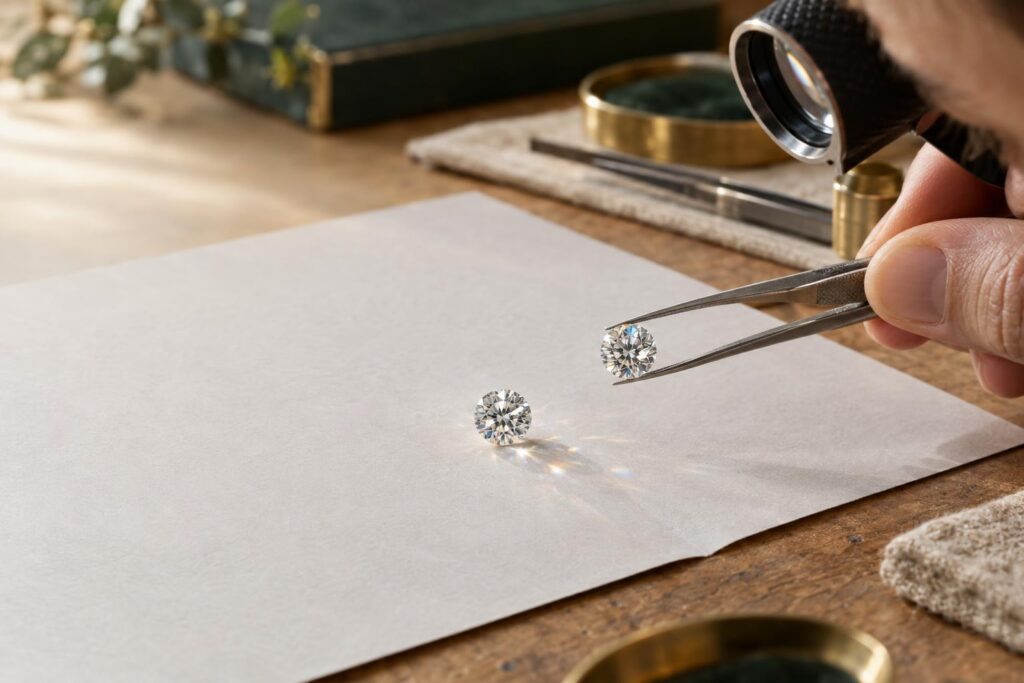
How does supply come into it? Natural diamonds formed millions to billions of years ago, while lab-grown diamonds are young. Lab-grown diamonds are also available at a lower price point 4. Lab-grown production isn’t limited by nature 6.
What does this mean when you sell? A secondary market, where people buy and sell used stones, does exist for lab-grown diamonds, but it is small. Trade-in and upgrade policies for lab-grown stones often differ from those for natural diamonds, and some sellers exclude them 6.
Grading works differently too. The great majority of lab-grown diamonds coming onto the market fall into a very narrow range of colour and clarity. GIA grades their quality in broad terms, "premium" or "standard", rather than the scales it uses for natural diamonds 5. For a full side-by-side, see Natural vs lab-grown diamonds: a clear comparison.
Why a grading report can help when you sell
Why does paperwork matter for a stone you can see and hold? By eye, a natural and a lab-grown diamond can be indistinguishable, and every GIA report tests the stone to confirm it is a diamond 4.
How does a report describe a stone? Independent documents exist that verify a diamond’s quality and identify it. A GIA Diamond Grading Report analyses quality based on colour, cut, clarity and carat weight. It includes a plotting diagram, a map of the stone’s own inclusions, which are tiny features inside the stone 3.
The report number can be micro-laser inscribed on the girdle, the thin outer edge of the diamond. The number is permanently registered in GIA’s database, which gives the owner added security. GIA grades only unmounted diamonds and isn’t affiliated with any commercial business 3.
What can you do with this? If your stone came with a report, keep it with the ring. To understand what each part says, see How to read a GIA diamond grading report and GIA vs IGI diamond reports.
The downsides of each way to sell
Why compare your options before you choose one? Each route works differently, and the facts below may weigh differently for you. It also helps to know how the trade sees diamonds: the trade press calls a diamond a luxury purchase, not a place to park money 6.
Selling for cash to a jeweller
Why might a cash offer feel low? Most jewellers will offer less than wholesale value, because they pay up front for a piece that may sit in stock for some time 1. That is the main downside of a cash sale.
Trading in
Why might a trade-in offer look higher? A trade-in often gets you more as credit towards a new piece than as cash 1. The downside is that the value comes as credit towards a new piece, so it suits you only if you plan to buy one. Ask how the credit can be used.
If your stone is lab-grown, ask first whether the seller accepts it, because some exclude lab-grown diamonds from trade-ins 6.
Consignment
Why might consignment work differently? The jeweller offers your piece for sale on your behalf. You are usually paid only once it sells, and the jeweller normally keeps a percentage as commission 1. The downside is that payment depends on the piece selling, so ask about the commission before you agree.
Keeping the stone for a new ring
Why consider reusing the stone? If you keep the stone and set it in a new ring, you don’t sell it at all. You can still ask whether the precious metal from the old mounting can be traded towards a new mounting 1. The downside is that this route releases no money for the stone.
What to ask any buyer before you agree
Why ask questions before you agree? Each question below links back to a factor covered in this article, so you can see what an offer is based on.
- Is this offer for cash, or for credit towards a new piece?
- What weight and caratage did you use to value the metal?
- How did you value the stone, and did you look at its grading report?
- Do you accept lab-grown diamonds, and on what terms?
- If you offer consignment, what commission do you keep, and when would I be paid?
- Can the metal from my old mounting go towards a new mounting? 1
If you are planning a new ring and would like to set a stone you already own, we offer a free consultation. You can book it online at bookings.ralphjacobs.org from any country, or contact us on WhatsApp.
Frequently asked questions
When jewellers buy from a wholesaler, they buy only when they need an item and can often pay in instalments. Buying from you means paying up front for a piece that may sit in stock for some time 1.
A secondary market for lab-grown diamonds exists, but it is small. Trade-in and upgrade policies for lab-grown stones often differ from those for natural diamonds, and some sellers exclude them 6. Ask each buyer first.
A trade-in often gets you more as credit towards a new piece than as cash 1. Whether credit suits you depends on whether you plan to buy a new piece from that seller.
Gold’s weight is measured in troy ounces and its purity in carats. Lower caratages contain less gold: 18ct gold is 75 per cent gold 2. So the amount of gold depends on both the weight of the metal, not counting stones, and its caratage.
A report is an independent document that verifies a diamond’s quality and identifies it. GIA grades only unmounted diamonds, so keep any report you already have with the ring 3.