
Why knowing what slows a custom ring helps you plan
You may have a date in mind: a proposal, a wedding or a birthday. If the ring isn’t ready, that plan is at risk. So it helps to know why a custom ring takes time, and what can make it take longer.
This guide follows one route a made-to-order ring can take. Much jewellery is designed with computer software, and the design is then turned into a model that can be cast in metal. 1 Not every ring is made this way, but this route shows clearly where the time goes.
This guide doesn’t give a fixed number of days. Instead, it shows what happens at each stage and what can stretch it. Some stages have to go slowly. During burnout, for example, the temperature must rise gradually, or the wax boils and damages the surface. 3
- Design and approval
- Choosing the stone
- Casting the metal
- Setting the stone
- Quality checks
Why the design stage is where changes are easy
Why start with design? Because changes are easy at this stage. Much jewellery is designed with CAD, short for computer-aided design software. CAD makes trial and error easy, and it creates a render, a photo-like image that shows what the finished piece will look like before it is made. 1
What makes this stage harder for some rings? The more complex a piece is, the harder it is to design. Designers also need engineering skills, such as knowing how strong prongs (the small metal claws that grip a stone) must be to hold it. 1
If you are still deciding on a style, the guides to ring settings and the custom jewellery process can help before you start.
Why the stone you choose matters to the setting
Why does the stone matter so early? The seat cut into each prong must fit the stone’s shape exactly, because any gap lets the stone move or loosen. 4 So it is worth asking your jeweller when they need your stone confirmed.
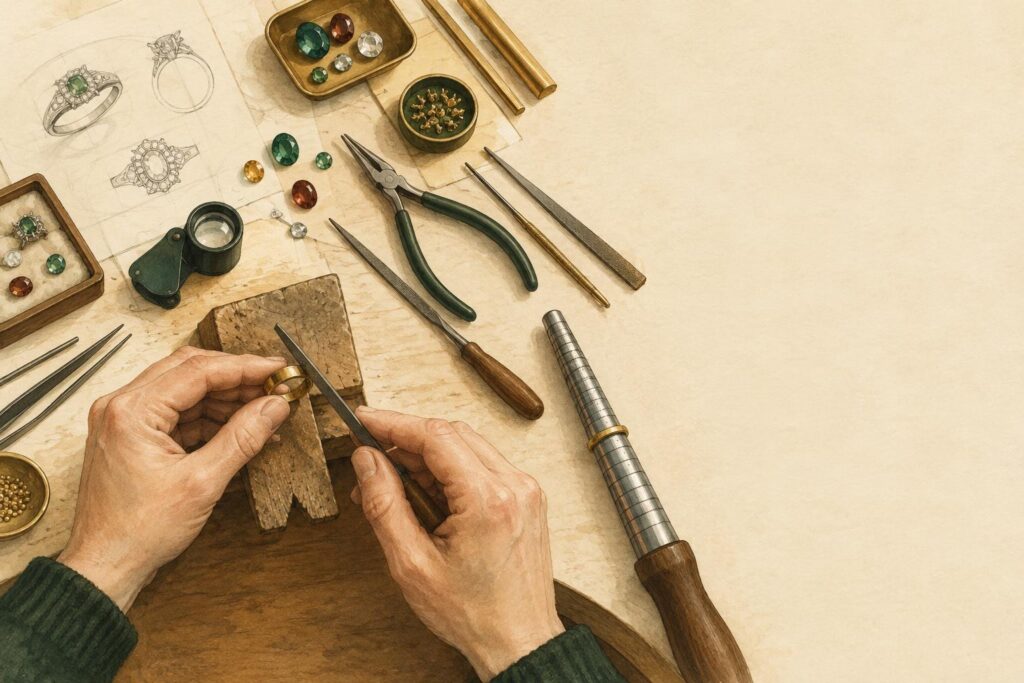
How do you choose a stone? Knowing your preferred cut and shape helps the jeweller choose suitable styles. It also helps to look at each diamond in different lighting before choosing. You can ask the jeweller for a GIA grading report, or ask to see only GIA-graded diamonds. 6
To understand reports before you choose, see how to read a GIA diamond grading report and GIA vs IGI diamond reports.
Why casting has waiting built in
Why does turning a design into metal take so long? In investment casting, a model of the ring is covered in a heat-proof material, the model is burned out, and metal is poured into the hollow it leaves. Along the way, materials must set, heat and cool. 2
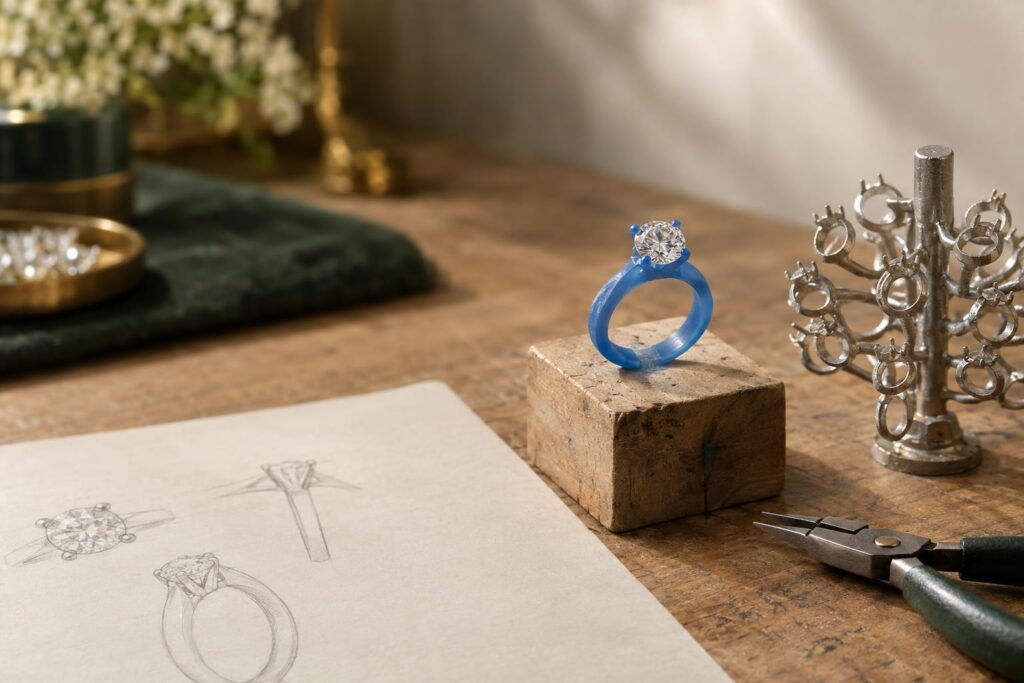
How the model is made
Why is a model needed? The mould takes its shape from it. A 3D printer can make a resin model from the CAD design that can be easily cast. The traditional method uses a wax model instead. 1
The models are then joined to a sprue tree, the channels that carry molten metal into the mould. 2
How investment casting works
Why does the mould need time? The model is covered in investment, a heat-proof casting material that has to dry and harden. One manufacturer’s guide says the investment should be left to set in a vibration-free place before the next step. After the metal is poured, the mould is quenched (cooled quickly) in water, and the investment is washed away. 2
Why burnout can’t be hurried
Why does the oven stage take so long? Burnout removes the wax and also cures the investment, so it can survive the heat shock of molten metal. The temperature must rise gradually. If it rises too fast, the wax boils and damages the surface. 3
The flask, the container that holds the mould, stays at top temperature until the investment is chalky white. If it is grey, it goes back in the oven. It must then cool to casting temperature and be held there before the metal is poured. A poor burnout can cause rough surfaces, discoloured metal or gaps where metal didn’t fill the mould. 3
How long burnout takes is not fixed. The cycle depends on the size and number of flasks in the oven. 3 One manufacturer’s guide adds that the schedule changes with the investment and how much printed material there is. Much shorter burnouts only work for lightweight designs and stronger investment materials. 2
Why setting the stone needs care
Why does setting take careful work? This is where a stone is either held securely or put at risk. Stones work loose, get damaged or are lost because of poor workmanship or a lack of setting standards. 4
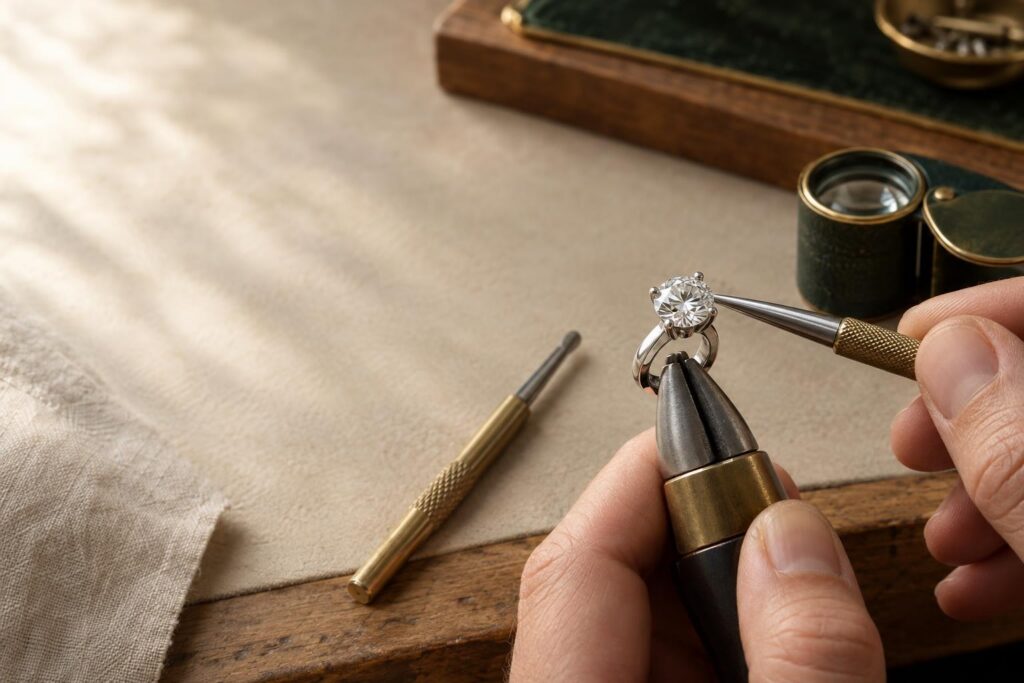
How is it done? A seat, a small groove, is cut into each prong, and it must match the stone’s shape exactly. Prongs should also be rounded, polished and even in size and shape. 4
If you are comparing claw styles, see four claws vs six claws.
Why quality checks are part of the process
Why check a ring that already looks finished? Because some faults put the stone at risk. Poorly cut stone seats and prongs that don’t fully touch the stone create a high risk of losing it. 5
The workshop route of a custom ring
Step through each stage of one common route for a made-to-order ring, from the first design to the final checks, and see where time goes.
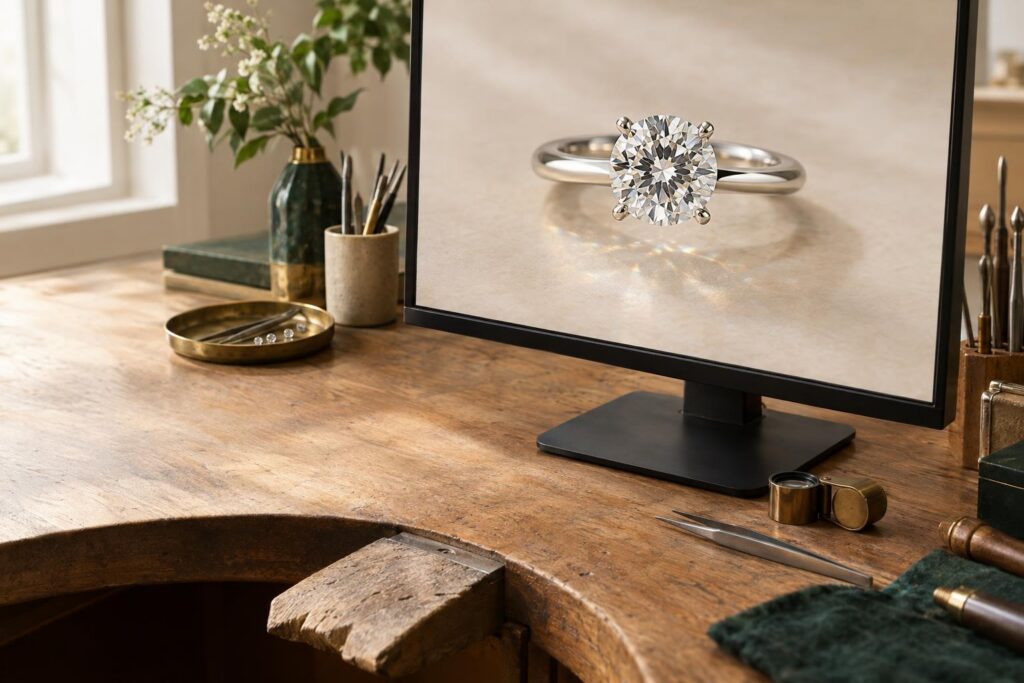
- Design in CAD
- Much jewellery is designed with CAD, computer-aided design software. It makes trial and error easy and creates a render, a photo-like image of the finished piece. Changes are easy at this stage. Designers also need engineering skills, such as knowing how strong prongs must be to hold a stone.
- Choosing the stone
- The seat cut into each prong must fit the stone's shape exactly, because any gap lets the stone move or loosen. So the jeweller needs your stone confirmed early. Looking at each diamond in different lighting helps before you choose.
- Making the model
- The mould takes its shape from a model of the ring. A 3D printer can make a resin model from the CAD design that casts easily, and the traditional method uses a wax model. The models are then joined to a sprue tree, the channels that carry molten metal into the mould.
- Investment and burnout
- The model is covered in investment, a heat-proof material, which has to set. Then the model is burned out. The temperature must rise gradually, or the wax boils and damages the surface. Burnout schedules change with the flask size and the design, and a flask that comes out grey goes back in the oven.
- Pouring the metal
- After burnout, metal is poured into the hollow the model leaves behind. Along the way, materials must set, heat and cool, so casting has waiting built in.
- Setting the stone
- A seat, a small groove, is cut into each prong and must match the stone's shape exactly. Prongs should also be rounded, polished and even in size and shape. Poor workmanship is why stones work loose, get damaged or are lost.
- Quality checks
- Some faults put the stone at risk, such as poorly cut seats and prongs that don't fully touch the stone. Checking each piece against benchmarks lets the jeweller fix problems before it is sold. The checks cover prong height and thickness, alloy strength and surface porosity, meaning tiny holes.
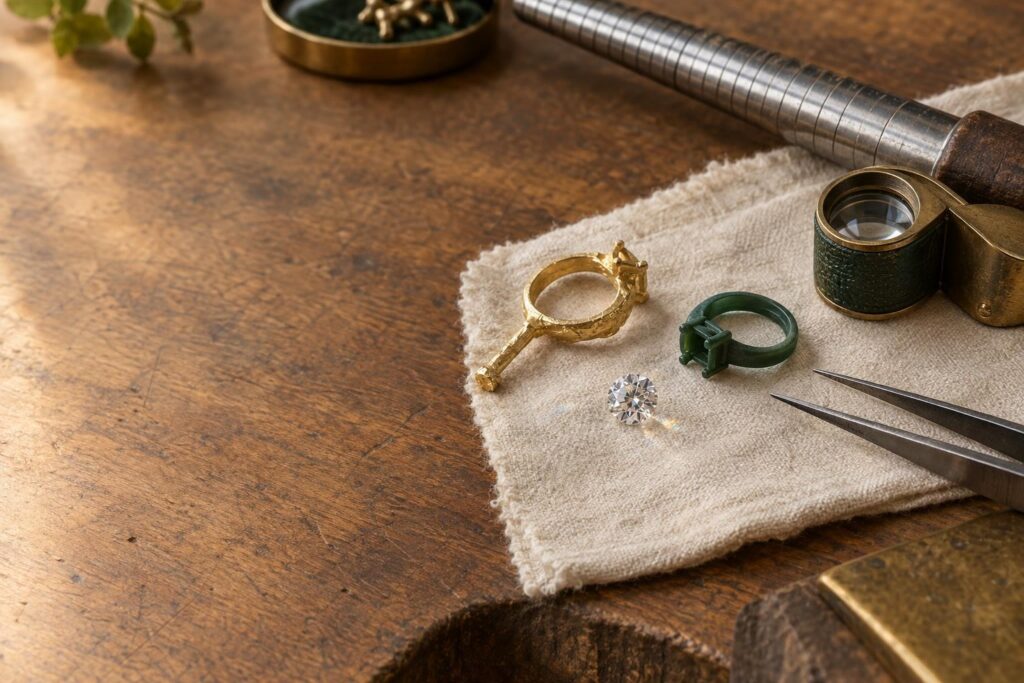
The pictures show one common route, using CAD and casting. Not every ring is made this way, and real workshops vary in how they carry out each stage. Pictures: AI-generated illustrations, checked for accuracy. They are not photographs of a real piece.
How is a ring checked? Benchmarks are set measures for judging whether a finished piece is acceptable. Checking each piece against them lets the jeweller fix problems before it is sold. 4
What do the checks look at? GIA’s Quality Assurance Benchmarks are criteria for judging jewellery workmanship. They include points such as these.
- Whether each prong is the right height and thickness to hold the stone.
- Whether the metal alloy (the mix of metals) is strong enough for a ring.
- Surface porosity, meaning tiny holes in the metal, which is likely a sign of the condition of the whole piece. 5
What about faults from casting? Defects such as pitted or rough surfaces can come from the burnout or the investment. One manufacturer’s guide lists a slower heating rate or a longer set time among the fixes for the casting process. 2
When a made-to-order ring isn’t the right choice
Why look at the downsides? If your date can’t move, it helps to know where the process has limits. Casting has waiting built in: the investment has to set before metal goes in, and burnout schedules change with the flask size and the design. 2
Rushing is not a safe shortcut. If the burnout temperature rises too fast, the wax boils and damages the surface. A flask that comes out grey goes back in the oven. 3
A render is a picture, not the ring itself. It is photo-like, but it is made on a computer before the ring exists. 1 It is also worth asking your jeweller what happens if you want a change after a model is printed or metal is cast.
What are the alternatives? Some people buy an unset diamond and have a setting made later, with their partner’s input. 6 Which route suits you depends on how fixed your date is and how much the design matters to you. The guide to buying a ring as a surprise vs choosing together covers that choice.
How to plan a custom ring around your date
Why plan backwards from your date? Your date doesn’t move, and some workshop stages have to go at their own pace. During burnout, for example, the temperature must rise gradually. 3 Starting from the date gives you one clear question for your jeweller: can the ring be ready by then?
- Start early. See when to start buying an engagement ring and the proposal planning timeline.
- Check the ring size before the design is approved. Compare size systems with the Ring Size Converter, or see how to find a ring size secretly.
- Settle the shape and setting style, with help from choosing a diamond shape and how to choose an engagement ring setting.
- Make your design changes at the CAD stage, where changes to a design are easy to make. 1
- Ask for the lead time in writing in your quote, and ask what happens if a quality check finds something to fix.
If you would like to talk through your date with us, we offer a free consultation, online from any country at bookings.ralphjacobs.org, by WhatsApp or at our showroom. Before we start a made-to-order piece, you approve the design, stone, size and engraving in writing. Our renders are a visual guide, not an exact photo, and the lead time in your quote is the one that applies.
Frequently asked questions
The work covers design, choosing the stone, casting, setting and checks, and each can take longer for some rings. Casting alone has waiting built in, because the investment has to set before metal goes in. 2 Ask your jeweller how long your ring will take, and get the lead time in writing before work starts.
Some stages have to go slowly. During burnout, the temperature must rise gradually, because wax that heats too fast boils and damages the surface. A poor burnout can leave rough or discoloured metal. 3
CAD makes trial and error easy, and changes to a design are easy to make. It also shows a photo-like image of the piece before it is made. 1 Ask your jeweller what happens if you want a change after a model is printed or metal is cast.
Some people buy an unset diamond and have a setting made later, with their partner’s input. 6 Whether that suits you depends on your date and how much the finished design matters to you.