Why onyx has stayed a classic black stone
Why should you know what onyx really is before you choose one? The name covers more than one look, and the black you see is often added by treatment. Most black chalcedony is treated, yet it is usually sold simply as black onyx 3.
Why does onyx feel so classic? Its stone family has a very long history. Chalcedony is quartz made of crystals too small to see with the naked eye, and these forms of quartz have fascinated people since ancient times 2.
Why do cutters know it so well? An opaque gem is one that light cannot pass through. As a variety of quartz, black onyx is probably the durable black opaque gem that gem cutters know best 1.
How is onyx defined? Gem references place it as a variety of agate, which is a variety of chalcedony, which is in turn a variety of quartz. The name onyx comes from the Greek word for "fingernail" 6.
Why the name onyx can mean two different looks
Why does one onyx look striped and another solid black? By strict definition, onyx has straight, parallel black and white stripes, and wavy or irregular bands make a stone agate 3. Classic layered onyx, with a black base and a white top layer, is also called "true onyx" 6.
What the name onyx can look like
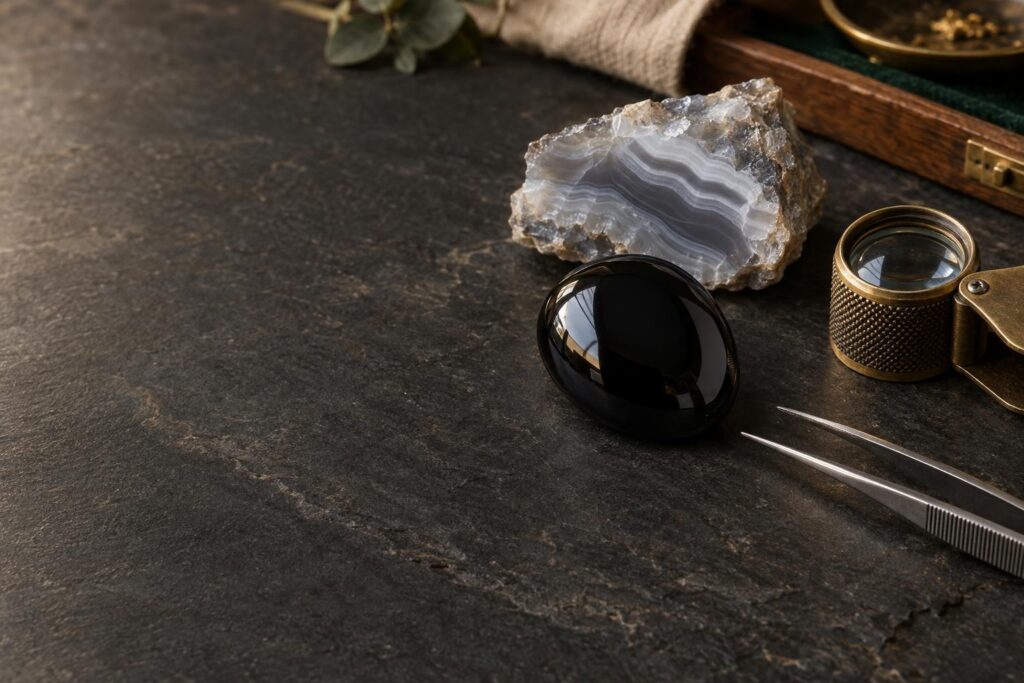
The name onyx covers more than one look. Switch between the stones to see how banded onyx, agate and solid black chalcedony differ.

- Layered true onyx
- By strict definition, onyx has straight, parallel black and white stripes. Classic layered onyx, with a black base and a white top layer, is also called true onyx.
- Wavy-banded agate
- Wavy or irregular bands make a stone agate rather than onyx. Agate is porous, so it is easy to colour, and agates used as gems are often dyed.
- Solid black chalcedony
- The name onyx is also used for chalcedony of a single colour. A completely black stone should properly be called black chalcedony, but it is usually sold as black onyx.
- Black onyx cabochon
- A cabochon is a smooth, domed stone with no facets. In a black onyx cabochon, banding may show only on a very thin edge.
The pictures show typical examples. Real stones vary in banding and in how even the black is. Pictures: AI-generated illustrations, checked for accuracy. They are not photographs of a real piece.
How did a solid black stone get the same name? The name onyx is also sometimes used for chalcedony of a single colour, such as black onyx 6. Pure black chalcedony is rare. A completely black stone should properly be called black chalcedony, but it is usually sold as black onyx 3.
What can a cut stone reveal? A cabochon is a smooth, domed stone with no facets. In a black onyx cabochon, banding may show only on a very thin edge under strong light, because the stone may have been a banded agate before it was treated black 1.
Why most black onyx is dyed, and why that matters
Why does treatment matter for a black stone? Because the even black you see is usually not the stone’s natural colour. Most black chalcedony is treated and should technically be called "dyed" or "enhanced" black chalcedony 3. One gem database assumes that black chalcedony sold as onyx is dyed 6, and a GIA study lists black onyx as "dyed chalcedony" 1.
How is it coloured? Agate is porous: it has tiny spaces that soak up liquid. That makes it easy to colour, and agates used as gems are often dyed 2.
What is the traditional method? Stones are soaked in sugar, then heated in sulfuric acid, which turns the sugar into black carbon. This method probably dates back to Roman times, and the colour it gives is permanent. Organic dyes are also used, and those colours may fade in direct sunlight 3.
What does this mean for you? Since the trade guidance above says these stones should be described as dyed or enhanced, you can ask how a stone was coloured. Learn more in how gemstone treatments should be disclosed.
Why onyx wears well, and where it needs care
Why think about wear before choosing a black stone? Polished black onyx scratches fairly easily and the scratches show. That is why most onyx carvings have a matte, or non-shiny, finish 3.
How hard is it? The Mohs scale ranks how well a material resists scratching, from 1 to 10. One gem database gives onyx a range of 6.5–7 6. Another source gives a hardness of 7 and fairly good toughness, which is a stone’s resistance to chipping and breaking 3. For more on the difference, see the Mohs scale is not the whole durability story.
Why does heat matter? Black onyx is sensitive to heat, so jewellers should remove it before re-tipping prongs or resizing a ring 3. Prongs, also called claws, are the small metal arms that hold a stone. Re-tipping adds new metal to worn ones.
Why it helps to ask questions before you buy
Why can a label be misleading? Any porous material can be dyed, black onyx has many imitations, and other materials have been sold as black onyx 1. So the name on a tag may not tell you what the stone is, or how it was coloured.

- Is this banded onyx, or solid black chalcedony sold as black onyx?
- Has the stone been dyed or enhanced, and by which method?
- Is the surface polished or matte?
- Would the stone need to come out for any future resizing or repair?
Why onyx suits signet rings, carvings and cabochons
Why is onyx so often carved? Black onyx is a popular material for artistic carvings, many of which are set in fine jewellery 1. Chalcedony has been used in Europe and the Middle East since ancient times for jewellery, cameos (designs carved above the surface) and intaglios (designs carved below it) 2.

How did carving lead to signet rings? A signet ring carries a carved seal design on its top. Chalcedony seals were pressed into wax to certify a signature or show a document was genuine. Family crests were later carved as intaglios and also used as seals 2.
What about settings? Black opaque gems are used mainly as side stones, in mosaics and in men’s jewellery 1. Both prong and bezel settings work for black onyx; a bezel is a metal rim that wraps around the stone’s edge 3. You can compare styles in ring settings explained.
Why this entry is a starting point
This entry describes onyx in general, not any single stone. If you would like to talk through a black stone for a ring, we offer a free consultation, online from any country at bookings.ralphjacobs.org. Inclusion in this guide does not confirm that Ralph Jacobs stocks this gemstone.
Frequently asked questions
Onyx has a hardness of 7 on the Mohs scale and fairly good toughness. Polished onyx scratches fairly easily, though, and the scratches show 3. You can weigh these facts against how often, and how, you plan to wear the ring.
Colour from the traditional sugar-and-acid method is permanent. Colour from organic dyes may fade in direct sunlight 3. You can ask the seller which method was used.