
Why aren’t coloured gemstones graded like diamonds?
Comparing coloured stones and unsure what makes one better than another? You are not alone. Knowing how experts judge them helps you compare stones with more confidence.
Why is there no simple grade to check? There is no broadly accepted grading system for coloured stones, because grading them involves countless variables 1. GIA (the Gemological Institute of America) contrasts this with its D-to-Z colour scale for diamonds, which uses master stones under controlled lighting 6. For a refresher on diamond grades, see The 4 Cs of Diamonds.
So how do experts judge a coloured stone instead? They weigh a set of value factors: colour, clarity, cut and carat weight, with origin also affecting value for many gems 2. Treatments may also affect a gemstone’s value 5. The sections below take each factor in turn, then show how they fit together.
Why colour matters most for coloured stones
Why start with colour? For a coloured stone, colour is the most important factor in judging quality 2. That is why this guide starts with it and gives it the most space.
How experts describe colour
Why break colour into parts? Because a word like "blue" can describe very different stones. Colour has three dimensions: hue (the colour itself), saturation (how intense it is) and tone (how light or dark it is). Coloured gems add a fourth: how evenly the colour is spread 2.
The ideal mix of hue, saturation and tone is different for each gem. Pale colours usually have relatively low value, and very dark gems are harder to sell 2. You can learn the vocabulary in more depth in Hue, Tone and Saturation in Gemstones.
What fine colour looks like in two gems
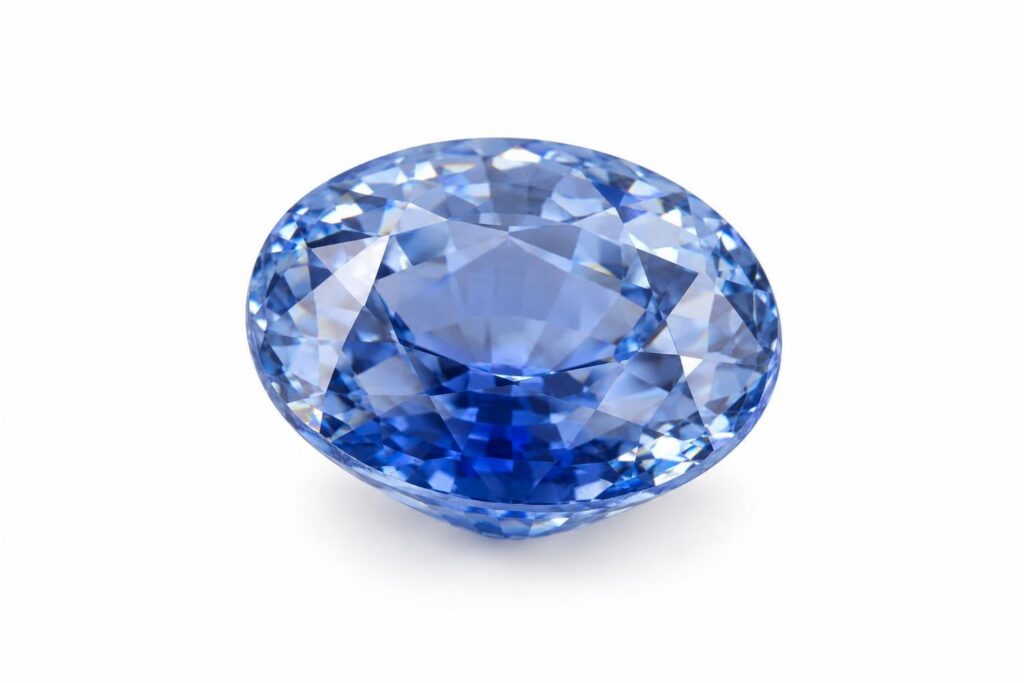
Why look at examples? They show how the ideal shifts from gem to gem. In general, the more intense and even the colour, the more valuable the sapphire. The most valued blues have strong to vivid saturation in medium to medium-dark tones, while less valuable ones may be greyish, too light or too dark 3.
Emerald follows its own ideal. The most desirable emeralds are bluish green to pure green, with vivid saturation and a tone that isn’t too dark 4.
Why even colour matters
Why check how the colour is spread? Uneven colour is called colour zoning. Because even colour marks most fine gems, more zoning seen face-up (looking down through the top) is usually seen as a negative. The trade also usually values a single pure hue more than a mix of hues 2.
Why clarity is judged gem by gem
Why can’t you judge a coloured stone’s clarity like a diamond’s? Clarity is about inclusions, the features found inside a stone. Each gem type has its own clarity value curve: some almost always have inclusions, while others are commonly eye-clean, meaning nothing shows to the naked eye 2.
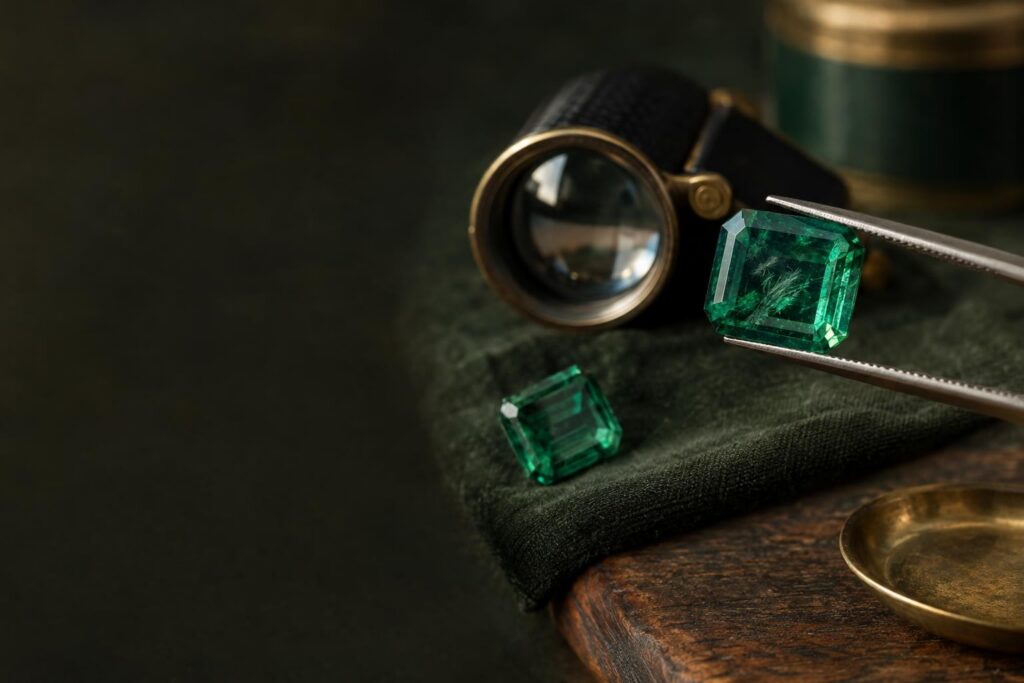
Inclusions are not always a fault. Some add value, such as the light-scattering inclusions that give Kashmir sapphire its velvety look 2.
How does clarity affect what you see? In coloured stones, transparency and clarity are closely linked. Emeralds usually have inclusions visible to the naked eye, and the trade accepts this. Inclusions that hurt transparency, though, sharply reduce value 4.
Durability matters too. For sapphire, inclusions generally make a stone less valuable, and price can drop substantially if they threaten durability 3. If the stone is for a ring worn every day, see Which Gemstones Suit Everyday Rings?
Why cut changes the colour you see
Why does cut matter so much here? Because it changes the colour you see. A cutter can darken a pale stone with a deep cut and a small table, the flat top facet. A dark stone can be lightened with a shallow cut and a large table 4.
How cut changes the colour you see
The same crystal can look darker or lighter depending on how it is cut. Switch between three cuts to see what a cutter is doing.
- Deep cut, small table
- A cutter can darken a pale stone with a deep cut and a small table, the flat top facet.
- Shallow cut, large table
- A dark stone can be lightened with a shallow cut and a large table.
- Windowing
- If the pavilion, the lower part of the stone, is cut too shallow, it causes "windowing": you can see straight through the stone.
The pictures exaggerate the proportions so the differences are easy to see. Real stones are cut to suit each crystal, and cutters also weigh colour zoning, pleochroism and weight. Pictures: AI-generated illustrations, checked for accuracy. They are not photographs of a real piece.
How is cut quality judged? It covers proportions, symmetry, polish and facet placement. If the pavilion, the lower part of the stone, is cut too shallow, it causes "windowing": you can see straight through the stone 2.
Cutters also weigh colour zoning, pleochroism (different colours seen from different directions) and how dark the crystal is. Their aim is the best colour, proportions and weight from that crystal 3.
Why size raises value per carat
Why does a bigger stone often cost more per carat, not only more overall? A carat is the unit of weight for gemstones. Value per carat rises as size reaches the range buyers want, and some gems are rarely found above a couple of carats 2.
Emerald shows how strong this effect can be. At the same quality, emerald price can rise dramatically with size 4. So when you compare two stones, it can help to compare stones of a similar size.
Why origin can matter, and why it is an opinion
Why do sellers mention where a stone comes from? Origin can strongly affect value for many gems. A few major labs can determine it, and GIA marks a result "inconclusive" when its data match more than one place 2.
How do labs decide? They can use a chemical analysis called LA-ICP-MS, comparing a stone’s chemistry with reference samples 6. Under CIBJO’s international guidance, a stated place of origin is a matter of opinion, and it does not imply a level of quality 5.
What about famous source names? Trade names based on a source usually refer to that source’s finest stones, but no single source always gives the same colour and quality 3. Emerald appearance also overlaps between sources 4.
Why treatment belongs in every evaluation
Why ask about treatment? Gemstones may be treated to change their colour, clarity or durability, and they have been treated throughout history. Treatments may affect value, are often not permanent, and may need special care 5.
What should a seller tell you? Under CIBJO’s standard, the seller shall tell the buyer about the treatment and any special care it needs. If treatment is possible but can’t be confirmed, it is prudent to disclose the suspected treatment 5. Read more in How Gemstone Treatments Should Be Disclosed and Heat Treatment in Gemstones.
How do experts find treatments? Standard testing uses instruments such as a refractometer, polariscope, dichroscope and handheld spectroscope. A stone’s reaction to UV light can also give clues about its identity and any treatments 6.
What does a treatment rating tell you? GIA rates clarity enhancement in emerald (a treatment that improves how clear the stone looks) as minor, moderate or significant. That rates the treatment only, and it is not a clarity grade 4.
Why the factors combine: how to evaluate coloured gemstones as a whole
Why look at all the factors together? Grading coloured stones is a highly complex process with countless variables 1. Colour is the most important factor in judging quality, each gem type has its own clarity value curve, and value per carat rises as size reaches the range buyers want 2. Treatments may also affect value 5.
What can you ask when comparing two stones? These questions follow the factors in order:
- Is the colour strong and even, and neither too pale nor too dark for this gem?
- Are the inclusions normal for this gem, and do they affect transparency or durability?
- Face-up, does the stone show a see-through window in the middle?
- Is the size in the range where value per carat rises for this gem?
- If an origin is claimed, which laboratory gave that opinion?
- Has the stone been treated, and what care does the treatment need?
If you’d like help comparing stones side by side, we offer a free consultation, booked online at bookings.ralphjacobs.org from any country. We can source a wide range of coloured gemstones as centre stones.
The downsides and limits of judging coloured gemstones
Why stay cautious even with these factors in mind? Because each one has limits:
- There is no broadly accepted grading system for coloured stones, and countless variables make a universal one difficult to establish 1.
- Origin can’t always be pinned to one place: GIA marks a result "inconclusive" when its data match more than one locality 2.
- Treatments are often not permanent and may need special care 5.
- GIA’s emerald clarity enhancement rating describes the treatment only. It is not a clarity grade 4.
Value factors also describe how the trade values a stone, not what you will enjoy wearing. Pale colours usually have relatively low value, and very dark gems are harder to sell 2. If you love a lighter or darker stone, that is a personal choice the value factors do not make for you.
Which factor matters most depends on what you value. If value matters most to you, the relevant facts are all the factors together, with colour the most important. If daily wear matters most, note that sapphire price can drop substantially when inclusions threaten durability 3. For gem-specific steps, see How to Buy a Sapphire and How to Buy an Emerald.
Frequently asked questions
Under CIBJO’s standard, the seller shall tell the buyer about any treatment and the special care it needs. If treatment is possible but unconfirmed, disclosing the suspected treatment is considered prudent 5.
This may be pleochroism, where a stone shows different colours from different directions. Cutters take it into account when shaping a stone for its best colour 3.