
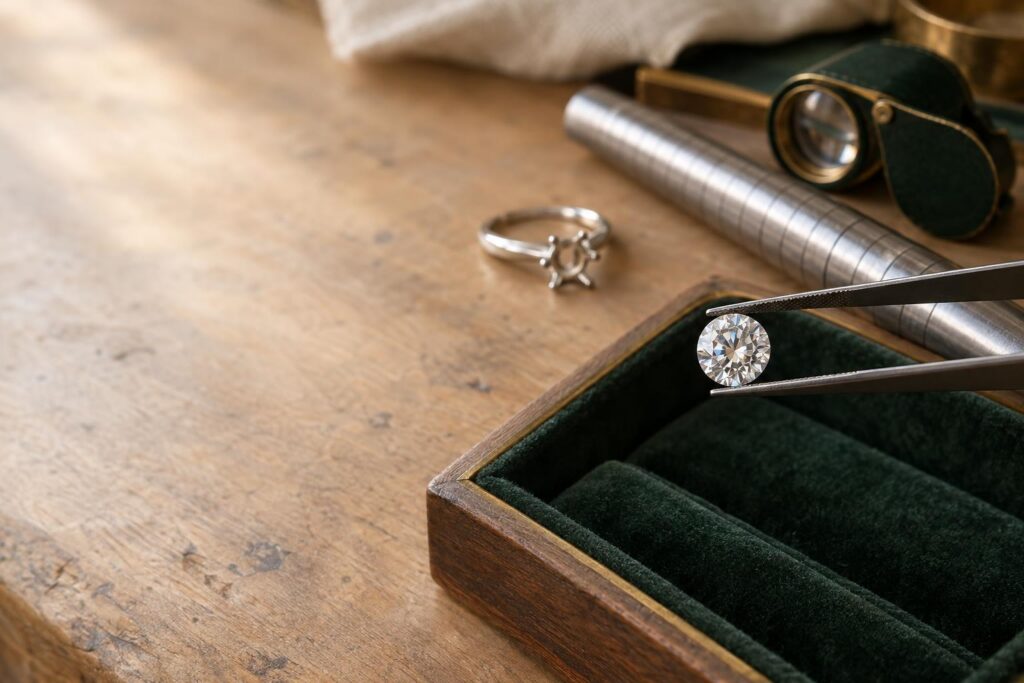
Why timing changes the ring you end up with
Why does it matter when you start? A custom ring takes time to make. If you are proposing on a particular day, ask the jeweller how long the ring will take 4. Your start date decides how many options are still open by then.
Knowing when to start buying an engagement ring comes down to adding up your steps. This guide walks through the ones that can come before a proposal: research, budget, ring size, the stone, making the ring and resizing. Not every purchase needs every step. Add up the ones that apply to you, and you have your own start date.
- Work backwards from your proposal date, not forwards from today.
- Learn the basics and set a price range before you visit a jeweller 3.
- A complex custom design takes longer to make than a simple one, so ask your jeweller how long your ring will take 4.
- Leave spare days before your date in case the ring needs a resize.
Why working backwards from your proposal date helps
Why plan in reverse? Your proposal date is fixed, so it is the natural place to start counting. Some steps depend on others. For example, it helps to know the ring size before you meet a designer 4.
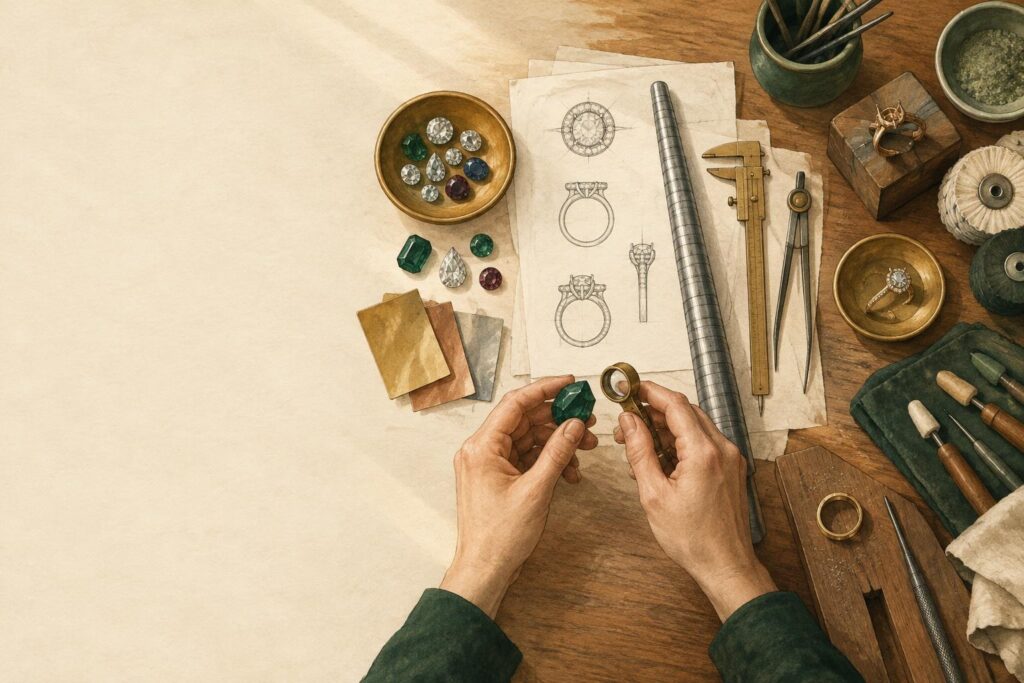
Here is one way to order the steps. Several of them can overlap, so treat this as a checklist rather than a strict sequence:
- Research: learn the 4Cs and notice the jewellery your partner already wears.
- Budget: set a price range you are comfortable with 3.
- Ring sizing: find the size, for example measured by a jeweller with finger gauges 1.
- Diamond sourcing: compare stones and their grading reports.
- Making the ring: ready-made or custom, with the lead time confirmed by the jeweller.
- Resizing: time to adjust the fit if needed.
- Buffer: spare days you choose to keep before the proposal.
The sections below explain what each step involves. For a wider plan that includes the proposal itself, see The Proposal Planning Timeline.
Why research and budget come first
Why learn before you shop? Learn about diamonds, starting with the 4Cs, before you visit a store 3. The 4Cs are colour, clarity, cut and carat weight, and they are the global standard for assessing diamond quality 2.
How do the 4Cs help you choose? Deciding which C matters most to you helps narrow the search and work within your budget 2. A carat is the unit used to weigh a diamond, not a measure of how big it looks. Cut quality affects a diamond’s beauty and value more than any other C, and a well-cut 1.75 ct diamond may look larger than a poorly cut 2.00 ct one 6. Read more in The 4 Cs of Diamonds.
What about budget? Have a price range in mind before you start shopping, because clear limits help the jeweller find a ring within it. It is also worth noticing your partner’s existing jewellery: classic or modern, white or yellow metal, delicate or chunky 3. The Engagement Ring Budget Planner and How to Set an Engagement Ring Budget Without Salary Rules can help with this step.
Why ring sizing needs its own step
Why not just guess the size? Measuring with string or paper is inaccurate, because string stretches and paper can shrink and curl with humidity and temperature. A jeweller can measure the finger with finger gauges, a set of sample rings in graded sizes 1. That means planning a visit to a jeweller, or a discreet way to measure.
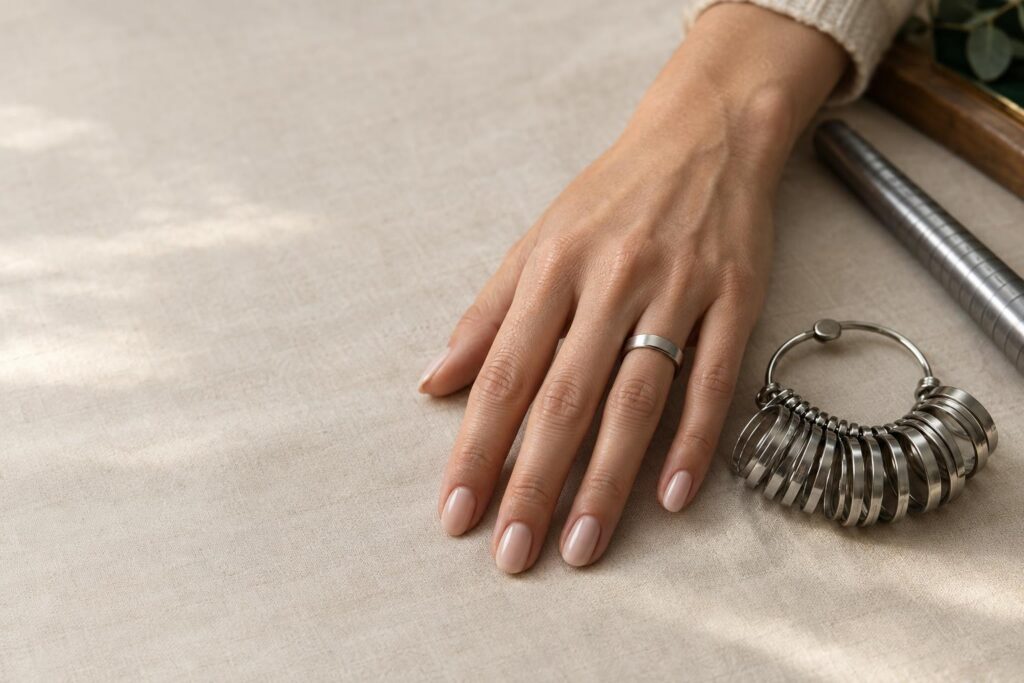
What else can change the reading? Fingers shrink in the cold and swell in the heat, and humidity, altitude and time of day also change finger size. For a right-handed person, the left ring finger is typically slightly smaller than the right 1.
How can you size a surprise ring? One way is to borrow a ring worn on the ring finger and have it measured on a mandrel (a tapered rod marked with sizes), or press it into a bar of soap. Wide shanks (the band part of the ring) usually need to be a bit larger, because they fit more snugly 1. So the width of a borrowed ring is worth noting.
Once you have a measurement, the Ring Size Converter lets you compare it across sizing systems. See How to Find a Ring Size Secretly for more ideas.
Why choosing a diamond deserves an unhurried look
Why give the stone time? View diamonds under different lighting, not just the jeweller’s spotlights 2. A diamond should keep its sparkle in a range of lighting conditions 6. If you can, plan more than one viewing so you can do this.
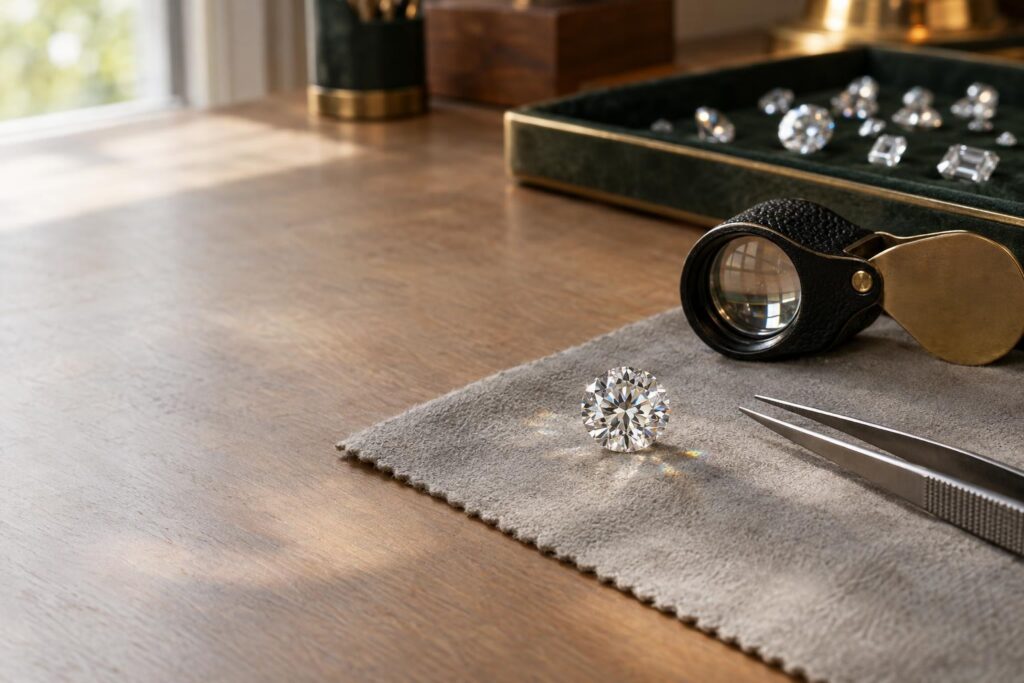
How do you check what you are buying? A grading report is a laboratory’s written assessment of a stone. Ask for one from an independent lab, because it confirms the diamond’s identity and quality, whether it is natural and whether it has been treated 2. To learn what a report shows, see How to Read a GIA Diamond Grading Report.
Why does GIA grade only loose diamonds? A setting can hide or affect the colour and clarity grade, and makes the exact carat weight hard to find 5. This means a GIA-graded diamond was assessed while loose, before going into a ring. If you are still deciding between a natural diamond and a laboratory-grown diamond, see Natural vs Lab-Grown Diamonds.
Why custom lead times matter most when you have a date
Why ask about time first? A custom ring is made to order. The lead time is the time between ordering and the ring being ready. If you are proposing on a particular day, ask the jeweller how long the ring will take 4.
How long can it take? It depends on the design. A complex design, or one that needs matched stones, takes longer than a straightforward one, so ask your jeweller how long your ring will take 4. Matched stones are two or more stones chosen to look alike in size and colour, such as a pair of side stones.
What will the designer ask about? The jeweller will ask about diamond shape, because it shapes the whole design 4. See How the Custom Jewellery Process Works and Choosing a Diamond Shape for more on each.
Why you should leave room for resizing and a buffer
Why plan for a resize? It is worth buying a ring slightly large, because sizing down is much easier than sizing up 3. It is easier to remove metal from a ring that is too big than to add metal to one that is too small 1.
How setting style affects resizing
Most rings can be resized by a small amount, but how easy it is depends on the style. Step through five settings, from easiest to hardest to resize.
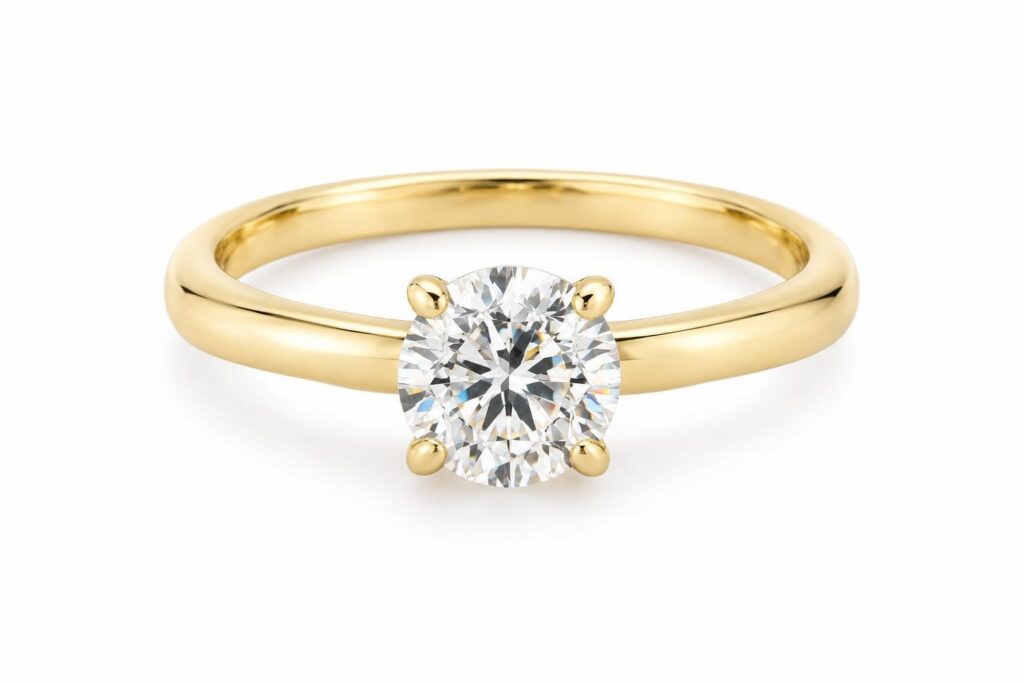
- Solitaire: easy to resize
- A solitaire is a ring with a single gemstone. It is easy to resize.
- Pavé: takes more work
- Pavé means many small diamonds set close together. A pavé band takes more work to resize, and pavé can't be resized easily.
- Bead-set: takes more work
- Bead-set diamonds are small stones held by tiny beads of metal. Bead-set stones on the band take more work to resize.
- Channel: hard to resize
- A channel setting holds stones in a groove between two metal walls. Channel settings can't be resized easily.
- Eternity: very difficult
- An eternity ring has stones set around the band. It can be very difficult to resize.
The pictures show typical examples. How easy a particular ring is to resize depends on its style, so ask your jeweller before you choose. Pictures: AI-generated illustrations, checked for accuracy. They are not photographs of a real piece.
How easy is a resize? Most rings can easily be resized by a small amount, while bigger changes may be harder, depending on the style. A solitaire (a ring with a single gemstone) is easy to resize. Rings with pavé (many small diamonds set close together) or bead-set diamonds (small stones held by tiny beads of metal) on the band take more work 2. Read more in Why can’t every ring be resized?
What is the buffer for? It is spare time you choose to keep between the ring being ready and the proposal. If a resize is needed, the work happens in this window. Ask your jeweller how long a resize of your chosen style would take.
The downsides: when a tight timeline limits your choices
Why look at the other side? These facts matter most when time is short:
- Complex custom designs: a complex design or one with matched stones takes longer to make, which may not fit a near date. Ask your jeweller how long it will take 4.
- Hard-to-resize styles: pavé and channel settings can’t be resized easily, and eternity rings can be very difficult to resize 1. A channel setting holds stones in a groove between two metal walls, and an eternity ring has stones set around the band. If you are guessing the size, check whether your chosen style can be resized.
- Choosing together instead: if the timeline feels too tight for a surprise, choosing the ring together is another option. See Buying a Ring as a Surprise vs Choosing Together.
Sizing a surprise ring also has limits. A borrowed ring or a soap impression measures a ring rather than the finger itself, while a jeweller can measure the finger directly with finger gauges 1. Whether any of these points matters depends on your chosen style and how much time you have.
Why a conversation can help you plan your timeline
Why talk to a jeweller early? Asking about timing before you commit lets you check it against your date. We design and make rings to order, and the lead time given in your quote is the one that applies. If you’d like to talk through your dates, we offer a free consultation, online at bookings.ralphjacobs.org from any country, by WhatsApp, or in our showroom.
Frequently asked questions
It depends on which steps apply to you. A complex custom design or matched stones take longer than a simple design, so ask your jeweller how long your ring will take 4. Count back from your date, adding time for research, sizing and choosing a stone, plus any spare days you want.
Yes. Fingers shrink in the cold and swell in the heat, and humidity, altitude and time of day also change finger size. It is best to have a jeweller measure with finger gauges rather than using string or paper 1.