Why chrysoberyl is more than one gemstone
Why can one mineral give you both a sharp cat’s-eye and the colour-changing alexandrite? Because both are chrysoberyl, a mineral made of beryllium, aluminium and oxygen (BeAl₂O₄) 1. Its name comes from the Greek word for golden, joined to the word beryl. Its crystals often grow together as twins that can look six-sided 5.
One mineral, several looks
Chrysoberyl is a single mineral, yet it can appear as a twinned crystal, a plain yellow-green stone, a cat's-eye or an alexandrite. Switch between them to compare.
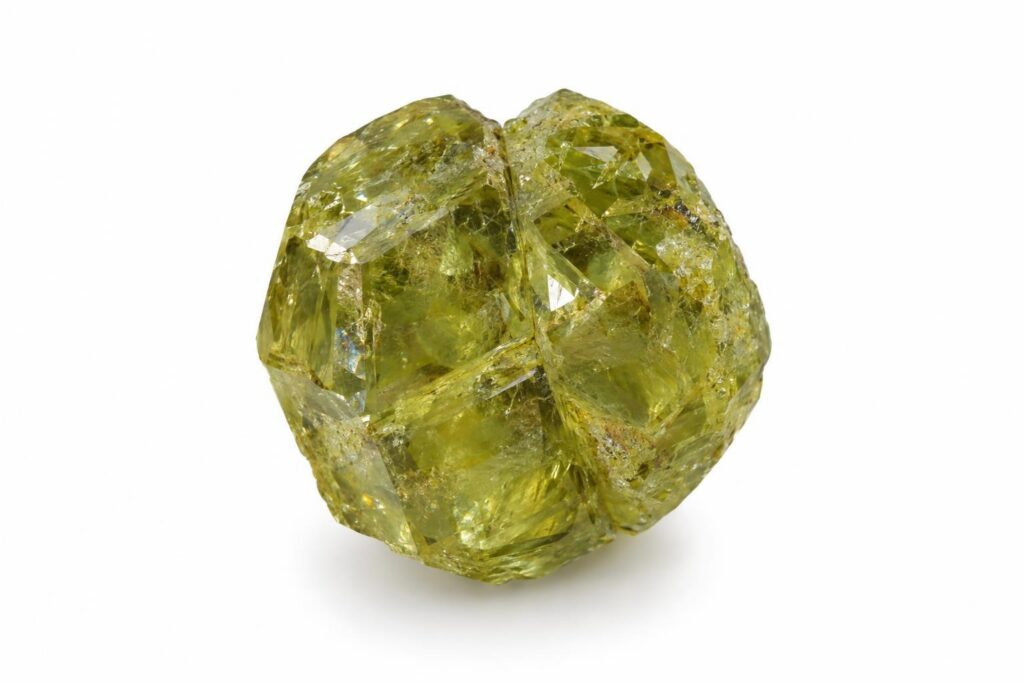
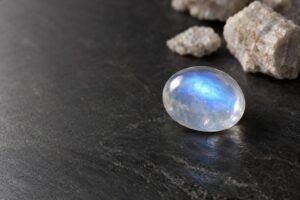
- Crystals that grow as twins
- Chrysoberyl crystals often grow together as twins that can look six-sided. The mineral is made of beryllium, aluminium and oxygen.
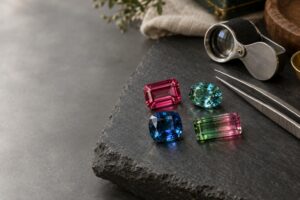
- Chrysoberyl in its usual colours
- Chrysoberyl's body colours run through green and yellow, with brownish shades and greenish black also seen. Turned in the light, it can show different colours because of pleochroism.
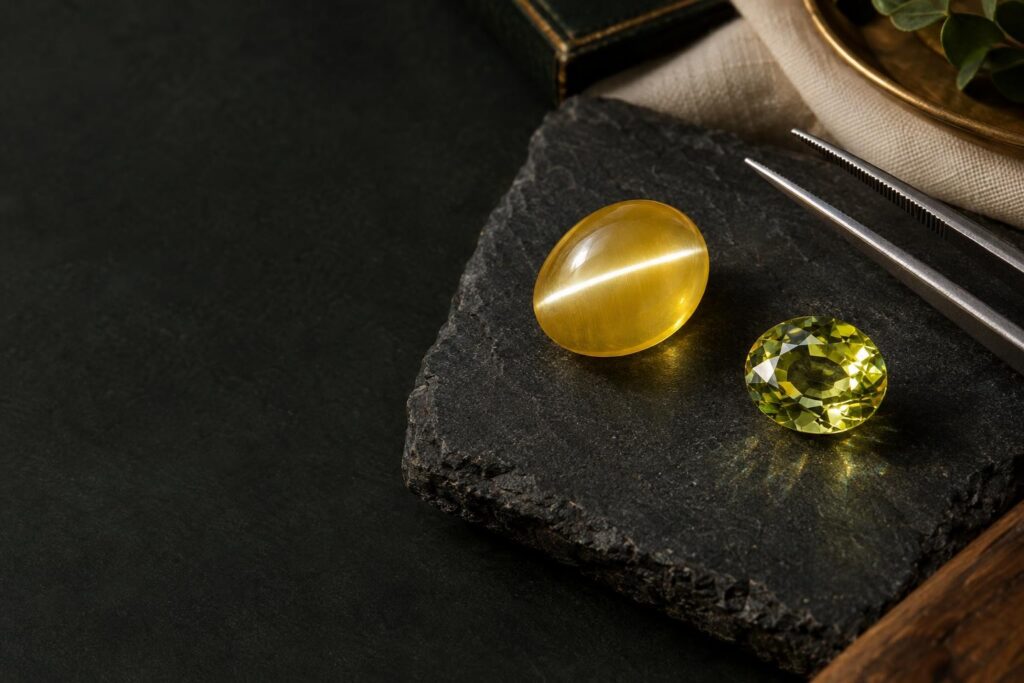
- Chrysoberyl cat's-eye
- Chrysoberyl cat's-eye, also called cymophane, shows a bright line of light across its surface. It is usually cut as a cabochon, with a domed top and a flat back, to show the eye best. A good eye is razor-sharp, complete and straight.
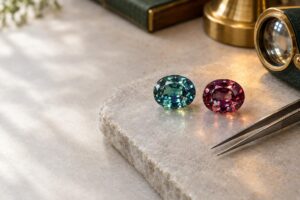
- Alexandrite, the colour-changing variety
- Alexandrite is the very rare variety of chrysoberyl that changes colour, and chromium causes this change. With chromium, a chrysoberyl may look raspberry-red under incandescent light, the warm light of a traditional bulb.
Colours in the pictures are illustrative. Real chrysoberyl varies from stone to stone, and alexandrite's colour change depends on the light. Pictures: AI-generated illustrations, checked for accuracy. They are not photographs of a real piece.
Two varieties have their own names. Alexandrite is the very rare variety that changes colour 1. Chrysoberyl cat’s-eye, also called cymophane, shows a bright line of light across its surface 4. If you have seen a cat’s-eye stone and wondered what it was, this entry explains what you saw and how it wears.
Why chrysoberyl’s colour and eye seem to move
Why does a chrysoberyl look different as you turn it? Part of the answer is pleochroism, which means a stone shows different colours from different directions. In chrysoberyl these can be red, yellow-orange and emerald-green. Its body colours run through green and yellow, brownish shades and greenish black. When it contains chromium, it may look raspberry-red under incandescent light, the warm light of a traditional bulb 5.
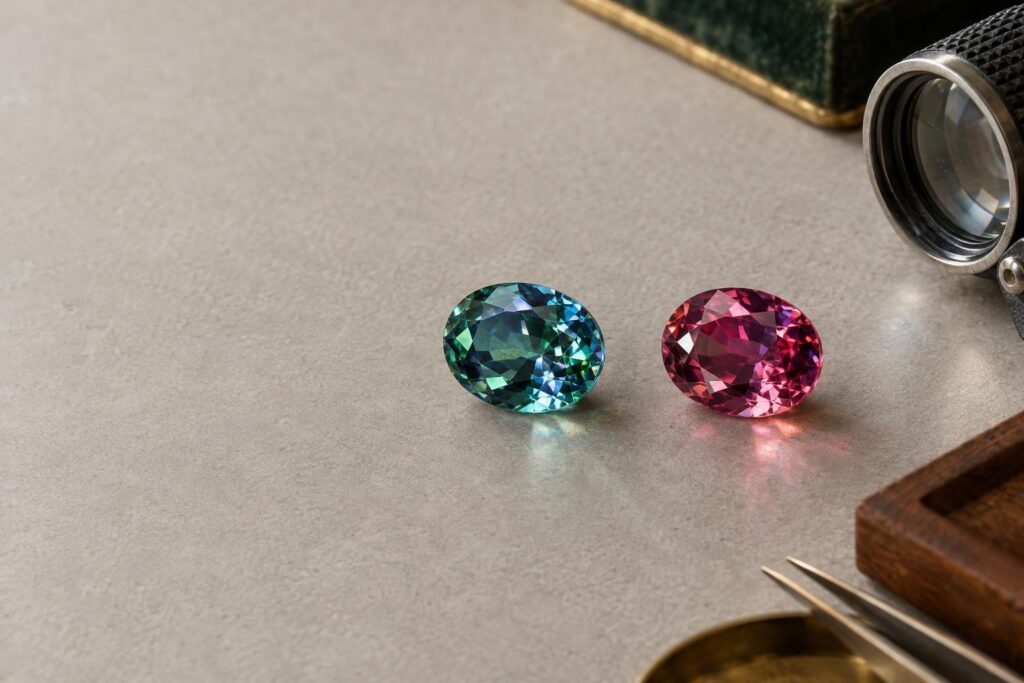
Chrysoberyl colours run from yellow and green to brown, and cat’s-eye stones tend towards mixed colours, such as greenish-yellow or brownish-yellow 6. Alexandrite is defined by a definite colour change caused by chromium 4.
How does the cat’s-eye form? The effect is called chatoyancy: a bright, narrow band of light that seems to glide across the stone as it moves. Light reflects off aligned, needle-like inclusions, tiny features trapped inside the stone, which act like tiny mirrors. To show the eye best, the stone is usually cut as a cabochon, with a domed top and a flat back 3. Under two light sources, the eye can split into two bands 6.
With light from the side, a fine cat’s-eye can look honey-coloured on one side of the eye and milky on the other. The trade calls this the ‘milk and honey’ effect 6.
Other stones, such as tiger’s eye and tourmaline, can also show a cat’s-eye, though tourmaline’s eye is usually coarser and less sharp 3. Under CIBJO naming guidance, those stones carry their own name, as in ‘Tourmaline cat’s-eye’. Chrysoberyl is the stone that ‘cat’s-eye’ alone refers to 4.
Why treatments are rare in chrysoberyl
Why ask about treatment at all? A treatment can change how a stone looks and how you should clean it. CIBJO lists chrysoberyl and chrysoberyl cat’s-eye as commonly untreated 4. Alexandrite is usually not treated, though it might have fractures 2.
The exceptions are rare. A few cat’s-eyes have been irradiated, meaning exposed to radiation to change their colour, and some may be radioactive 4. Very dark brown, heavily irradiated stones were found in the late 1990s, so it is worth checking dark brown cat’s-eyes for leftover radiation 6.
In alexandrite, fissures are rarely filled with oils, wax or resins, and CIBJO classes those fillings as unstable 4. This is a form of fracture filling: putting material into cracks so they show less. Both irradiation and filling are treatments to ask about and to have disclosed. How gemstone treatments should be disclosed explains what that covers.
Laboratory-grown stones exist too. CIBJO records ‘some’ synthetic chrysoberyl, ‘few’ synthetic cat’s-eyes and ‘many’ synthetic alexandrites 4. So it is worth asking whether a stone is natural or laboratory-grown.
How well does chrysoberyl cope with daily wear?
Why does this matter? If you want to wear a chrysoberyl every day, both hardness and toughness play a part. Chrysoberyl rates 8.5 on the Mohs scale, which ranks how well a stone resists scratching 5. The steps on that scale are not evenly spaced, so the number tells only part of the story 2. The Mohs scale is not the whole durability story explains why.
Toughness, a stone’s resistance to chipping and breaking, matters as well. Alexandrite has excellent toughness and no cleavage, a tendency to split along flat planes. That makes it a good choice for rings worn every day 2. The cat’s-eye is very durable and tough enough to take a pretty good hit 6.
Sources do not fully agree, though. The Handbook of Mineralogy lists distinct cleavage in one direction and describes the mineral as brittle 5. So even a hard, tough stone can be damaged by a sharp knock.
Alexandrite is stable in normal wear and resists heat, light and common chemicals. Warm, soapy water is always safe, and ultrasonic and steam cleaners are usually safe. Fracture-filled stones should be cleaned only with warm, soapy water 2. For cat’s-eyes, ultrasonic and steam cleaning should be fine 6.
Where does chrysoberyl come from?
Why look at where chrysoberyl forms? It shows how these stones reach the surface, though not where any one gem was mined. It forms in some granite pegmatites, a type of coarse-grained rock, and is also found in placer gravels, loose deposits of gem-bearing gravel. It is abundant in the gem gravels of the Ratnapura district in Sri Lanka 5.
Cat’s-eyes have a history going back at least to first-century Rome, and JCK names Sri Lanka, India and Brazil as their main sources 6. Alexandrite was first found in Russia’s Ural Mountains in the 1830s, and is also found in Sri Lanka, East Africa and Brazil 1. These sources name regions, not individual stones, so they cannot confirm where any one gem was mined.
Why chrysoberyl is linked to June
Why does chrysoberyl appear on birthstone lists? Through its alexandrite variety. Alexandrite is listed as a birthstone for June, alongside pearl and moonstone 1.
What to look at when buying chrysoberyl
Why look closely? Because in a cat’s-eye, the quality of the eye shapes how the stone is valued. Cat’s-eye chrysoberyl is considered the most valuable and sought-after gem showing chatoyancy, because of its sharp, intense eye and its rarity 3.
How can you judge the eye? A good eye must be razor-sharp, complete and straight. Check it under a strong single light 6. For colour and other qualities, see how coloured gemstones are evaluated.
- Is the stone natural or laboratory-grown?
- Has it been treated in any way, including irradiation or fissure filling?
- If it is a dark brown cat’s-eye, has it been checked for leftover radiation?
- If it is sold as alexandrite, does it show a definite colour change?
- Does it come with a report from an independent gemmological laboratory?
Why the cabochon shape guides chrysoberyl designs
Why does design start with the cut? A cat’s-eye is usually cut as a cabochon, with a domed top and a flat back, to show the eye best 3. Ask your jeweller how a setting would hold that shape. Cat’s-eye chrysoberyl is also highly popular in men’s jewellery 3.
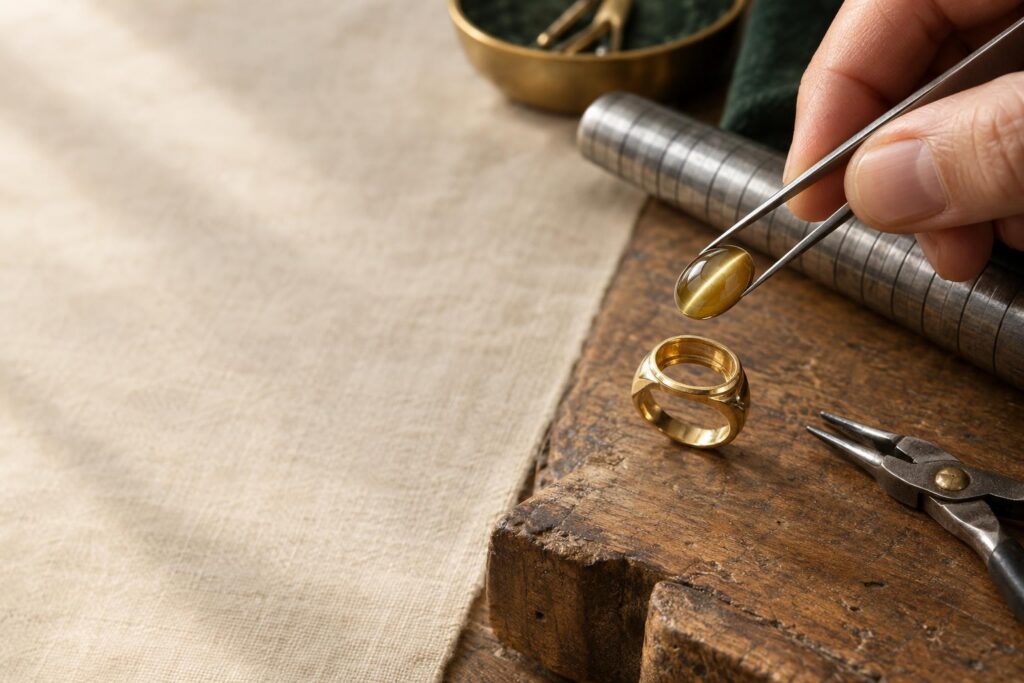
The cat’s-eye’s durability means it is seen in rings for both men and women 6. For how different settings hold a stone, see ring settings explained.
Seeing chrysoberyl for yourself
If you would like to talk through a chrysoberyl, or another coloured gemstone, in a ring design, we offer a free consultation. You can book online from any country at bookings.ralphjacobs.org, or visit our showroom in Secunda. Inclusion in this guide does not confirm that Ralph Jacobs stocks this gemstone.