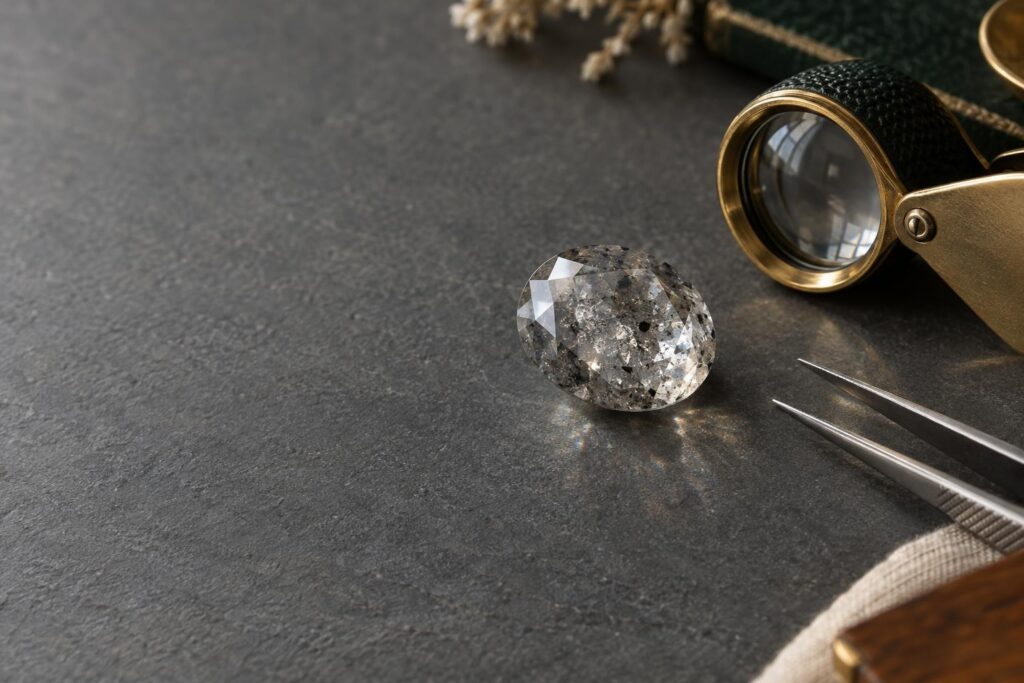
Why salt-and-pepper diamonds look speckled
If you love the speckled look, the first question is often whether all those marks make the stone weak. The short answer is that it depends on which marks there are and where they sit 1. This entry explains why, so you can look at any salt-and-pepper diamond with clearer eyes.
The name is used for natural diamonds with many inclusions you can see. Inclusions are internal "birthmarks" in a diamond, while marks on the outside are called blemishes 4. Because diamonds form under great heat and pressure, nearly every diamond has some 3.
In a salt-and-pepper diamond, these marks become the feature rather than something to hide. Research on heavily included diamonds shows that inclusions can create a distinctive appearance of their own 5.
Why the specks can look white or dark
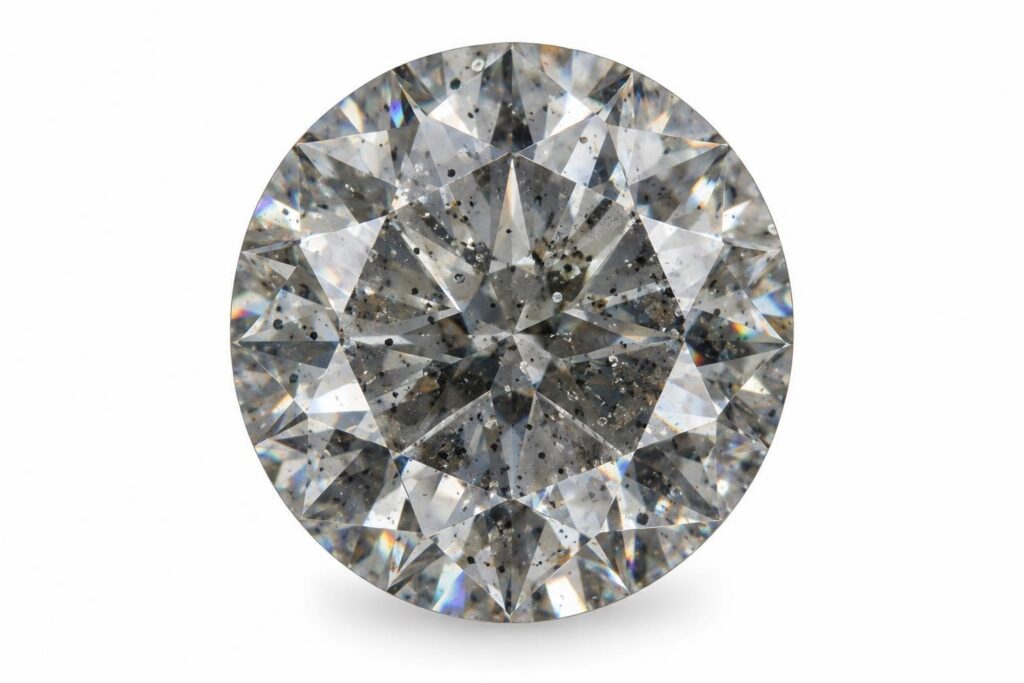
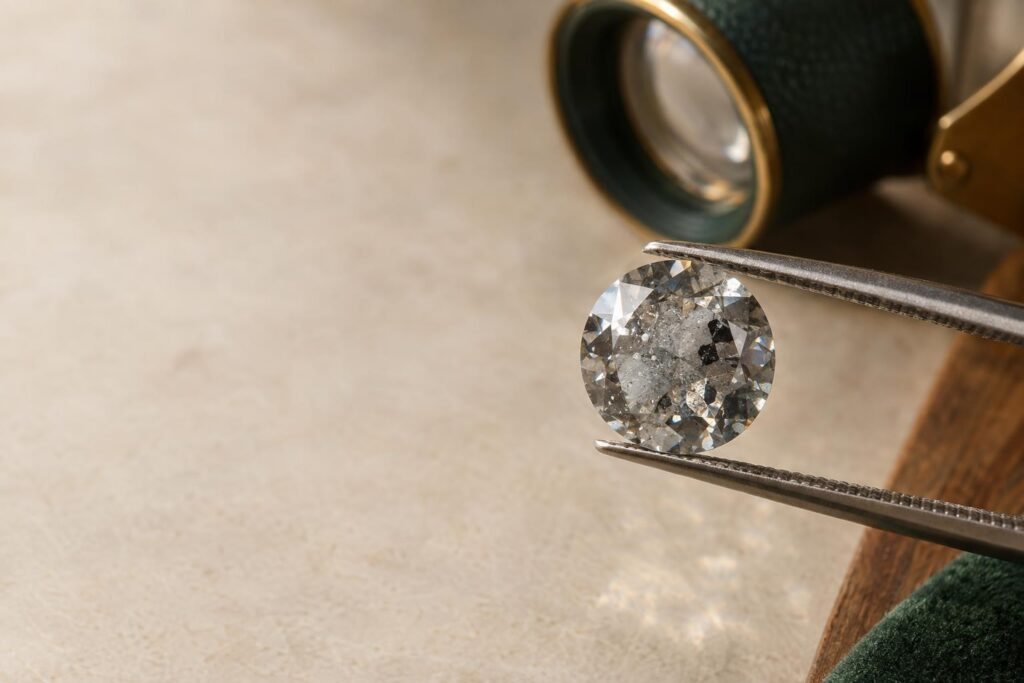
Why do some specks look like salt and others like pepper? The answer lies in what is trapped inside the crystal. Different kinds of inclusion look different to the eye.
Six kinds of inclusion you might see
These are the marks that give a salt-and-pepper diamond its speckled look. Choose one to see what it looks like inside the stone.
- Pinpoint
- A pinpoint is a very small crystal. At 10× magnification (ten times larger) it looks like a tiny dot.
- Cloud
- A cloud is many pinpoints grouped tightly together, which look hazy.
- Crystal
- A crystal inclusion is a mineral crystal held inside the diamond.
- Feather
- Feather is the trade term for a break in a gemstone. It is often white and feathery.
- Cavity
- A cavity is an angular opening. It is left when part of a feather breaks away, or when a crystal at the surface drops out.
- Grain centre
- A grain centre is a small area of distorted crystal. It can look white or dark.
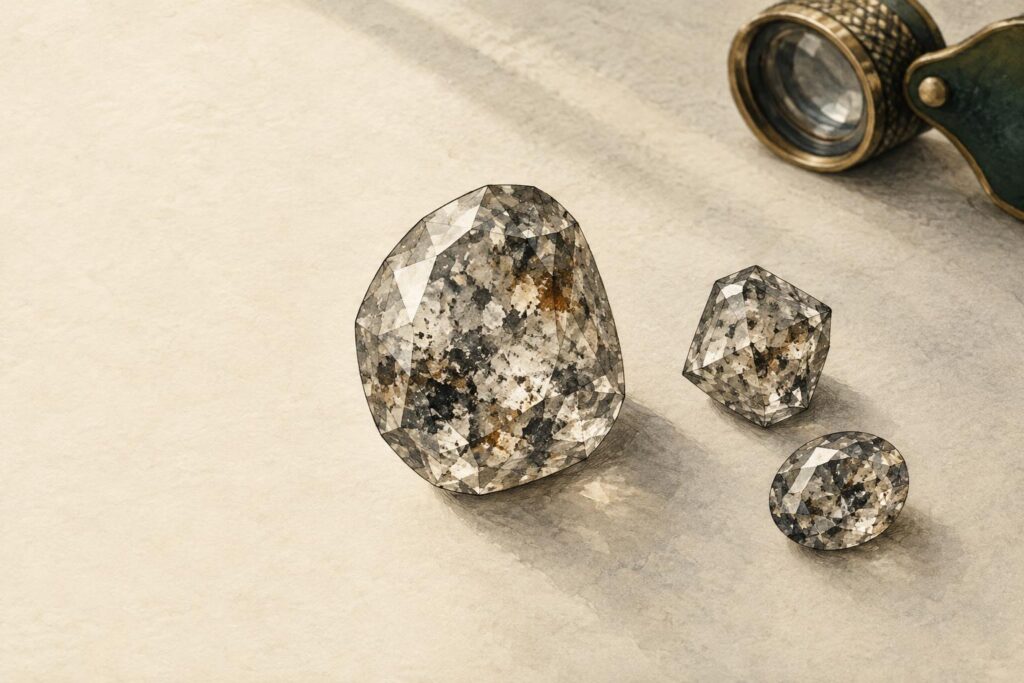
Real inclusions vary a lot in size and appearance, and most need magnification to see clearly. These pictures show one simple example of each. Pictures: AI-generated illustrations, checked for accuracy. They are not photographs of a real piece.
- Pinpoint: a very small crystal that looks like a tiny dot at 10× magnification (ten times larger).
- Cloud: many pinpoints grouped tightly together, which look hazy.
- Crystal: a mineral crystal held inside the diamond.
- Feather: the trade term for a break in a gemstone, often white and feathery.
- Cavity: an angular opening left when part of a feather breaks away or a crystal at the surface drops out.
- Grain centre: a small area of distorted crystal that can look white or dark.
Some dark specks have a known cause. In diamonds graded Fancy white, dark, obvious inclusions are generally inclusions or stress fractures that have turned to graphite 5.
How visible each speck is depends on contrast. The more an inclusion differs in brightness, darkness or colour from the diamond around it, the easier it is to see 2. A diamond with many inclusions can also look off-colour, pitted or scratched.
Clarity grades are based on what is seen at 10× magnification. On the GIA clarity scale, which runs through 11 grades from Flawless (FL) to I3, the lowest grades are I1, I2 and I3. In these "included" grades, inclusions are obvious at 10× and may affect transparency and brilliance, the white light a diamond returns 4. Some diamonds hold so many inclusions that they would fall below I3, and the inclusions give them their colour 5.
Why treatments matter when the look comes from inclusions
Why ask about treatments? Some treatments work on exactly the features that give this stone its look: its inclusions and fractures.
Laser drilling and fracture filling are used to improve diamond clarity. Fracture filling means putting a material into a break so it is harder to see. It does not heal the fracture, and it is not permanent 2.
Heat can also change a heavily included diamond. Heating heavily fractured or cloudy diamonds, which often start out greyish, can turn them black by graphitising them 5. A treated black diamond can begin as a heavily fractured stone whose surface-reaching fractures turn black when heated 6.
It helps to ask whether a stone has been treated, and whether its report states it. You can read more in how gemstone treatments should be disclosed.
Do all those inclusions make a salt-and-pepper diamond weak?
Why does this matter? If you plan to wear the stone often, you want to know how it will hold up. To answer it, it helps to split durability into parts.
Durability comes down to three properties. Hardness resists scratches, toughness resists breaking and chipping, and stability resists chemicals and sudden temperature change. Diamond is very stable and extremely hard, but only somewhat tough. It also has four perfect cleavage directions, which are flat planes where the crystal can split, and these are the main source of damage to diamonds 1.
Even heavily included black diamonds still rank 10 on the Mohs scale of scratch resistance. They can, however, contain hundreds or thousands of tiny fractures and inclusions, which can make the stone more brittle and prone to chipping if struck sharply 6.
Where the inclusions sit also matters. A diamond with many inclusions near its girdle (the thin outer edge) or its points is more prone to chipping or breaking. A blow that lands on a feather near a cleavage direction is likely to chip it 1.
Feathers that reach the surface, and deep feathers that run from the top of the stone towards the pavilion (the lower part), can also pose durability concerns. There is some reassurance too: a diamond with significant durability problems generally does not survive the cutting process 2.
Everyday care follows from this. For heavily included black diamonds, avoid hard knocks, skip ultrasonic or steam cleaning, and use mild soap and water instead 6.
Why the type and place of inclusions matter when buying
Why look closely when the speckles are the attraction? Because chipping risk is linked to inclusions near the girdle and the points, and to feathers near a cleavage direction 1. A jeweller or grading laboratory can examine a stone in detail. The factors below help you follow that conversation.
- Size: how large each inclusion is.
- Number: how many there are.
- Location: where they sit, for example near the girdle or the centre.
- Relief: how much they contrast with the diamond.
- Nature: what type of inclusion each one is.
The edge of the stone deserves a careful look. Open cavities at the girdle are much like chips and are more easily damaged 1.
Some GIA reports include a plotting diagram, a map of the type, location and relative size of inclusions 2. You can ask whether a stone’s report includes one. Our guide on how to read a GIA diamond grading report explains the diagram, and the 4 Cs of diamonds puts clarity in context.
- Are there feathers that reach the surface or run deep into the stone?
- Are there inclusions or cavities near the girdle or the points?
- Has the stone been treated, and is the treatment stated on a report?
- Does the report include a plotting diagram?
Why the setting matters for a heavily included diamond
Why think about the setting early? Chips usually happen when the girdle or a point hits something hard, such as a countertop or another diamond worn next to it 1.

Points and corners are better protected by a bezel (a metal rim around the stone), a partial bezel, or V-shaped prongs that cover each tip. Take care with tension settings too, where the stone is held only by the pressure of the band. Bent or broken prongs are a very common cause of chipping, and that a chipped diamond should not be worn until it is repaired 1.
Whatever the setting, have the prongs or bezel checked regularly 6. You can compare styles in ring settings explained and four claws vs six claws. Shapes with points are covered in choosing a diamond shape.
Why this entry is here
This entry describes the material so you can enjoy its patterns and judge its strength for yourself. Inclusion in this guide does not confirm that Ralph Jacobs stocks this gemstone. If you would like to talk through a stone or a setting, we offer a free consultation, booked online at bookings.ralphjacobs.org from any country.
Frequently asked questions
For heavily included black diamonds, skip ultrasonic and steam cleaning and use mild soap and water instead 6. If you are unsure about a particular stone, ask a jeweller before using any machine cleaner.