
Why the stone is only part of your engagement ring budget
Why isn’t the diamond the whole budget? Because a diamond needs something to hold it on your finger. If you set your budget around the stone, the rest of the ring may have changed your total more than you expected.
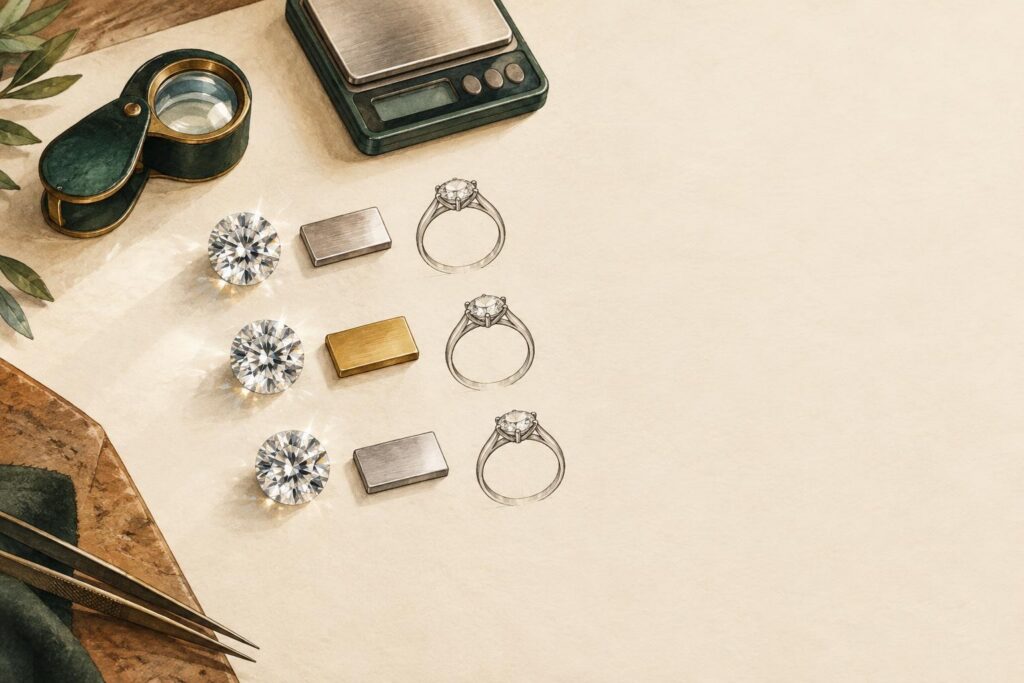
A ring setting is the metal mounting of a ring. It includes the parts that hold the stone and the band that wraps around your finger. It has three main parts: the head, which holds the stone, the shoulders, and the shank, which is the band itself 1. Each part is a choice you make.
Here are the parts worth checking in a quote, with what the sources say about each:
- Metal: gold is generally more affordable than platinum 3.
- Gold purity: 18ct (18K) gold is 75% gold, and lower caratages contain less gold 5.
- Setting style and band: flush-set rings usually need wider, thicker shanks, so they often use more metal than raised settings 1.
- Accent stones: one piece of jewellery can hold dozens or even hundreds of small stones, and cutting and sorting them is labour-intensive 4.
What do these parts have in common? Each one changes what goes into the ring: how much of the metal is gold 5, how much metal the band needs 1, and how many small stones must be cut, sorted and set 4. Jewelers of America, a jewellery trade association, says the price of gold jewellery depends on factors including its caratage, its weight and its craftsmanship 7. So a higher purity puts more gold into every gram, and a wider or thicker band puts more grams into the ring. GIA adds that halo, three-stone and pavé settings raise the price because of the extra stones and the labour involved, and that settings needing more precise craftsmanship can also increase costs 8. Facts such as platinum’s rarity, its density or the number of prongs describe the ring; on their own they do not tell you its cost, which also depends on how much metal the design uses and how much work it takes. The clearest way to see what each part adds is to ask for a quote that lists the metal, the stones and the setting work separately.
Why your choice of metal changes the cost
Why start with the metal? Because it touches cost, strength and care at the same time. On cost, gold is generally more affordable than platinum 3.
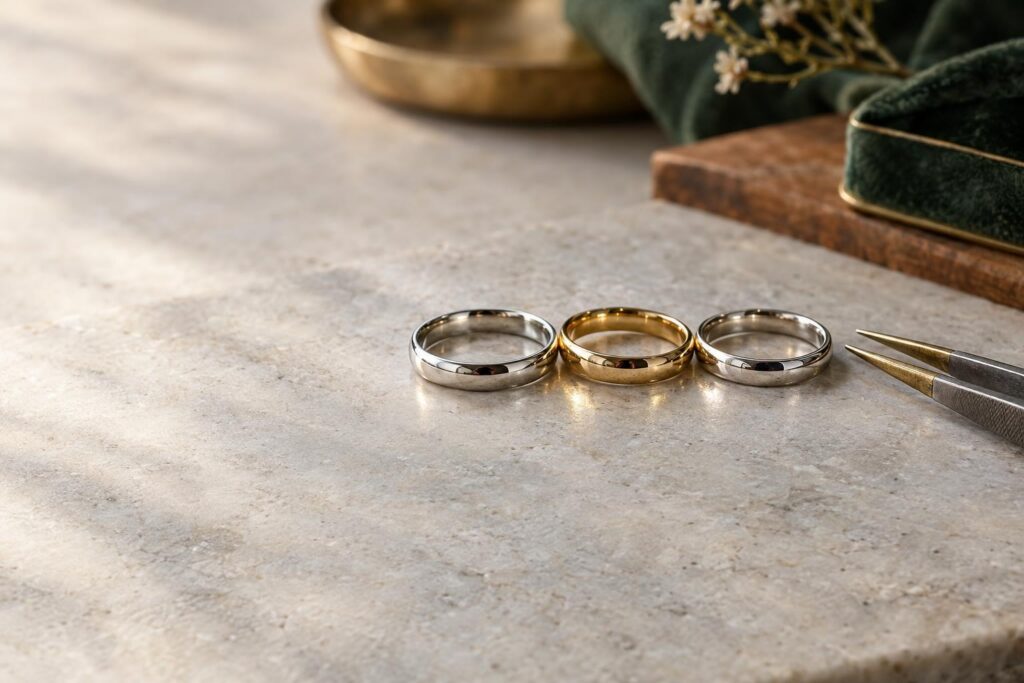
How do the two metals differ? Platinum is far rarer than gold. It is also denser, which means heavier for its size, and stronger. Its prongs, the small metal arms that grip the stone, are less likely to break 2.
What does that mean for care? Platinum is a shiny, silvery-white metal that resists corrosion as well as gold does 6. White gold is gold mixed with other metals. It is usually plated with rhodium, a thin coating that gives a harder surface and a brighter shine 5.
That plating wears away gradually, so the ring needs replating from time to time 2. Because this upkeep comes after you buy, you may want to ask about it when you plan your budget. For a side-by-side look at both metals, see white gold vs platinum.
Why gold purity matters to your budget
Why does the number in front of "ct" matter? Because it tells you how much of the metal is gold. Pure gold is too soft for an engagement ring, so it is alloyed, or mixed, with metals such as copper, silver and zinc to make it harder 3.
How is purity measured? Pure gold is 24 carat, and lower caratages contain less gold. Fineness is the same idea written in parts per thousand. Most 14ct (14K) gold is marked 585 rather than 583 5.
What does that mean for your ring? 18ct gold is 75% gold, or 750 parts per thousand, and 14ct gold is 58.3% gold. To see the gold’s fineness, look for the quality mark stamped inside a ring. Both 14K and 18K are good choices for engagement rings 3. The marks are explained in what 375, 585 and 750 gold marks mean.
Because purity tells you how much of the metal is gold, it is worth checking that two quotes use the same purity. One thing to watch: "ct" after gold means purity, but "ct" after a diamond, as in 1.00 ct, means weight in carats. To compare every purity, including 9ct, see 9ct vs 14ct vs 18ct gold.
Why the setting style shapes the whole ring
Why look past the diamond? Two rings can share the same centre stone yet differ in their metal, prongs and small stones. The sections below show what each style involves. For pictures of each style, see ring settings explained.
How setting styles change the ring
Two rings can share the same centre stone and still differ in their metal, prongs and small stones. Pick a style to see what it involves for your quote.
- Prong setting
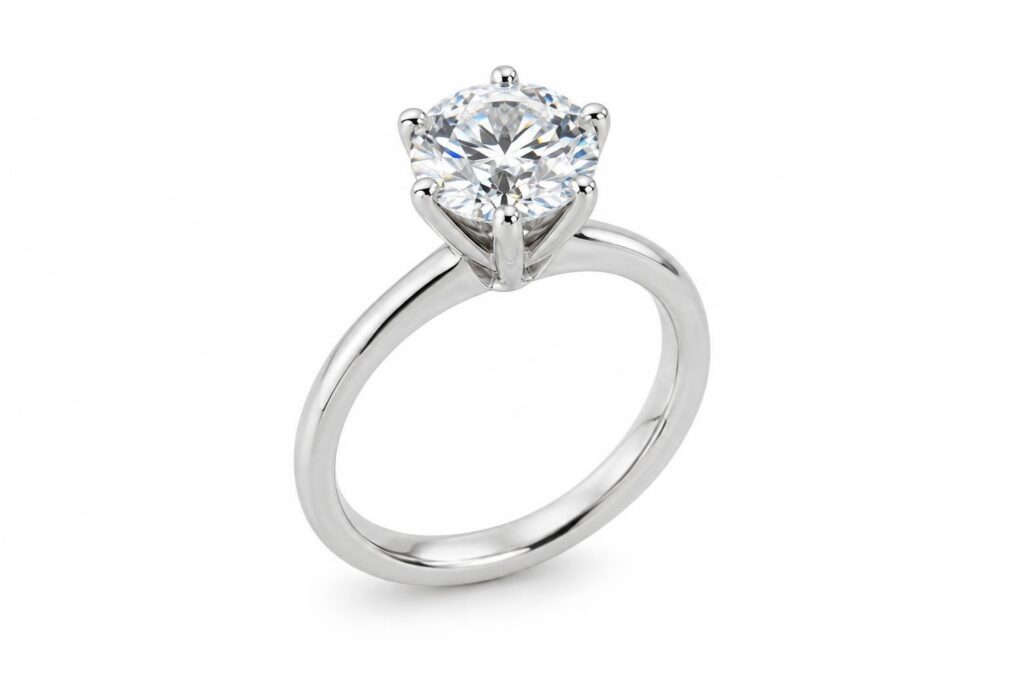
- Prongs, also called claws, are the small metal arms that grip the stone. Larger stones need more prongs. If you choose a larger centre stone, you could ask how many prongs the quote includes.
- Halo setting
- A halo surrounds the centre stone. That adds to the ring beyond the diamond itself, so the setting can change the total as much as the stone.
- Pavé setting
- Pavé may need occasional maintenance and can be harder to resize. Check this when you compare it with a plain band.
- Channel setting
- Channel-set rings can be hard to resize, so ask about resizing before you commit to one.
- Tension setting
- In a tension setting the stone is held by the pressure of the band. These rings can be hard to resize, and tension settings sometimes cannot be resized at all.
- Flush setting
- In a flush setting the stone is set into the band, so its top sits about level with the metal. Flush-set rings usually need wider, thicker shanks, so they often use more metal than raised settings.
The pictures show one typical version of each style. Real rings vary in prong count, stone size and band width. Pictures: AI-generated illustrations, checked for accuracy. They are not photographs of a real piece.
Why bigger stones need more prongs
Why count the prongs, also called claws? Because the number depends on the stone. Larger stones need more prongs, and large gemstones often need extra prongs for support 1. If you choose a larger centre stone, you could ask how many prongs the quote includes. The trade-offs are covered in four claws vs six claws.
Why halo and cluster settings change the look
Why do these two styles matter when you plan? A halo is a centre stone surrounded by a ring of smaller accent stones. A larger halo can greatly increase the ring’s overall footprint, which is the area the ring covers on your finger. A cluster setting works another way: smaller stones create a bold look while keeping a relatively affordable price 1.
How pavé and channel settings hold small stones
Why are these styles so detailed? In a pavé setting (said pah-vay), small stones sit in three or more rows, held by tiny beads of metal raised by hand. In a channel setting, stones sit in a row between two metal walls. Pavé, bead and channel settings all require metal to be removed to seat the stones 4.
Why accent stones are worth counting
Why look closely at the small stones? Because there can be a lot of them. Melee are small diamonds and gemstones weighing less than 1/5 carat, though size ranges vary across the trade 4.
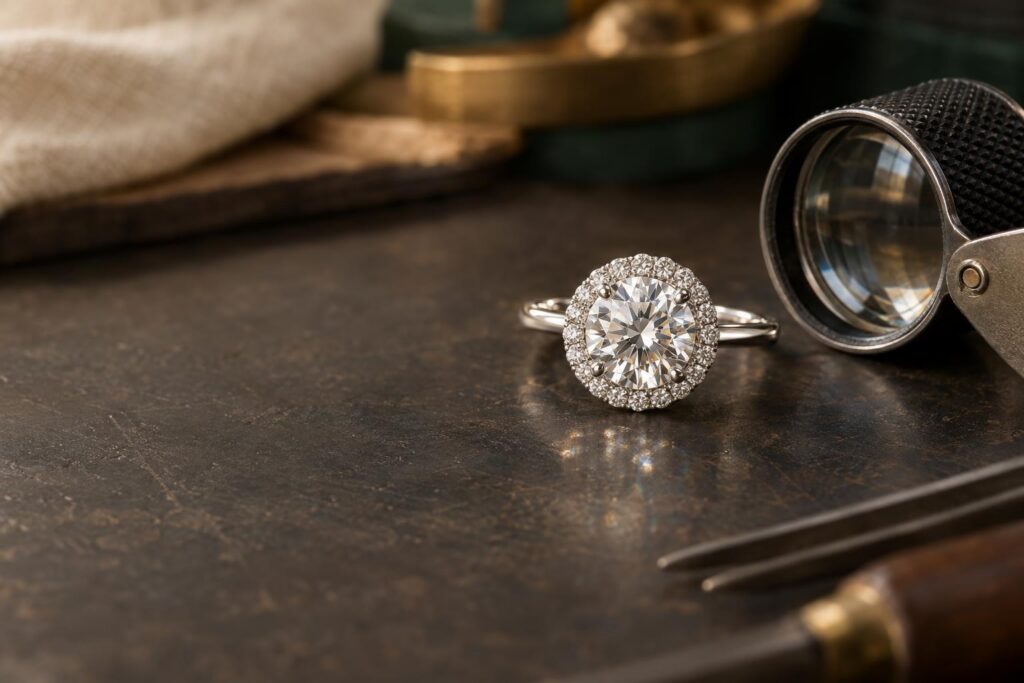
Why does the number matter? Each small stone is inexpensive compared with a larger centre stone, which is why designers use them generously to add sparkle. Yet one piece of jewellery can hold dozens or even hundreds of them, and cutting and sorting melee is labour-intensive. Manufacturers also try to match the colour of the small stones to the centre stone 4.
What does this mean for your total? Diamond weight drives price. A ring with many small diamonds totalling 2.50 carats total weight (tcw, the combined weight of all the stones) can cost much less than a single 2.50 ct diamond 4. For how weight relates to what you see, read diamond carat weight vs visible size.
Why band width and thickness matter
Why does the band matter? Because the style you choose can change its size. In a flush setting, the stone is set into the band so its top sits about level with the metal. Flush-set rings usually need wider, thicker shanks, so flush settings often use more metal than raised settings 1.
When you compare quotes, you could ask for the band’s width and thickness in millimetres, not only the style name. How width and style work together is covered in how to choose an engagement ring setting.
The downsides: when spending more on the setting isn’t the right choice
Why look at the downsides before you choose? Here are the facts on upkeep and resizing that sit alongside the cost:
- Upkeep and resizing: pavé may need occasional maintenance and can be harder to resize. Channel-set and tension-set rings, where the stone is held by the pressure of the band, can also be hard to resize, and tension settings sometimes cannot be resized at all 1.
- Replating: rhodium-plated white gold needs replating from time to time as the plating wears away 2.
- One total: if your budget is fixed, the stone and the setting share it. How you split it is your choice, and the 4 Cs of diamonds explains what each diamond grade changes.
There is another side too. A ring with many small diamonds totalling 2.50 ct can cost much less than a single 2.50 ct diamond 4. Which trade-off suits you depends on what you value most: the centre stone, the overall look or lower upkeep. Resizing limits are explained in why can’t every ring be resized?.
What to ask so your budget covers the whole ring
Why ask before you commit? So you know what each part of your quote is for. These questions follow the parts of the ring covered above:
- Which metal and which gold purity is quoted, and is there a quality mark inside the ring?
- How wide and how thick is the band, in millimetres?
- How many prongs hold the centre stone?
- How many accent stones are there, and what is their total weight (tcw)?
- Will the ring need replating or maintenance, and can it be resized later?
To try different splits between the stone and the setting, use the engagement ring budget planner. For the bigger picture, read how to set an engagement ring budget without salary rules.
If you would like to compare metals and settings side by side, Ralph Jacobs offers a free consultation. You can book it online from any country at bookings.ralphjacobs.org, or visit our showroom.
Frequently asked questions
Each small stone is inexpensive compared with a centre stone. But one piece can hold dozens or even hundreds of them, and cutting and sorting them is labour-intensive 4.
Yes. 18ct gold is 75% gold and 14ct gold is 58.3% gold. Look for the quality mark inside a ring to see its fineness 3.
It depends on the setting. Pavé can be harder to resize, channel-set and tension-set rings can be hard to resize, and tension settings sometimes cannot be resized at all 1. See why can’t every ring be resized?.