
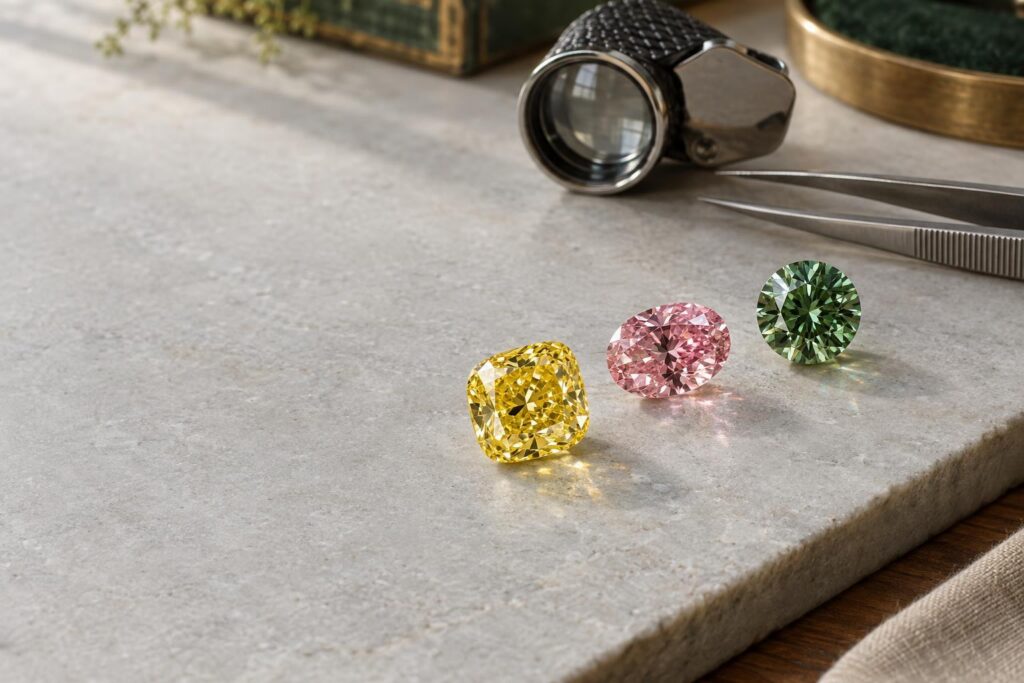
Why a diamond’s colour changes what you are buying
You may have seen a green diamond and wondered how a diamond can be green at all. Before you consider one, it helps to know that its colour is more than a look. For coloured diamonds, rarer colours are worth more 1.
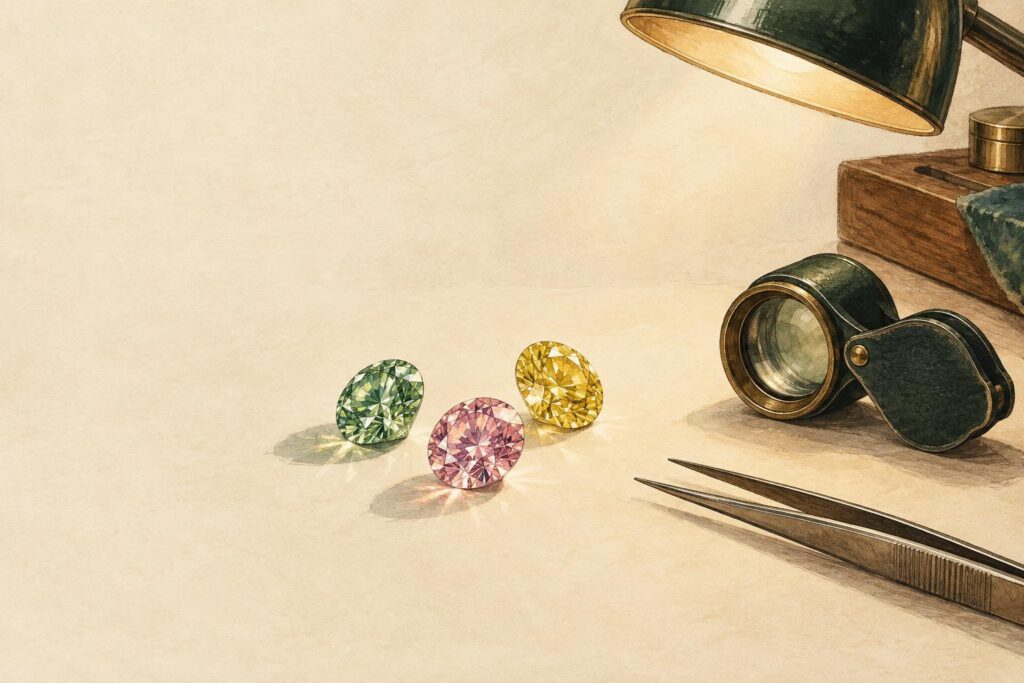
Diamonds whose colours fall outside the D-to-Z range are called fancy colours, or fancies. GIA grades their colour by hue, tone and saturation 1. You can read about the D-to-Z scale in the 4 Cs of diamonds.
There is one more layer. Yellow and orange diamonds, for example, can get their colour in the earth, from a colour treatment or from growth in a laboratory 3. A seller must disclose a treatment or laboratory growth 6.
- Structural imperfections in a diamond, and impurities such as boron, can create colour 5.
- Fancy coloured diamonds are graded by hue, tone and saturation, not on the D-to-Z scale 1.
- A natural-colour and a treated-colour green diamond can look the same but differ vastly in value 2.
- Treatments and laboratory growth must be disclosed by the seller 6.
Why are some diamonds coloured at all?
Why should a stone made of carbon show any colour? Because no diamond is perfect, and its structural imperfections can create colour 5. You will meet two terms below. A trace element is a tiny amount of another element, such as nitrogen or boron, caught inside the crystal. A structural defect is a fault in the way the carbon atoms are arranged.
Four fancy colours and what lies behind them
Switch between the colours to see how each looks and what the page says causes it.
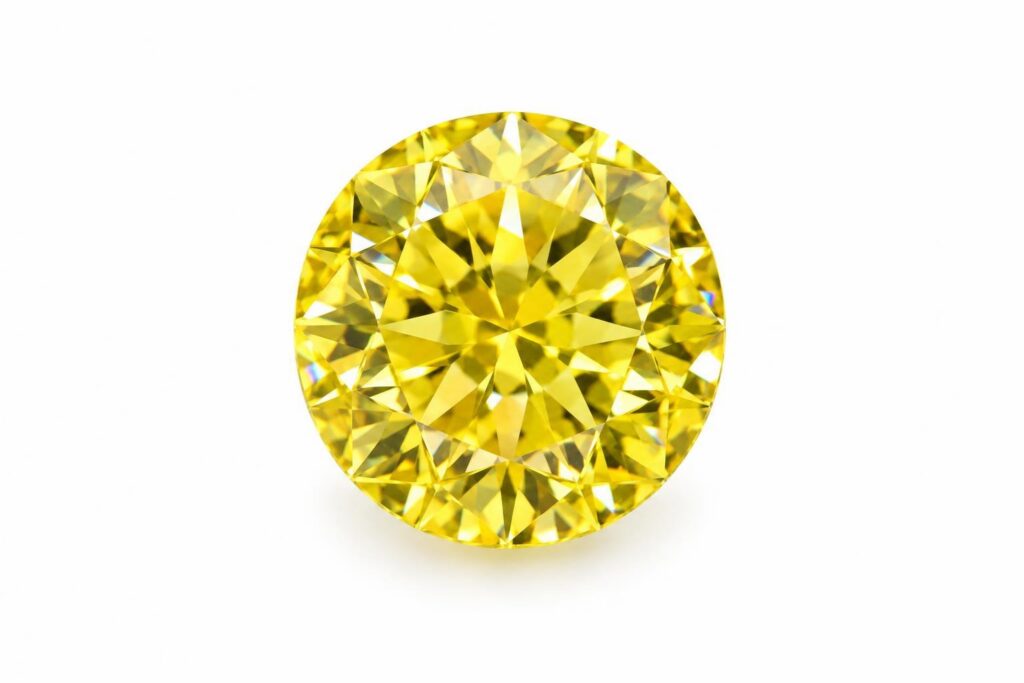
- Yellow
- Yellow is the most common fancy colour. It comes from atomic-level defects linked to nitrogen, the most common impurity in natural diamond. Yellow diamonds can get their colour in the earth, from a colour treatment or from growth in a laboratory.
- Orange
- Orange is linked to nitrogen, as yellow is. Like yellow, orange diamonds can get their colour in the earth, from a colour treatment or from growth in a laboratory, so a seller must disclose a treatment or laboratory growth.
- Green
- One known cause of green is radiation, which can be natural or applied in a laboratory. Natural and treated green diamonds can look the same but differ vastly in value, and a laboratory cannot always tell them apart.
- Brown
- Brown colour can come from vacancy clusters, a structural defect in the crystal. HPHT annealing, a controlled heating process at high pressure and high temperature, can remove it.
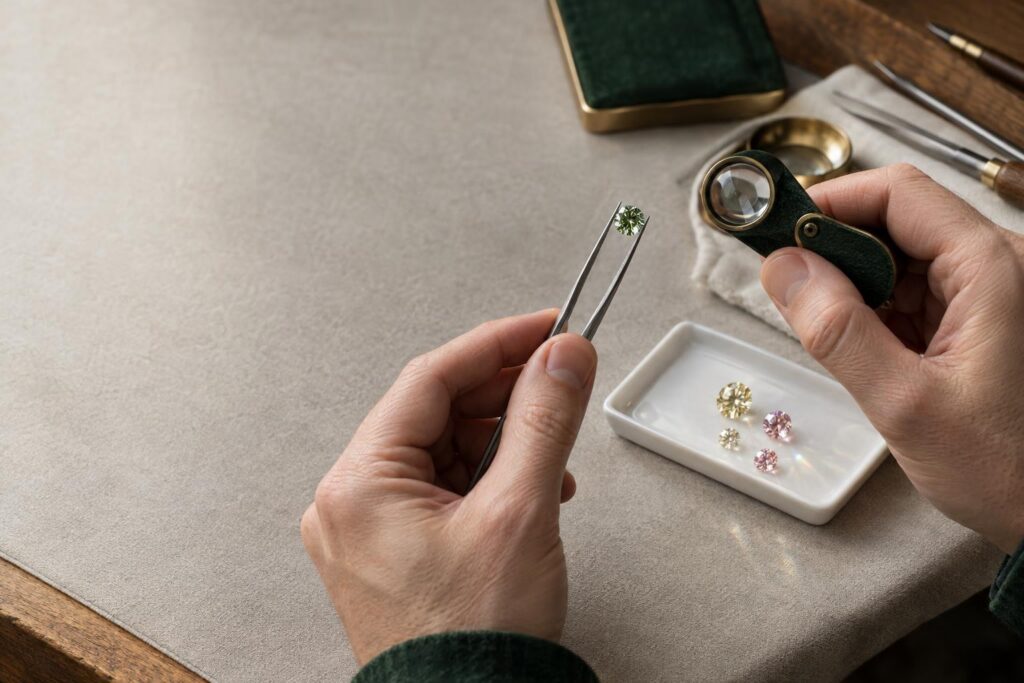
The pictures show typical examples. Real stones vary in tone and saturation, and pink is not shown because this page does not describe its cause. Pictures: AI-generated illustrations, checked for accuracy. They are not photographs of a real piece.
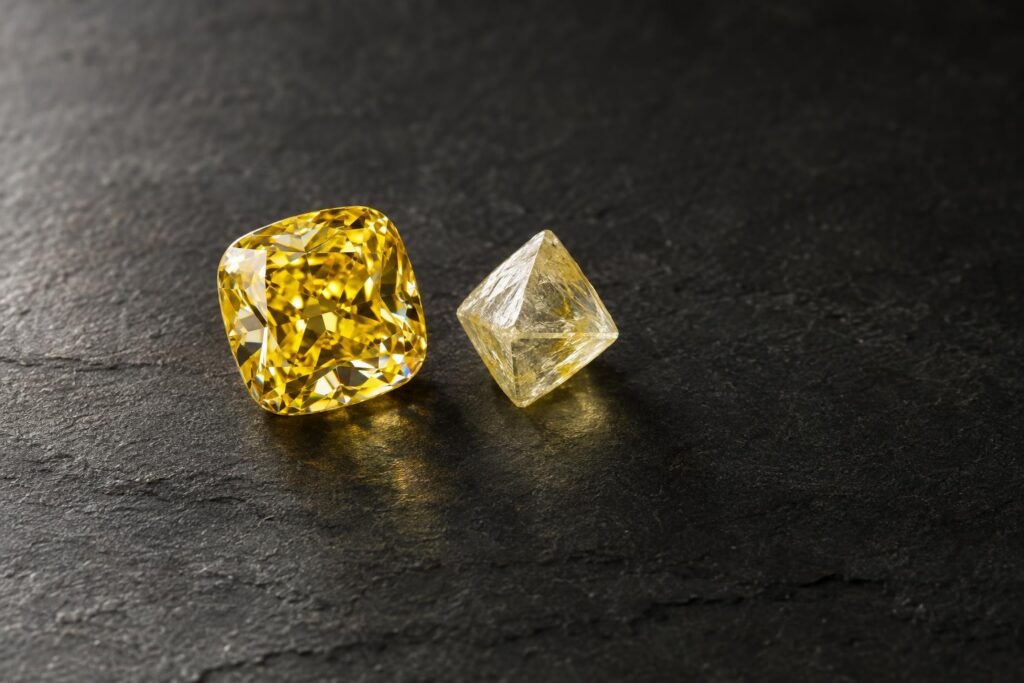
The sections below take each colour in turn, with the causes behind it. Knowing these causes helps you understand what a laboratory report is telling you about a stone.
Why yellow and orange are linked to nitrogen
Why is yellow the colour you see most often? Yellow is the most common fancy colour, while orange with no secondary colour is among the rarest. Both get their colour from atomic-level defects linked to nitrogen. Nitrogen is the most common impurity in natural diamond, because nitrogen and carbon atoms are very similar in size. Four groups of nitrogen-related defects cause nearly all yellow and orange colour 3.
Why pink and brown are linked to deformation
Why would a diamond turn pink? Most natural pink diamonds get their colour from a broad band of light absorption linked to plastic deformation. Plastic deformation means the crystal has been permanently bent out of shape, a little like a metal spoon that stays bent. The colour is often packed into narrow parallel lines, known as pink graining, caused by shear stress and natural plastic deformation 4.
The deformation that forms these coloured bands happens only while a diamond spends a long time above 900°C, deep in the earth or while erupting to the surface. Most brown diamonds are also coloured by natural deformation, through tiny clusters of missing atoms called vacancy clusters 4.
Why blue points to boron
Why are blue diamonds so seldom seen? Natural-colour blue diamonds are among the rarest gemstones. The most familiar cause is boron, in a diamond with extremely low nitrogen. This explains over half of the natural blues GIA sees with no secondary colour, and the Hope diamond owes its blue to boron. Blue, grey and violet can also come from defects caused by radiation, or from defects involving hydrogen 5.
Why green is often linked to radiation
Why should a green diamond prompt questions about its origin? One well-known cause of green colour is exposure to radiation, and that radiation can come from nature or from a laboratory. In nature, it comes from radioactive uranium in rocks near the earth’s surface. In a laboratory, it comes from a linear accelerator, gamma rays or a nuclear reactor 2.
Natural green crystals often carry green or brown "radiation stains" only on their surface. Cutting often removes these, so the finished stone loses most of its colour. The Dresden Green, about 41 ct, is different: its natural colour runs through the whole stone 2. Here ct means carat, the unit used to weigh diamonds.
Why fancy coloured diamonds are graded differently
Why can’t a green diamond be graded like a colourless one? Its colour falls outside the D-to-Z range, so it is called a fancy colour and graded on its own system. GIA grades it on three things 1:
- Hue: the colour itself. GIA recognises 27 hues for fancy coloured diamonds.
- Tone: how light or dark the colour is.
- Saturation: how deep and strong the colour is.
How is the grade decided? Graders look at the diamond face-up, meaning from the top, as it would sit in a ring. They view it under controlled lighting, compare it with reference stones, and give one of nine fancy grades. GIA first built the system in the 1950s for yellow diamonds, and an expanded version in 1994 added Fancy Deep and Fancy Vivid 1.
What does this mean when you compare stones? For fancy colours, rarer colours are worth more, and clarity, cut and carat weight matter less 1. Clarity is the grade for tiny features inside a diamond, called inclusions, and on its surface. For a closer look at the three colour terms, see hue, tone and saturation in gemstones.
Why the origin of colour matters as much as the colour
Why does it matter where the colour came from? Because two stones can look identical and still be valued very differently. Natural-colour and treated-colour green diamonds can look the same, but their value is vastly different. Earth’s radiation is so similar to treatment radiation that a laboratory cannot always tell them apart 2.
Diamonds can be treated to change their colour, so expert testing is needed to find what GIA calls the "origin of color" 1. Brown colour from vacancy clusters, for example, can be removed by HPHT annealing. HPHT stands for high pressure, high temperature, and annealing means a controlled heating process 4.
Colour can also be grown in. Yellow and orange diamonds can be grown in a laboratory, and most HPHT laboratory-grown diamonds come out yellow to orange under normal growth conditions, unless steps are taken to remove nitrogen 3. In pinks, nitrogen-vacancy centres (defects that pair nitrogen with a missing carbon atom) are almost always the cause in treated and lab-grown stones. Natural pinks coloured this way are extremely rare 4.
So identifying a fancy coloured diamond means answering two questions. Did it grow in the earth or in a laboratory? And is its colour natural or treated 3? To find your way around a report, see how to read a GIA diamond grading report. The HPHT method is compared with CVD in CVD vs HPHT lab-grown diamonds.
What a seller should tell you
Why can you expect a clear answer about origin? CIBJO, the World Jewellery Confederation, sets out disclosure rules for the diamond trade in its Diamond Book 6. Under those rules:
- All material information must be disclosed, even if you don’t ask and whatever the effect on value.
- A treated stone must be called a "treated diamond", with "treated" as prominent as "diamond". It must not be shortened or replaced by an asterisk.
- Words that hide a treatment, such as "improved", must not be used, and any special care the treatment needs must be disclosed.
- A stone grown wholly or partly in a laboratory must be described as "synthetic", "laboratory-created" or "laboratory-grown", placed directly before "diamond". It must never be called "natural", "real" or "genuine" 6.
The wider principles behind these rules are covered in how gemstone treatments should be disclosed.
When a fancy coloured diamond may not be the right choice
Why look at the downsides? Because each fact above has a flip side. Whether any of them matters depends on what you want from the stone.
- Origin can stay uncertain. For green diamonds, a laboratory cannot always tell natural colour from treated colour 2.
- Value rests on colour. Rarer colours are worth more, while clarity, cut and carat weight matter less 1.
- Some treatments need special care. Any special care a treatment requires must be disclosed, so it is worth asking what that care involves 6.
- Identification is part of the purchase. It means working out whether the stone grew in the earth or a laboratory, and whether its colour is natural or treated 3.
If you want to compare other coloured stones, how coloured gemstones are evaluated explains how they are judged, and which gemstones suit everyday rings looks at how they wear.
Why the right questions keep the decision yours
Why ask questions before you fall for a colour? Because the answers tell you what you are really buying. These questions follow from the grading and disclosure rules above:
- Is the colour natural, treated or laboratory-grown, and does a laboratory report say so?
- Which hue, tone and saturation does the report give, and which fancy grade?
- Has the stone been treated, and does that treatment need special care?
- For a green stone, was the laboratory able to determine the origin of colour?
If you’d like to look at fancy coloured diamonds and talk through a report, we offer a free consultation, online from any country at bookings.ralphjacobs.org, on WhatsApp or at our Secunda showroom. You can also read more about the stone itself on our diamond page.
Frequently asked questions
Both exist. One known cause of green is radiation, which can be natural or applied in a laboratory. Natural and treated green diamonds can look the same but differ vastly in value, and a laboratory cannot always tell them apart 2. Ask what the report says about the origin of colour.
Yellow is the most common fancy colour. It comes from atomic-level defects linked to nitrogen, the most common impurity in natural diamond 3.
They matter less than colour. For fancy colours, rarer colours are worth more, and clarity, cut and carat weight play a smaller part in value 1.
Yes. Yellow and orange diamonds can be grown in a laboratory, and under normal growth conditions most HPHT lab-grown diamonds come out yellow to orange, unless steps are taken to remove nitrogen 3. Laboratory growth must always be disclosed, using a term such as "laboratory-grown" directly before "diamond" 6.
Most often boron, in a diamond with extremely low nitrogen. This explains over half the natural blues GIA sees with no secondary colour, and the Hope diamond’s blue comes from boron 5.