
Key takeaways
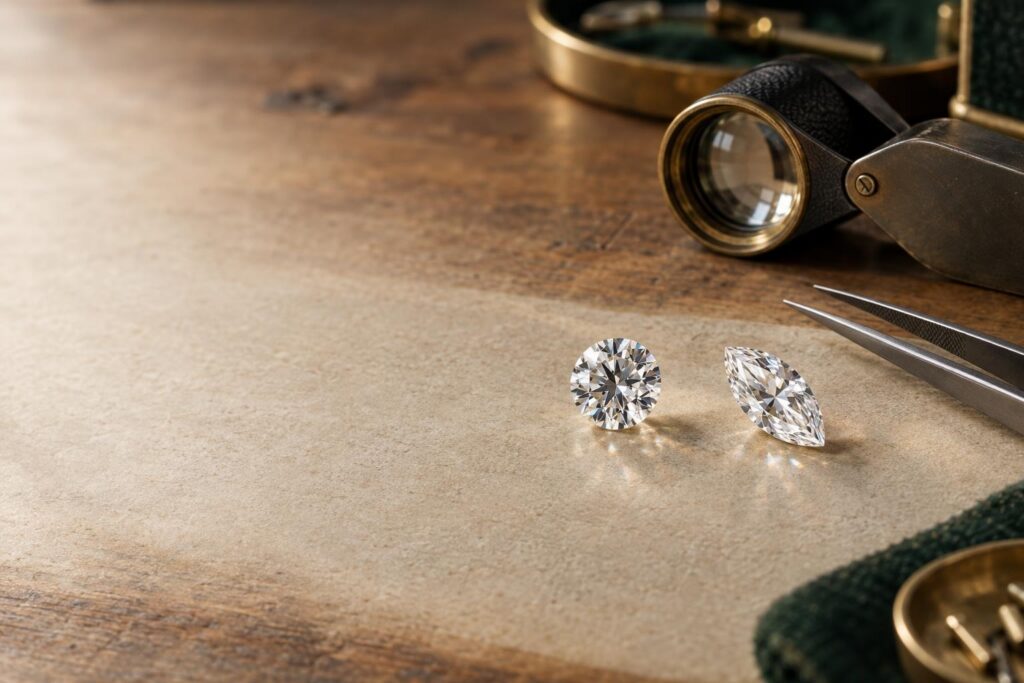
- A marquise’s long shape can make it look larger face-up than a round diamond of the same carat weight.
- Most marquise diamonds are cut between 1.5:1 and 2.5:1 length-to-width, and the ideal ratio is personal preference.
- Most marquise diamonds show a bow-tie; a slight one adds contrast, but a dark, wide one can reduce brilliance.
- The pointed tips are the parts most likely to chip, so V-prongs, bezels or halos are used to protect them.
- Check that the points line up, each half mirrors the other, and the tips are free of inclusions.
Why a marquise diamond ring looks larger than its weight
You may have noticed that a marquise diamond ring can look bigger than a round diamond of the same carat weight 3. That is not your imagination. Knowing why it happens, and what can go wrong with the shape, helps you choose one you will enjoy for years.
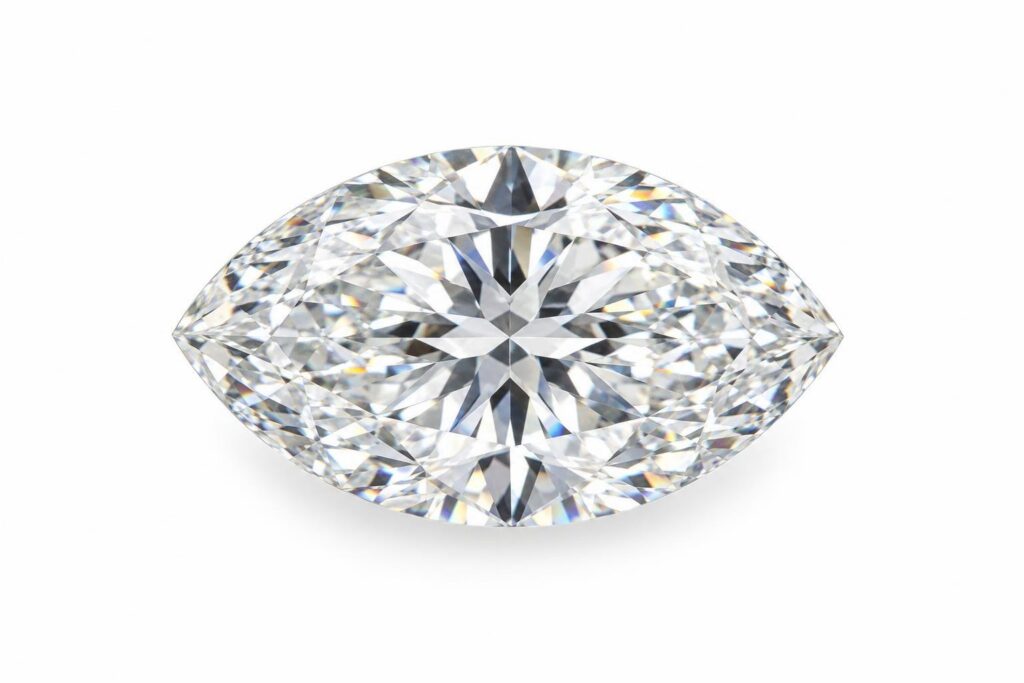
So what is a marquise? It has a long outline with curved sides and two pointed ends. It is also called a navette, because it looks like a simple boat, and the classic outline is formed where two circular arcs meet 2.
Why does it look bigger? Diamonds are weighed in carat, so two stones of the same carat weight can still look different in size. The long shape can make a marquise look larger face-up, meaning seen from above as it sits in a ring, than a round diamond of the same carat weight 1. It often looks larger than other shapes of the same weight too, and it makes the finger look longer and slimmer 3.
One laboratory’s guide also suggests oval or marquise shapes for slender fingers 6. To compare outline sizes by weight, try the Carat to Millimetre Estimator. For the wider story, see why carat weight and visible size don’t always match.
Why the length-to-width ratio changes the look
Why does one marquise look sleek and another look short and wide? The answer is the length-to-width ratio. It compares the length from point to point with the width across the belly, the widest part of the stone. A ratio of 2:1 means the stone is twice as long as it is wide, which is the classic marquise 1.
How the length-to-width ratio changes a marquise
The ratio compares the length from point to point with the width across the belly. Step through three ratios from the usual range to see how the outline changes.
- 1.5:1, the short end
- Marquise diamonds are usually cut between 1.5:1 and 2.5:1, and 1.5:1 is the short end of that range. Very short stones can look stubby.
- 2:1, the classic
- A ratio of 2:1 means the stone is twice as long as it is wide. This is the classic marquise.
- 2.5:1, the long end
- At 2.5:1 the stone sits at the long end of the usual range. Longer stones are harder to cut with good face-up brightness, and a marquise that is too long could be less durable.
The pictures show the same style of cut at different ratios. Real stones also vary in bow-tie, symmetry and girdle, which these images do not show. Pictures: AI-generated illustrations, checked for accuracy. They are not photographs of a real piece.
How long are most marquise diamonds? They are usually cut somewhere between 1.5:1 and 2.5:1, which is longer than ovals or pears 2.
What does the ratio change? Longer stones are harder to cut with good face-up brightness, and very short ones can look stubby 1. A marquise that is too long could also be less durable 5.
Guides differ a little on the range to aim for. Marquise diamonds sent to the GIA lab most often fall between 1.6:1 and 2.2:1, yet the same guide says the ideal ratio is, in the end, personal preference 1. Another guide suggests 1.75:1 to 2.25:1 5. Seeing a few ratios side by side can help you learn which outline you like.
The scale runs from 1.4:1 to 2.6:1 and highlights 1.6:1 to 2.2:1, the ratios most often seen in marquise diamonds at the GIA lab, with the classic 2:1 marked 1.
- 1.61.6:1
- 2Classic 2:1
- 2.22.2:1
Why many marquise diamonds show a dark bow-tie
Why does a dark band sometimes cross the middle of a marquise? Most marquise diamonds show a bow-tie: a dark, hourglass-shaped area across the centre 1. It can range from slight to thick, and some bow-ties brighten as the stone moves 2.
How does it happen? When you look down at the stone, your head and shoulders block some of the light that would enter it 1. The facet pattern and proportions can make the bow-tie stronger or weaker. Main facets on the pavilion that run across the belly often make it stronger 2.
The pavilion is the lower part of the diamond, below its widest edge. Very shallow or very deep pavilions are more likely to give a strong bow-tie, while balanced proportions help reduce it. Looking at the stone under several kinds of light shows how strong it really is 1.
What does this mean for you? A slight bow-tie is normal and adds contrast, but a dark, wide one can reduce brilliance, the white light a diamond returns to your eye. Broad, dark bow-ties that stay visible as the stone moves are generally disliked, while opinions differ on narrower, lighter ones 2. For more detail, see why some diamonds show a dark bow-tie.
Why the points and symmetry deserve a close look
Why focus on the tips? The pointed tips are the parts of a marquise most likely to chip or break 1. That makes it worth checking how they were cut.
How do cutters protect the points? The girdle is the thin outer edge that runs around a diamond. A slightly thicker girdle at the points is acceptable and often helps, and some cutters use French tips, a facet pattern that strengthens the points 1. Trade observers have criticised girdles that are too thin or uneven in thickness 2.
Why does symmetry matter so much here? Symmetry describes how evenly the outline and facets are shaped and lined up. On a marquise, uneven sides or misaligned points are obvious, so guides suggest a symmetry grade of Excellent or Very Good 3. A simple check is whether the two points line up and each half mirrors the other 5. For how grades are laid out on a report, see how to read a GIA diamond grading report.
What about inclusions? Inclusions are features inside a diamond, and they vary in size. A marquise can hide small inclusions quite well at either end 3. Even so, check the points for inclusions 5.
Why the setting decides how well the points are protected
Why does the setting matter so much for this shape? Because the tips are vulnerable, the metal around them does a lot of work. A claw setting holds the stone with small metal arms, called claws or prongs. V-prongs are claws shaped like a V that wrap around each point to protect it 1. By wrapping the points, they reduce the risk of chipping and keep the stone secure 4.
How are the claws usually arranged? Six-prong settings usually use two V-prongs at the tips and four prongs on the sides 1. More prongs add security, while fewer prongs show more of the stone 4. The trade-offs are covered in 4 claw vs 6 claw settings.
What other options are there? A bezel is a rim of metal around the stone, and it can be partial or full. Bezels give more protection and are much less likely to snag on clothing than prong or halo settings, which suits active wearers 1.
A halo softens the sharp tips with a border of small diamonds, and an east-west setting turns the stone sideways 3. A halo also adds a buffer around the centre stone and often makes it look larger 1. For more styles, see ring settings explained.
| Six claws with V-prongs | Bezel (partial or full) | Halo | |
|---|---|---|---|
| Layout | Two V-prongs at the tips, four prongs on the sides 1 | A metal rim around part or all of the stone 1 | A border of small diamonds that softens the sharp tips 3 |
| How the tips are protected | V-prongs wrap the points, reducing the risk of chipping 4 | More protection than prong or halo settings 1 | Adds a buffer around the stone 1 |
| Snagging | More likely to snag than a bezel 1 | Much less likely to snag than prong or halo settings 1 | More likely to snag than a bezel 1 |
| Often noted for | More prongs add security 4 | Suits active wearers 1 | Often makes the stone look larger 1 |
When a marquise diamond ring may not be the right choice
Why think about the downsides before you buy? The features that make a marquise striking also bring trade-offs. Knowing them helps you judge whether the shape fits your daily life.
- Chipping risk: the pointed tips are the parts most likely to chip or break 1.
- Bow-tie: on elongated shapes, most brilliant facet patterns produce one, and it can range from slight to thick 2.
- Visible shape flaws: uneven sides or misaligned points are obvious on a marquise 3.
- Very long stones: a marquise that is too long could be less durable 5.
If you lead an active life, the setting is part of the answer. Prong and halo settings are more likely to snag than a bezel, while partial or full bezels give more protection and suit active wearers 1. If you would rather avoid points altogether, choosing a diamond shape compares other outlines, so you can weigh the look against the care each one needs.
What to check before you buy a marquise diamond ring
Why use a checklist? The checks in this article are easy to forget once you fall for a ring. The steps below gather them in one place, so you can work through them stone by stone.
For colour, clarity and carat, see the 4 Cs of diamonds, which explains what each grade changes. If you would like to compare marquise outlines and settings with a jeweller, Ralph Jacobs offers a free consultation, online from any country at bookings.ralphjacobs.org, or at our showroom in Secunda.
Checking a marquise diamond ring
- Choose your ratio Most marquise diamonds are cut between 1.5:1 and 2.5:1 2. Very short stones can look stubby 1, and a stone that is too long could be less durable 5.
- Look for the bow-tie View the stone in several kinds of light. A slight bow-tie adds contrast; a dark, wide one can reduce brilliance 1.
- Check the symmetry Make sure the two points line up and each half mirrors the other 5.
- Inspect the points Look for inclusions near the tips 5. A slightly thicker girdle at the points is acceptable and often helps 1.
- Match the setting Ask how each point is protected, for example with V-prongs, a bezel or a halo 1.
Frequently asked questions
It often does. The long shape can make a marquise look larger face-up than a round diamond of the same carat weight, and its slim outline makes the finger look longer 1.
There is no single right answer. The classic marquise is about 2:1, and stones at the GIA lab most often fall between 1.6:1 and 2.2:1. The ideal ratio is, in the end, personal preference 1.
Not always. Most marquise diamonds show one. A slight bow-tie is normal and adds contrast, but a dark, wide one can reduce brilliance, so view the stone in several kinds of light 1.
The pointed tips are the parts most likely to chip. V-prongs, bezels and halos help protect them, and a slightly thicker girdle or French tips at the points can help too 1.
Yes. An east-west setting turns the stone sideways 3. The points still need protecting, so ask how each tip is held.