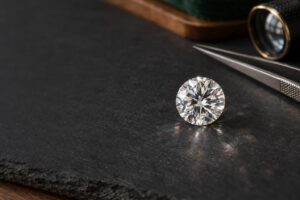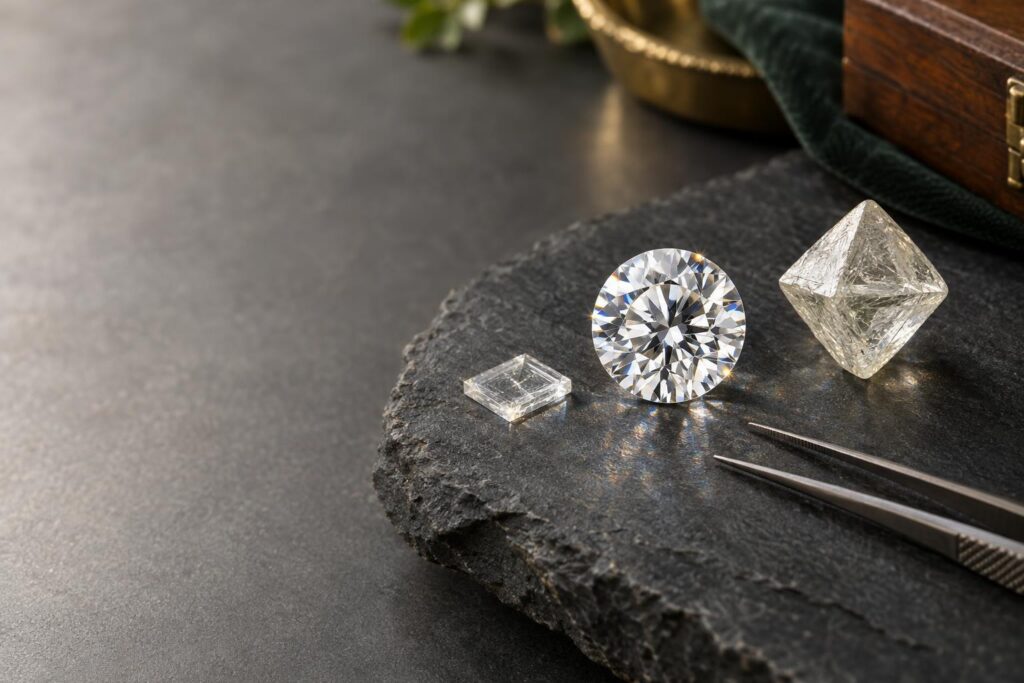
Why a laboratory-grown diamond is a diamond, not an imitation
Why does it matter what a laboratory-grown diamond really is? Natural, laboratory-grown and treated diamonds differ greatly in commercial value, so correct identification matters for valuation and disclosure 1. A laboratory-grown diamond is diamond made by people in a laboratory or factory, rather than formed by nature 3.
How is it different from a look-alike? CIBJO, the World Jewellery Confederation, defines it as an artificial product with essentially the same chemical composition, physical properties and structure as diamond, whichever growth method is used 6. A simulant only looks like diamond. Cubic zirconia and synthetic moissanite are simulants, while laboratory-grown diamonds correspond very closely to natural diamonds in their chemical and physical properties 1.
What should you call it? Laboratory-grown, laboratory-created and synthetic all mean the same thing, and CIBJO prefers "laboratory-grown diamond" for buyers. Its guidelines say words such as natural, real, genuine, cultured and gem shall not describe these stones 6. CVD diamond was first grown in 1952, although for decades those crystals were not suited to gems 2. HPHT growth followed in the mid-1950s, and gem-quality crystals have been produced since the mid-1990s 1.
Why it helps to know how a lab-grown diamond is made
Why should you care how a stone was grown? Each method leaves its own growth markers in the crystal, and these let GIA tell laboratory-grown from natural diamond and even identify the method used 1. Both methods start from a diamond seed, a piece of diamond that acts as the blueprint for the growing crystal 2.
- HPHT (high pressure, high temperature): a carbon source crystallises on the seed at 1300–1600 °C and 5–6 gigapascals (GPa) of pressure. 3
- CVD (chemical vapour deposition): hydrogen and a carbon gas such as methane are broken down by a microwave beam in a vacuum chamber. The carbon settles on flat diamond seed plates. Growth stops and starts so that non-diamond carbon can be polished off 1.
CVD runs at moderate temperatures of 700–1300 °C and lower pressures than HPHT 3. CVD stones dominate the laboratory-grown diamonds sent to GIA for grading 2. For a side-by-side look, see CVD vs HPHT lab-grown diamonds.
Why lab-grown diamonds come in different colours
Why does colour tell you something about a laboratory-grown diamond? Colour can come from the growth itself or from work done afterwards. Adding boron during growth gives blue, while pink and red can come from radiation and heating after growth 1.
Lab-grown diamond colours and where they come from
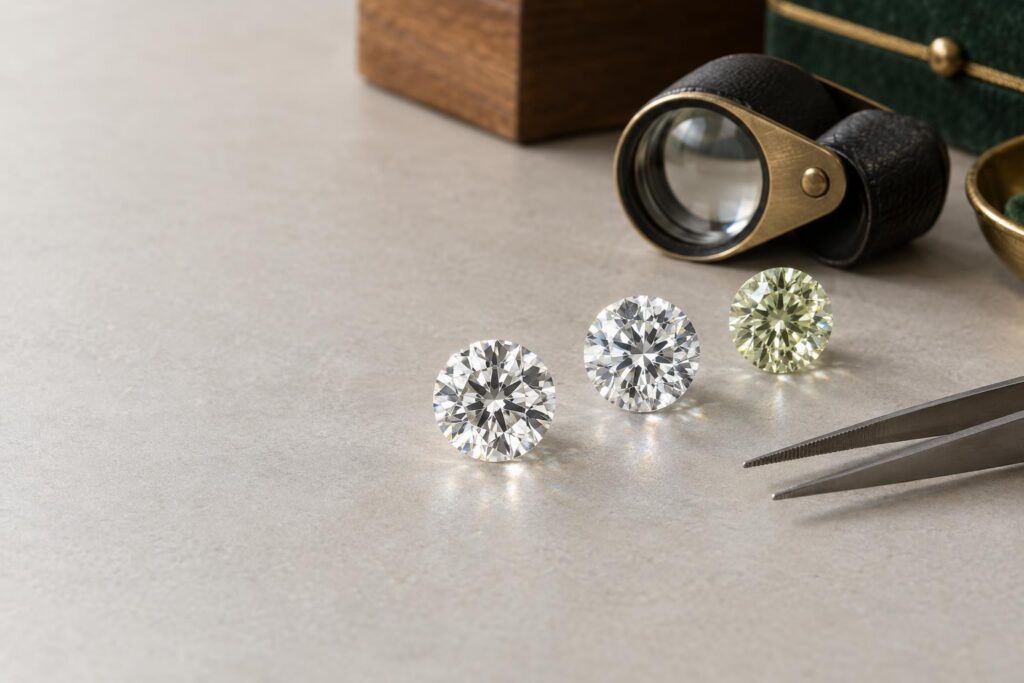
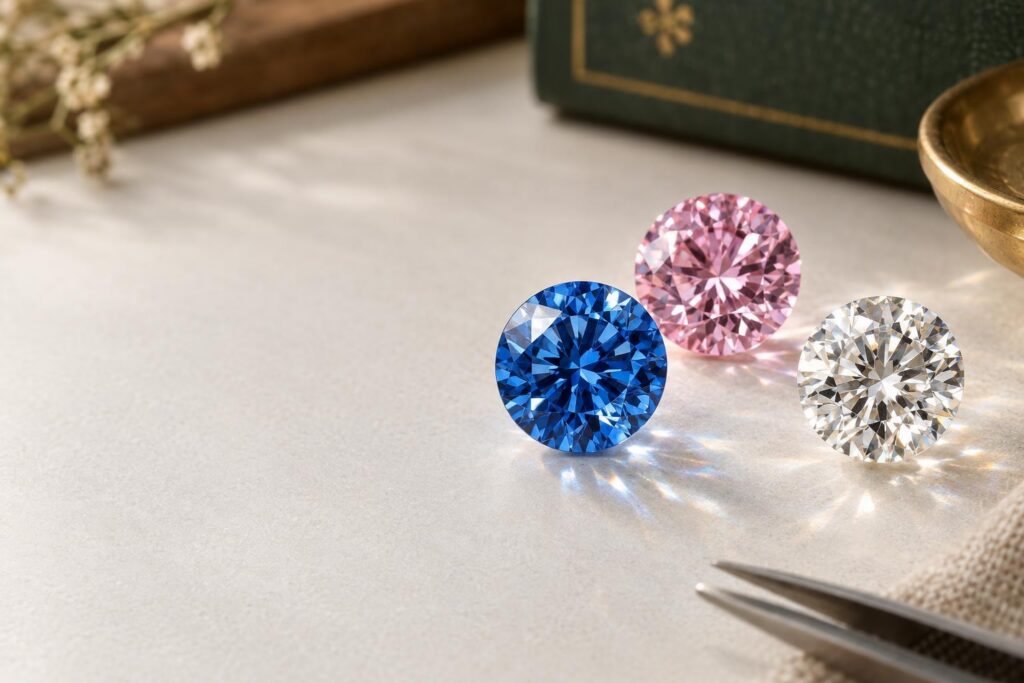
Colour in a laboratory-grown diamond can come from the growth itself or from work done afterwards. Switch between the stones to see what produces each colour.
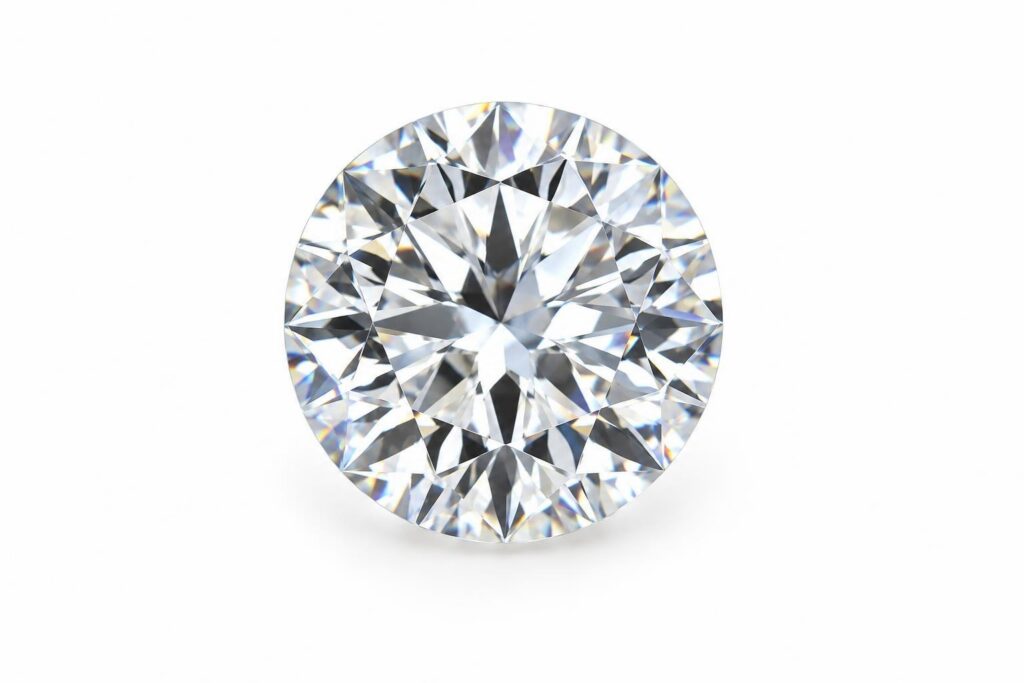
- Colourless
- Colourless laboratory-grown diamonds are type II, which means they have no detectable nitrogen. Only about 1% of natural diamonds are type II.
- Blue
- Adding boron during growth gives a blue diamond.
- Pink or red
- Pink and red can come from radiation and heating after growth, so these colours can be the result of work done once the crystal has formed.
- Brown
- Producers may grow CVD diamond quickly even if it turns out brown, then improve its colour grade by annealing, a controlled heating process.
The colours shown are illustrative. Real stones vary in depth and evenness of colour, and a stone's colour alone does not show how it was made. Pictures: AI-generated illustrations, checked for accuracy. They are not photographs of a real piece.
Colourless laboratory-grown diamonds are type II, which means they have no detectable nitrogen. Only about 1% of natural diamonds are type II. Producers may also grow CVD diamond quickly even if it turns out brown, then improve its colour grade by annealing, a controlled heating process 2.
Why post-growth treatment should be disclosed
Why does treatment matter if the stone is already laboratory-grown? Because it is a common step. Most colourless CVD material on the market probably began as brown crystals that were decolourised by HPHT annealing 1. The same HPHT equipment can also improve the colour of natural or laboratory-grown diamonds 3.
What should be disclosed? Under the CIBJO guidelines, sellers must disclose that goods are laboratory-grown before the sale and on all commercial documents. They add that the growth process and any post-growth treatment should be disclosed, with the process given by its full name (high pressure, high temperature or chemical vapour deposition) and not only as HPHT or CVD, and that a stone treated later needs a new report 6.
IGI reports for untreated CVD and HPHT stones name the growth process and say "as grown with no indication of post-growth treatment". Other CVD stones are noted as "may include post-growth treatment" 5. Read more in how gemstone treatments should be disclosed.
Why a lab-grown diamond wears like a diamond
Why look at durability? If you plan to wear a piece often, you will want to know how the stone holds up. A laboratory-grown diamond has essentially the same physical properties and structure as diamond, and CIBJO counts care requirements as "material information": facts that could change a stone’s value, saleability or desirability 6. For what diamond’s properties mean in daily wear, including its place on the Mohs scale (a ranking of scratch resistance), see the diamond entry.
Why the grading report matters when you buy
Why lean on a report? Colourless to near-colourless laboratory-grown diamonds share so many properties with natural ones that they are hard to separate without advanced equipment or a laboratory 2. GIA studies inclusions (tiny features inside a stone), graining, reactions to ultraviolet light such as fluorescence (a glow under ultraviolet light), and other features to decide whether a stone is natural, treated or laboratory-grown 3.
How do laboratories spot the growth method? Markers include metallic flux inclusions and geometric colour zoning in HPHT stones, and banded strain in CVD stones 1. A "LABORATORY-GROWN" inscription or maker’s mark is commonly found on the girdle, the thin outer edge, of commercial-size stones 2.
How grading works: the four Cs
Why are diamonds graded on four things? No single quality tells you how a stone will look. The four Cs are colour, clarity, cut and carat weight. Colour describes how colourless a stone is, on a scale from D to Z. Clarity describes how free it is of internal features (inclusions) and surface marks (blemishes).
Cut grade describes how well the stone is proportioned and finished, which is not the same as its shape, such as round or oval. Polish and symmetry are part of this: they describe the finish of the facets and how evenly they line up. Carat is the unit used to weigh gemstones. For more, see the 4 Cs of diamonds.
How GIA classes lab-grown diamonds
Why does GIA use different terms for laboratory-grown diamonds? Its stated reason is that most of them fall into a very narrow range of colour and clarity. For D-to-Z laboratory-grown diamonds, GIA uses descriptive terms instead of the grading terms it created for natural diamonds. Stones are classed Premium or Standard from an overall assessment of clarity, colour and cut 4.
- Premium: D colour, VVS clarity (very, very slightly included) or higher, and Excellent polish and symmetry. Round brilliants also need an Excellent cut grade.
- Standard: any combination of Premium-level criteria and these minimums: E to J colour, VS clarity (very slightly included), Very Good polish, and Very Good symmetry (Good for fancy shapes, meaning shapes other than round). Round brilliants also need at least a Very Good cut grade.
- Below the Standard minimum: the stone gets no assessment. Each assessed stone’s girdle is laser-inscribed with "Laboratory-Grown" and its assessment number 4.
How other reports describe grades
Why compare report styles? Reports do not all record the same details. IGI has issued laboratory-grown diamond reports since 2005. Its reports can name the growth process, and you can ask for the diamond type: type IIa for CVD stones and type II for HPHT stones 5.
The recommended approach in the CIBJO guidelines is the standard D–Z colour and clarity terms with an "LG" prefix, such as "LG VS1", plus a footnote explaining it. The report heading must state "Laboratory-Grown Diamond" clearly and prominently 6. For how GIA and IGI present colour and clarity grades, see GIA vs IGI diamond reports and how to read a GIA diamond grading report.
Why identification affects value
Why does all this checking matter? Natural, laboratory-grown and treated diamonds differ greatly in commercial value 1. How much that matters depends on why you are buying. Natural vs lab-grown diamonds: a clear comparison sets out both sides.
Why you might want to talk it through
Why ask questions before deciding? You may have questions about your own situation that an article cannot answer. If you would like to compare laboratory-grown and natural diamonds and ask questions, we offer a free consultation, online from any country at bookings.ralphjacobs.org. Inclusion in this guide does not confirm that Ralph Jacobs stocks this gemstone.
Frequently asked questions
In composition and structure, yes. A laboratory-grown diamond has essentially the same chemical composition, physical properties and structure as diamond 6. What differs is its origin: people grow it in a laboratory or factory, rather than nature forming it.
Not with the unaided eye. Colourless to near-colourless laboratory-grown diamonds are hard to separate from natural ones without advanced equipment or a laboratory 2. A grading report, and the girdle inscription found on many stones, help confirm what you have.