
Why does the pavilion matter? It is the part that sends light back to your eye, so it shapes how bright your diamond looks. The pavilion runs from the bottom edge of the girdle (the thin outer rim of the stone) down to the culet, the tip at the bottom 2. Its facets (small, flat, polished surfaces) reflect light back up through the crown, the top part of the stone, to your eye 1.
The parts of a diamond
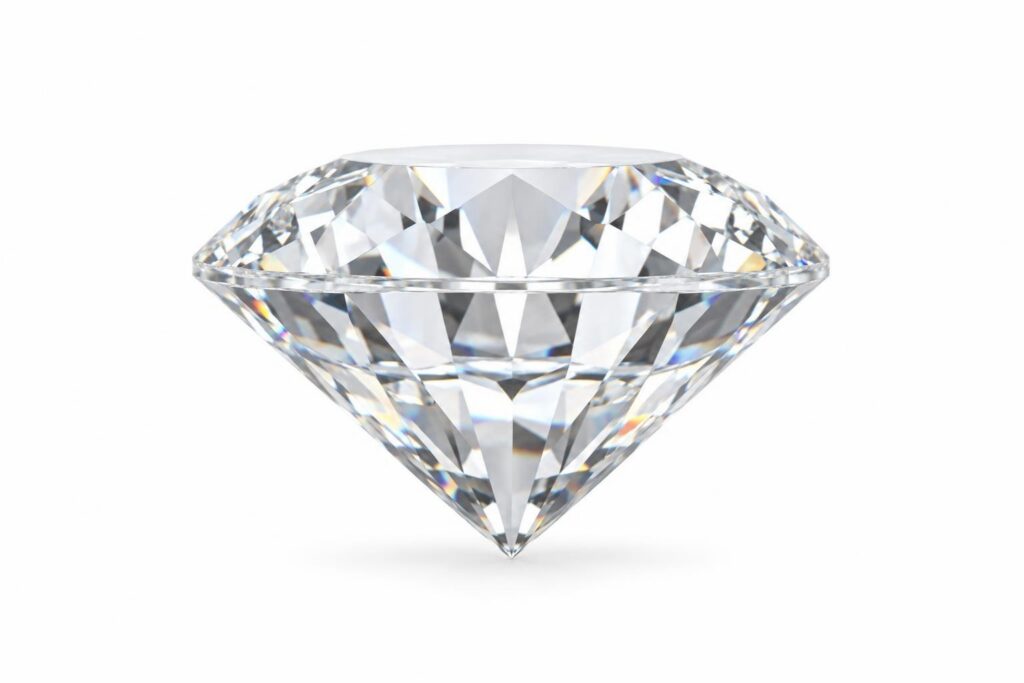
- Table
- The large flat facet on top. Most light enters the stone here.
- Crown
- The upper part, between the table and the girdle. Its angled facets help split light into flashes of colour (fire).
- Girdle
- The thin outer edge at the widest point. The setting usually grips the stone here.
- Pavilion
- The lower part, below the girdle. Its angle decides how much light reflects back up through the top.
- Culet
- The point, or tiny facet, at the very bottom of the pavilion.
- Total depth
- The height from the table to the culet, compared with the diameter. It is one of the measurements behind the cut grade.
Pictures: one AI-generated illustration of a diamond, adjusted for each grade. They show how the grades differ; they are not a grading of any stone.
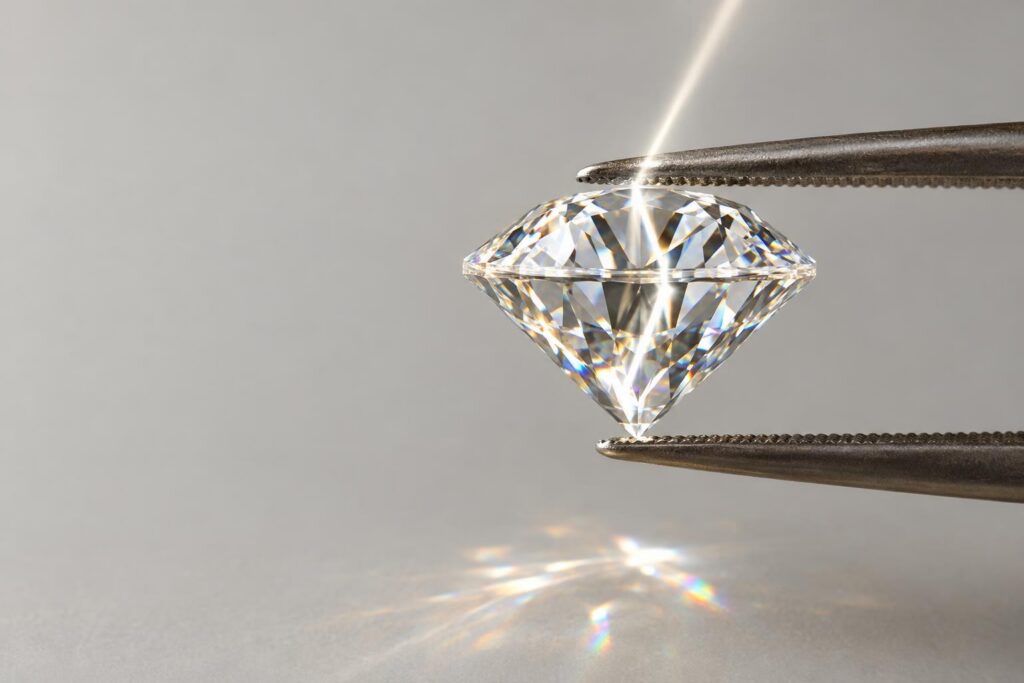
Why do its depth and angles matter so much? A pavilion that is too shallow or too deep lets light escape out of the side or bottom, instead of sending it up through the crown 2. Small changes in pavilion angle can strongly affect how the stone looks from above 1. One GIA study found that brilliance (white light returned to your eye) peaked at a pavilion angle of about 40.7°, with the other proportions held at set values. The authors also advise against judging cut one measurement at a time 4.
What does a poor pavilion look like? Light that passes through the pavilion and is lost can leave dark or neutral areas 6. Poorly cut diamonds can look dull and lifeless 3. A very shallow pavilion can cause a "fish-eye" effect, where the girdle reflects in the table, the large flat top facet 5.
Example: Imagine your GIA report for a round diamond lists a pavilion angle of 41.0°. That sits inside the 40.6° to 41.8° range GIA gives for "Excellent", as long as the other measurements are also in range 2. A stone with a much steeper angle may show dark areas under the table 1.