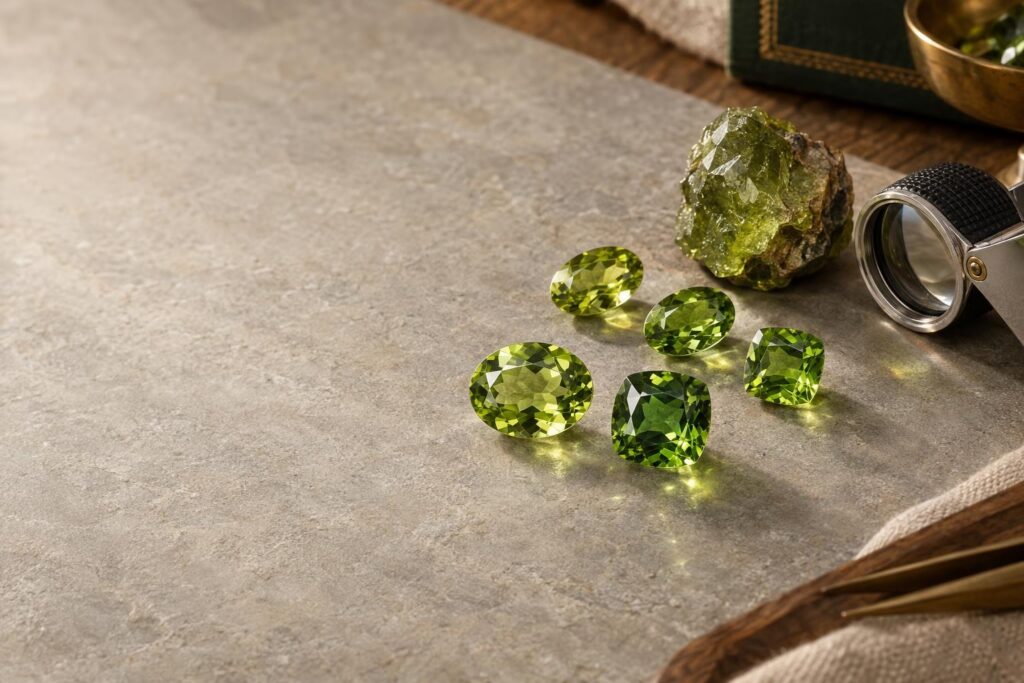
Why peridot is green by nature
Why is peridot always some shade of green? Its colour comes from its own chemistry, not from a trace of something else. Peridot is the gem variety of the mineral olivine, with the formula (MgFe)₂SiO₄, and the iron in it causes its yellowish-green colours 1.
Research on peridot from Pakistan found the stones were 88–96% forsterite, the magnesium-rich form of olivine 6. Forsterite belongs to the olivine group and forms a series with another mineral called fayalite 5.
Why peridot’s green varies from stone to stone
Why does one peridot look brownish and another look bright green? Its colour range is narrow, moving from brown-green through yellowish green to pure green. Yellowish green is the colour most often seen in jewellery 2. Peridot from Pakistan ranges from yellowish green to greenish yellow 6.
The colour range of peridot
Peridot is always some shade of green, but the shade changes from stone to stone. Step through the range from brown-green to pure green.
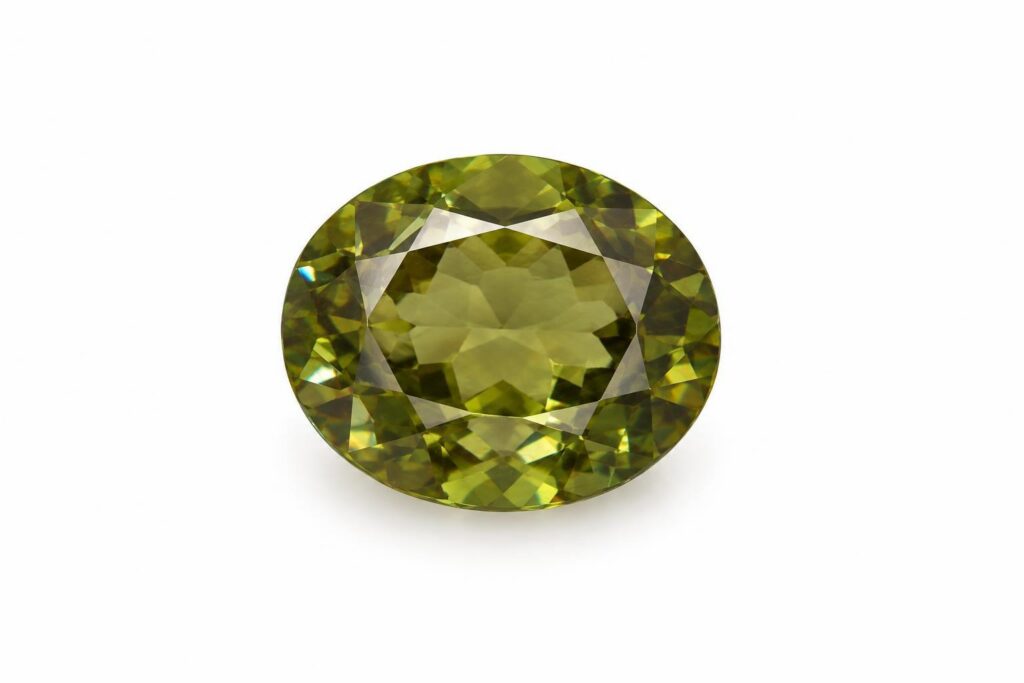
- Brown-green
- This is where peridot's narrow colour range begins. Brown undertones lower the value of a stone.
- Yellowish green
- This is the colour most often seen in jewellery. Smaller stones tend to look yellowish green, and peridot from Pakistan ranges from yellowish green to greenish yellow.
- Pure grass green
- This richly saturated grass green is the most favoured colour. It is usually seen only in stones of 10 ct or more.
Screens show colour differently, and the stones are drawn at the same size to compare them. In reality, pure grass green is usually found only in larger stones. Pictures: AI-generated illustrations, checked for accuracy. They are not photographs of a real piece.

Size plays a part too. The most favoured colour is a richly saturated pure grass green, which is usually seen only in stones of 10 ct or more, while smaller stones tend to look yellowish green 4. A carat (ct) is the unit used to weigh gems.
Peridot has a vitreous lustre, meaning its surface shines like glass, and it is transparent to translucent 5. It also has very strong double refraction: light splits in two as it passes through. Look closely through the stone and you can see two of each back facet, on the part called the pavilion 1.
Why the inside of a peridot is worth a closer look
Why look at what is inside a peridot? An inclusion is an internal feature of a gem, such as a tiny crystal of another mineral, and inclusions affect how clear a stone looks. In higher-quality peridot, no inclusions are visible to the eye, though tiny black spots, which are minute mineral crystals, may appear under magnification. Another common inclusion is a reflective, disc-shaped feature called a "lily pad" 4.
Some inclusions even hint at a stone’s history. In Pakistani peridot, researchers found ludwigite, magnetite, serpentine and brucite, and ludwigite can help show where a stone was mined 6.
Why treatment is rarely part of peridot’s story
Why ask about treatment at all? A label such as "unheated" can sound like a sign of something special. No peridot is known to be heated to improve its appearance, so an "unheated" claim is technically true but misleading 4. It does not set one peridot apart from another. To learn more, see heat treatment in gemstones and how gemstone treatments should be disclosed.
Why peridot needs a little care in daily wear
Why does peridot need more thought than some gems? Hardness and toughness are different things. The Mohs scale ranks how well a material resists scratching, and peridot sits at 6.5 to 7. Its toughness, which is resistance to chipping and breaking, is fair to good 3.
Mineral data describe it as brittle. It has imperfect cleavage, a tendency to split along certain flat planes, and conchoidal fracture, meaning it breaks with curved, shell-like surfaces 5. That is why the Mohs scale is not the whole durability story.
GIA calls peridot durable enough for jewellery, but suggests wearing it with some care to avoid scratches, and to avoid hard knocks that can fracture it. Rapid or uneven heat can also cause fractures. It is stable to light, but sulfuric acid attacks it easily, hydrochloric acid less easily, and acidic sweat can attack it over a long time 3.
How should you clean it? Use warm, soapy water; ultrasonic and steam cleaners are not recommended 3.
Why peridot’s origins feel so remarkable
Why does peridot spark such wonder? Much of it formed deep inside the earth. It often occurs in basalts, which are volcanic rocks rich in iron and magnesium. It is found as nodules in some lava flows and, very rarely, as large crystals lining veins or pockets in certain solidified molten rocks. Geologists link both kinds of deposit to sea-floor spreading, when rock from the mantle, the thick layer beneath the earth’s crust, is pushed up to the surface 2.
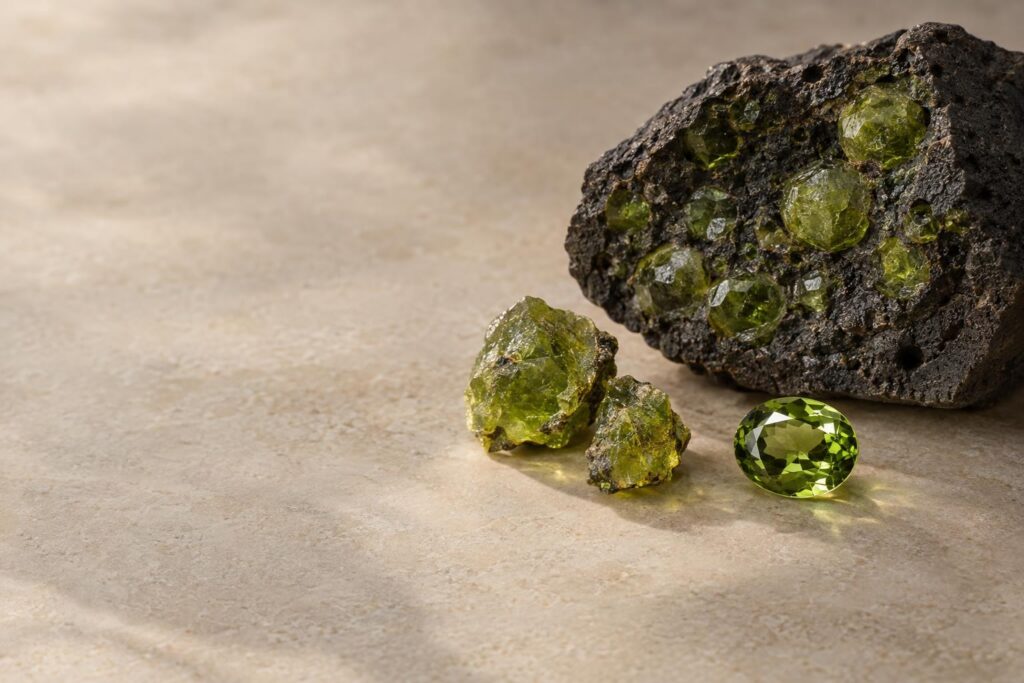
Some peridot comes from even further away. It is found in pallasite meteorites, and it has been found in comet dust brought back by the Stardust probe 1. On earth, gem-quality peridot from Sapat in Pakistan has been studied in detail 6. The sources here describe peridot’s geology in general terms rather than listing every mining area.
Why peridot is linked to August
Why do so many people know peridot as a birthday gem? It is the birthstone for August and the gemstone for the 15th wedding anniversary. The ancient Egyptians called it the "gem of the sun" 1.
Why peridot is harder to compare between sellers
Why can two sellers describe peridot so differently? There are no standard quality-grading scales for it, so labels such as "AAA" are each company’s own terms 4. Higher-quality stones have an intense colour 1. For background, see how coloured gemstones are evaluated.
- Colour: brown undertones lower the value.
- Size and colour together: a rich grass green is usually seen only in larger stones, and smaller stones tend to look yellowish green.
- Clarity: in higher-quality stones, no inclusions are visible to the eye.
- Treatment claims: "unheated" is technically true for peridot but misleading 4.
Why the setting and use matter for peridot
Why think about how a peridot piece will be worn? Peridot should be protected from scratches, and from hard knocks that can fracture it 3. So it can help to think about where and how often you will wear a piece, and how often it may meet hard surfaces. For more, see ring settings explained and which gemstones suit everyday rings.
Heat matters in the workshop too. If a peridot piece ever needs repair or resizing, tell the jeweller it contains peridot, because rapid or uneven heat can cause it to fracture 3.
Why this entry is here
This entry exists to help you understand peridot’s colour, durability and care. Inclusion in this guide does not confirm that Ralph Jacobs stocks this gemstone. If you would like to talk through peridot or another coloured gemstone for a custom piece, we offer a free consultation online at bookings.ralphjacobs.org.
Frequently asked questions
Ultrasonic and steam cleaners are not recommended for peridot. Clean it with warm, soapy water instead. Rapid or uneven heat can cause it to fracture, and acids can attack it 3.
No peridot is known to be heated to improve its appearance, so an "unheated" claim is technically true but misleading 4. It does not set one peridot apart from another.