Why spinel is called history’s most underappreciated gem
If you have heard that spinel is a lesser-known alternative to ruby and sapphire, you may be wondering whether it can stand up to daily wear. Spinel deserves a closer look. It is often very transparent 1. Its colours run from intense red and vibrant pink to blue 2. It is also hard and tough enough for all types of jewellery 5.
So why was it overlooked for so long? Ancient mines that supplied royal courts from Rome to China produced spinel, but it was usually confused with ruby and sapphire. Large spinels from central and southeast Asia became known as "Balas rubies". They often changed hands as spoils of war. GIA calls spinel a good candidate for "History’s Most Underappreciated Gem" 3.
Some of history’s most famous "rubies" are spinels. The "Black Prince’s Ruby" in England’s Imperial State Crown is one. Edward, the Black Prince, received it in 1367. The "Timur Ruby" in the Crown Jewels is also a spinel. It weighs over 350 carats, the unit used to weigh gems, and carries several Persian inscriptions 3.
How was the mistake finally caught? In 1783 the mineralogist Jean Baptiste Louis Romé de Lisle identified spinel as a different mineral from ruby. Learning to tell the two apart helped give birth to gemmology, the science of gems. Spinel’s chemical formula is MgAl₂O₄, a compound of magnesium, aluminium and oxygen. Its crystals form so well that in Burma (Myanmar) they are said to be nat thwe, "polished by the spirits" 1.
Like garnet and diamond, spinel belongs to the cubic crystal system. Its typical crystal is an octahedron, an eight-sided shape like two pyramids joined at their bases. Gem spinel is a small part of a larger group of minerals with the same crystal structure. Not all of them form clear crystals suitable for jewellery 2.
Why spinel’s colours look so vivid
Why does spinel catch the eye? Its colour comes from tiny traces of other elements. Red spinel gets its colour from chromium, the same trace element that colours ruby and emerald. Spinel is also singly refractive, which means light passing through it is not split into two rays 1.
The colours of spinel
Spinel comes in a wide spread of colours. Choose a colour to see what it looks like and what causes it.
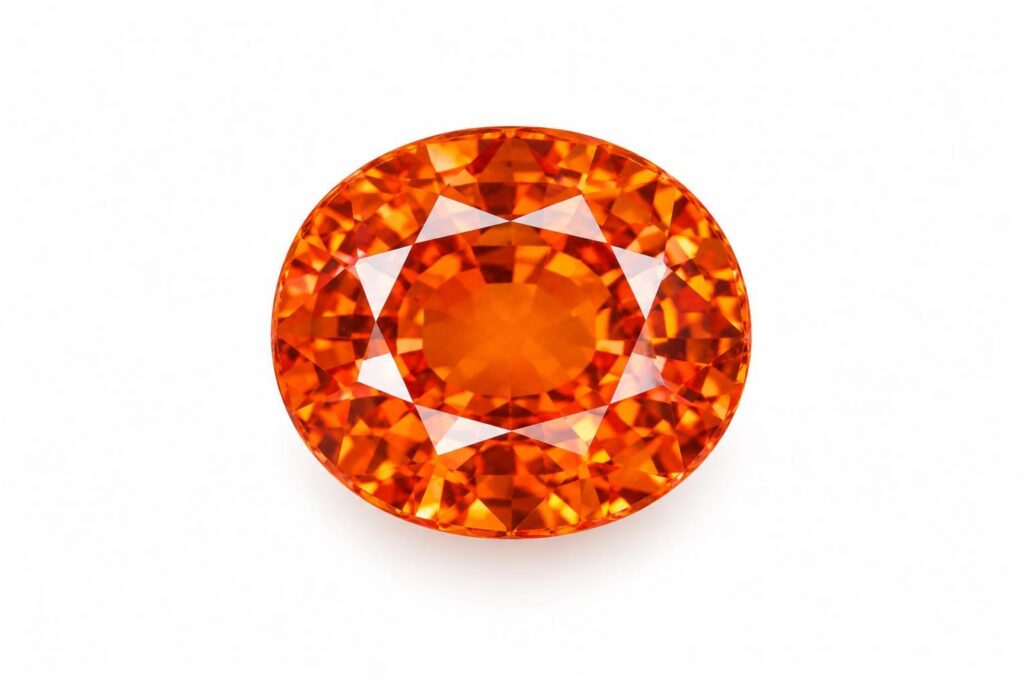
- Orange spinel
- Spinel runs from orange to red. Orange and purple spinel get their colour from a mix of iron and chromium. Vivid orange is among the colours buyers look for after red, cobalt blue and hot pink.
- Red spinel
- Intense "stoplight" red comes from traces of chromium, the same trace element that colours ruby. More chromium gives a stronger red. Red is generally the most desirable spinel colour, and the finest stones are pure red to slightly purplish red in a medium to medium-dark tone.
- Pink spinel
- Vibrant pink is another chromium colour, so it shares its cause with red spinel. Vibrant hot pink is one of the most sought-after spinel colours, after red and fine cobalt blue.
- Purple spinel
- Spinel comes in all shades of purple. Like orange, purple comes from a mix of iron and chromium. Violet and lavender stones are less in demand than red, blue, pink or orange.
- Blue spinel
- Violet to blue spinel gets its colour from trace iron. Fine cobalt blue is the colour ranked after red in desirability. Most blue spinels are low in saturation and look greyish.
- Bluish green spinel
- Bluish green is where the colour range ends. Spinel runs from orange and red through pink, purple, violet and blue to bluish green.
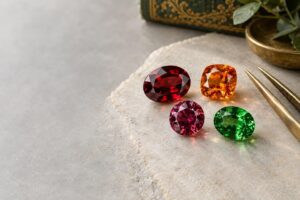
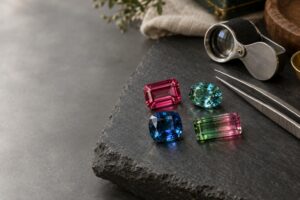
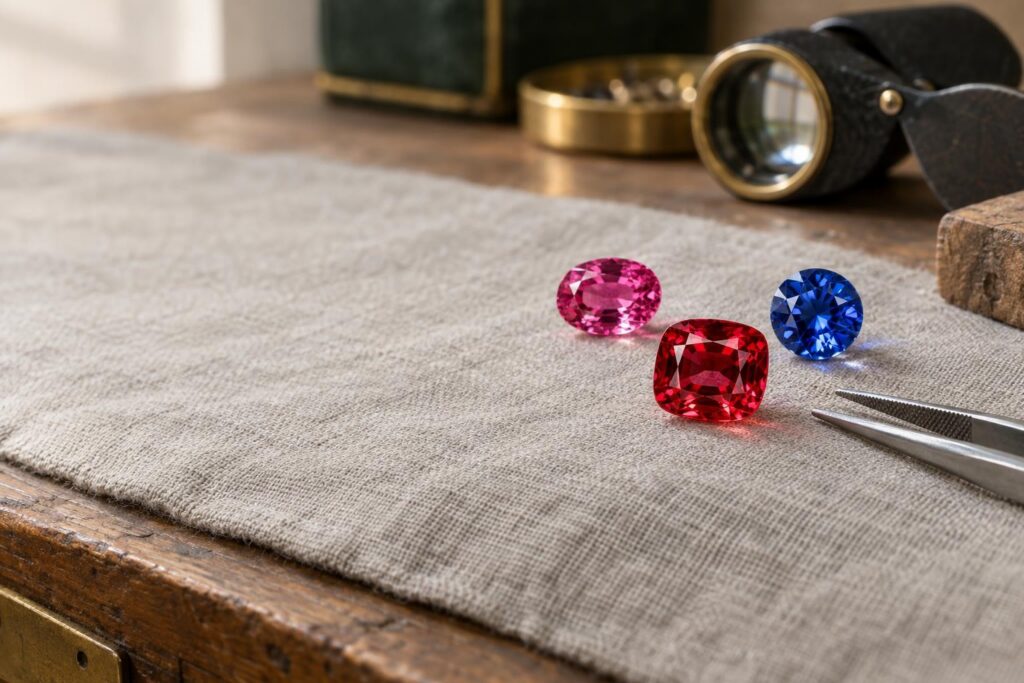
The pictures are illustrations. Real spinels vary in tone and saturation within each colour, and every stone is shown in the same oval cut so the colours are easy to compare. Pictures: AI-generated illustrations, checked for accuracy. They are not photographs of a real piece.
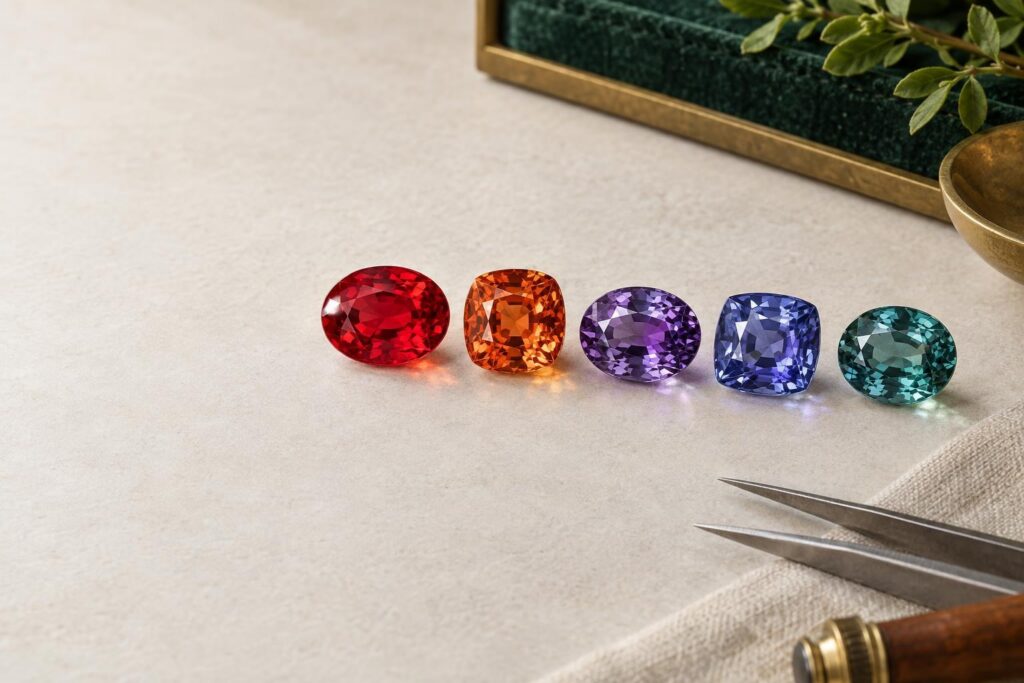
How wide is the range? Spinel runs from orange to intense "stoplight" red and vibrant pink. It also comes in all shades of purple, blue and violet, through to bluish green 2. Each colour has its own cause:
- Intense reds and pinks: traces of chromium, with more chromium giving a stronger red.
- Orange and purple: a mix of iron and chromium.
- Violet to blue: trace iron.
- Vibrant, saturated blues: trace cobalt 2.
Why spinel is heat treated less often than ruby
Why ask about treatment? It tells you what has been done to a stone’s colour, and it can affect how you clean it. Heat treatment means heating a stone to change its colour; read more in heat treatment in gemstones. It is much less common in spinel than in ruby, but heat-treated spinel does exist in the market 6.
When spinel is heated, the new colour is stable in normal wear. Fracture filling, which fills cracks that reach the surface, is rarely done to spinel. Any filled stone should be cleaned only with warm soapy water or a damp cloth 5.
How can heating be found? In very clean spinel, a microscope alone usually can’t detect it. GIA tests all spinel with photoluminescence spectroscopy, a laboratory test that studies the light a stone gives off when it is lit 6. As editorial practice, this entry names both treatments, heating and fracture filling. If treatment matters to you, you can ask the seller what has been done to a stone and whether a laboratory report is available. See how gemstone treatments should be disclosed.
Why spinel is considered durable for daily wear
Why does durability matter? If you plan to wear spinel every day, you want to know how well it resists scratches and knocks. Spinel is 8 on the Mohs scale, a 1 to 10 scale of scratch resistance. It also has good toughness, meaning resistance to chipping and breaking. That makes it durable enough for all types of jewellery 5. Hardness is only part of the picture, as the Mohs scale is not the whole durability story explains.
What can affect it? High heat can fade some spinel colours, but spinel is stable when exposed to light and chemicals. Warm soapy water is always safe. Ultrasonic and steam cleaners are usually safe, but some inclusions (tiny features inside a stone), such as fractures, could cause problems 5.
Why some spinel sources are famous
Why does origin come up? Some sources are tied to famous stones. GIA says the finest red spinel from Myanmar matches the best red of any gem 4. The Black Prince’s Ruby was probably mined in Afghanistan 3. This entry names only the places linked to these facts, so it is not a complete list of where spinel is found.
Why fine spinel is harder to find than you might expect
Why does quality vary so much? Colour plays a large part in value. Red is generally the most desirable spinel colour, followed by fine cobalt blue, then vibrant hot pink and vivid orange. Violet and lavender stones are less in demand. The finest reds are pure red to slightly purplish red, in a medium to medium-dark tone (how light or dark the colour is). Most blue spinels are low in saturation (colour strength) and look greyish 4. See hue, tone and saturation in gemstones.
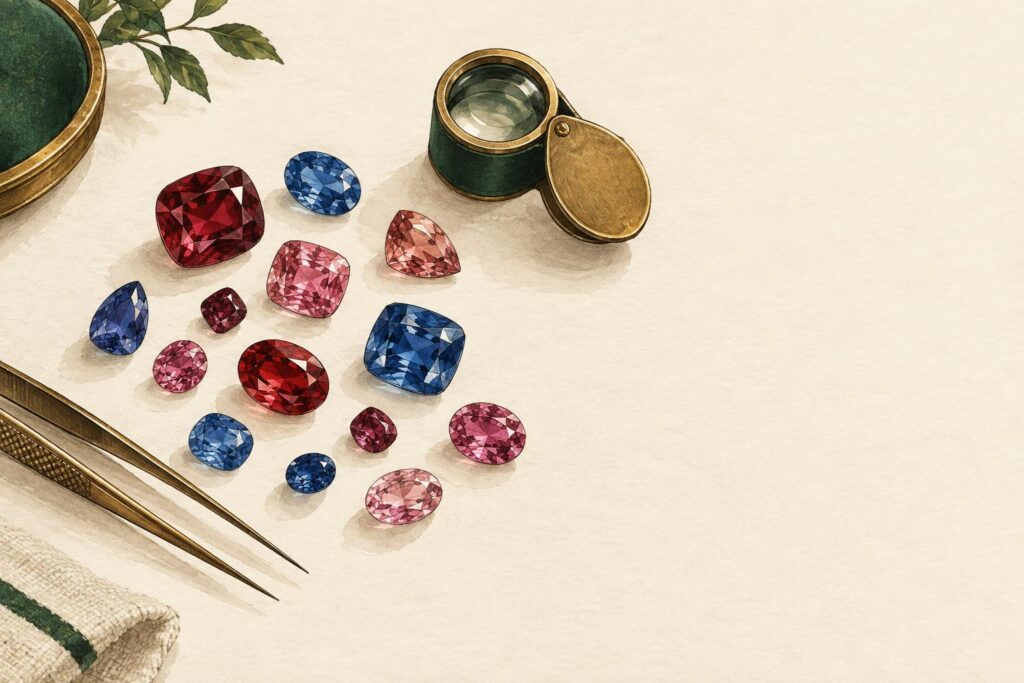
How do clarity and size affect value? Stones with no inclusions visible to the eye are worth more, and value drops as inclusions become easier to see. Because fine spinel is scarce, most fine rough is cut to non-standard sizes to save weight. Fine red, pink and blue stones above five carats are much harder to find, and matched sets of large, high-quality spinels are very rare 4.
What else is worth knowing? Synthetic spinel, made in a laboratory, is widely used to imitate other gems. That is one reason most buyers don’t know a natural version exists 3. Red spinel can also be mistaken for ruby. In one GIA case, a red stone sent in as a ruby proved to be natural spinel. Its single refractive index (a measure of how a stone bends light) of 1.717 did not match doubly refractive ruby. Judging by colour alone can lead to misidentification 6.
Why cut matters in spinel jewellery
Why does the cut matter? When spinel is well proportioned, it has excellent brilliance, the bright light returned from inside a cut stone. Cushion and oval shapes are the most common cuts 1. Because spinel is durable enough for all types of jewellery, rings, earrings and pendants are all possible 5. For how different settings hold a stone, see ring settings explained and how to choose an engagement ring setting.
Why this entry is in our guide
This entry describes spinel so you can understand the stone and ask informed questions. Inclusion in this guide does not confirm that Ralph Jacobs stocks this gemstone. We work with a wide range of coloured gemstones, and if you would like to talk one through, we offer a free consultation, booked online at bookings.ralphjacobs.org from any country.
Frequently asked questions
Spinel is 8 on the Mohs scale and has good toughness, so it is durable enough for all types of jewellery. High heat can fade some colours, but spinel is stable when exposed to light and chemicals 5.
Red spinel gets its colour from chromium, the same element that colours ruby. For centuries the two were confused. In 1783 Romé de Lisle identified spinel as a separate mineral from ruby 1.
Yes. Synthetic spinel is widely used to imitate other gems, which is one reason most buyers don’t know a natural version exists 3.