
Why does the girdle matter to you? It is your diamond’s edge, and it is the part the setting grips. The girdle is a narrow band between the crown (the top part) and the pavilion (the lower part). It works as the diamond’s setting edge 2. Chips usually happen when the girdle or a point of a diamond strikes something hard 3.
The parts of a diamond
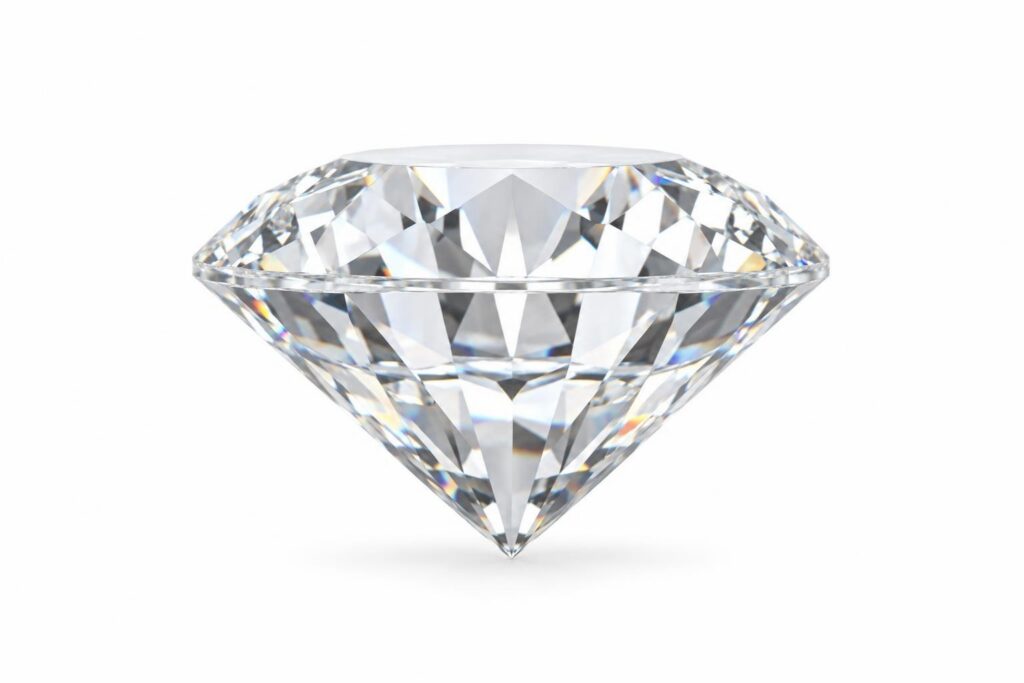
- Table
- The large flat facet on top. Most light enters the stone here.
- Crown
- The upper part, between the table and the girdle. Its angled facets help split light into flashes of colour (fire).
- Girdle
- The thin outer edge at the widest point. The setting usually grips the stone here.
- Pavilion
- The lower part, below the girdle. Its angle decides how much light reflects back up through the top.
- Culet
- The point, or tiny facet, at the very bottom of the pavilion.
- Total depth
- The height from the table to the culet, compared with the diameter. It is one of the measurements behind the cut grade.
Pictures: one AI-generated illustration of a diamond, adjusted for each grade. They show how the grades differ; they are not a grading of any stone.
Why does thickness matter? It changes both strength and look. Graders view the girdle from the side, magnified ten times. They describe it from Extremely Thin to Extremely Thick, often as a range such as "Very Thin to Medium" 1. An extremely thin girdle is at extreme risk of chipping, while a thicker one is harder to chip 3. But a thick girdle adds weight where it matters least, so the diamond can look smaller for its carat weight 2. The American Gem Society counts girdle thickness in its cut grade, and it alone can set the final grade 5. So the trade-off is between a sturdier edge and more visible size for the weight. Which matters more depends on what you value.
Why might the girdle affect your setting? Corners on princess and emerald cuts need enough girdle thickness to reduce the chance of chipping. A bezel (a metal rim around the stone) or V-shaped claws (small metal prongs) protect points and corners better 3. You can compare these styles in Ring settings explained. The girdle is also where GIA can laser-inscribe a report number or short message. You can’t see it with the naked eye, but you can read it when it is magnified ten times 4.
Example: Say a report lists your diamond’s girdle as "Thin to Slightly Thick". This means the edge is thinner in some places and thicker in others as it runs around the stone. You could ask your jeweller whether the thinner parts will sit under a claw or a rim.